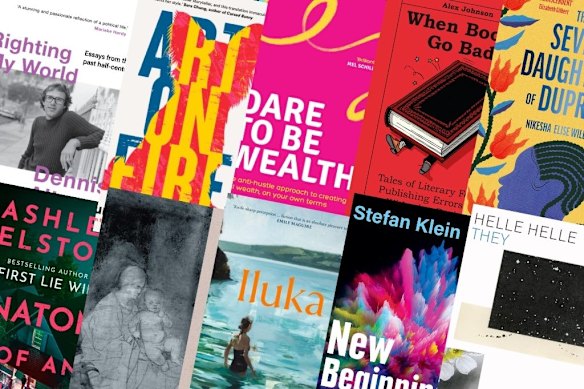
From a Danish coming-of-age story and a sweeping family saga of Black resistance, to a thesis on why humans find it difficult to change and a history of controversies in the literary world, this week’s books should sate every reader’s tastes.
FICTION PICK OF THE WEEK
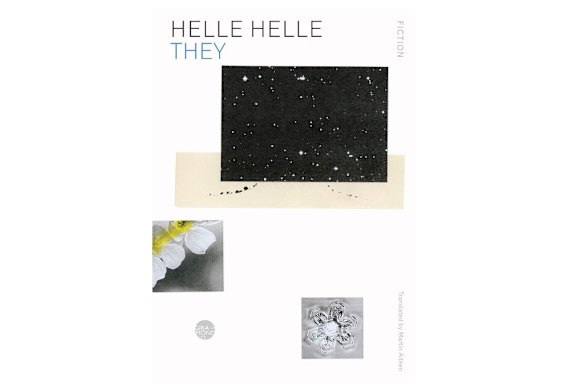
They
Helle Helle
Giramondo, $29.95
Danish writer Helle Helle will enchant readers with this short and subtle coming-of-age novel, the first in a trilogy to be published by Giramondo Press. In the 1980s, a mother and her 16-year-old daughter live together above a hairdresser’s shop in an island town in Denmark. The daughter is starting high school and just starting to make new friends – a group of adolescent misfits whom her circle will shortly widen to contain. At the centre of her quotidian, achingly detailed existence lies her mother. Their lives are in close orbit, enmeshed with one another and attuned to quiet daily rhythms and rituals. When the mother receives a cancer diagnosis, there is no panic or drama. Rather the quality of their attention and the comfort they take in each other’s company intensifies, knowing the latter cannot last. And yet the girl’s loneliness grows … Martin Aitken’s wonderful translation captures Helle’s virtuosity as a writer – the luminous presence she brings to the present tense, the terse transfiguration of the ordinary into poetic strangeness, the understated humour and unspoken pain of losing a parent so young.
Art on Fire
Yun Ko-eun
Scribe, $29.99
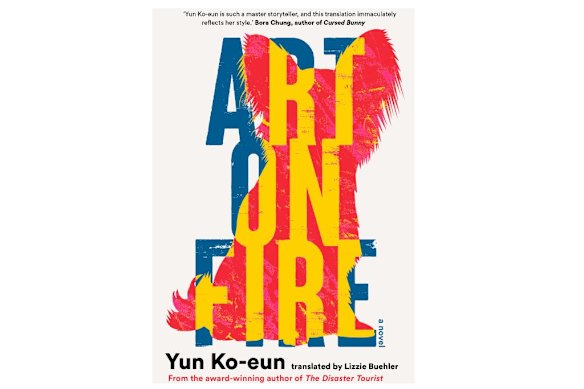
Absurdity and apocalyptic tones attend this satire skewering the contemporary art world from South Korean writer and broadcaster Yun Ko-eun. Painter An Yiji is experiencing mid-career doldrums when she gets an offer she can’t refuse – an elite artist’s residency in California, all expenses paid for by the prestigious Robert Foundation. She has qualms – the Foundation’s chief benefactor is, after all, a little dog called Robert (also a photographer of some genius, known for his legendary arrogance). All this An is willing to take in her stride. But there’s one final catch: by accepting the residency, she agrees to allow Robert to incinerate one of her paintings at his selection. Despite her misgivings, the Faustian bargain is struck, and An flies immediately into a hellscape in which California wildfires rage unabated as sponsors mob her, each vying to get the painter to make their business the subject of her art. Art on Fire is a savagely funny satire of decadence, complicity, and the corrupting power of money and celebrity on taste-making in the fine arts.
The Seven Daughters of Dupree
Nikesha Elise Williams
Simon & Schuster, $34.99
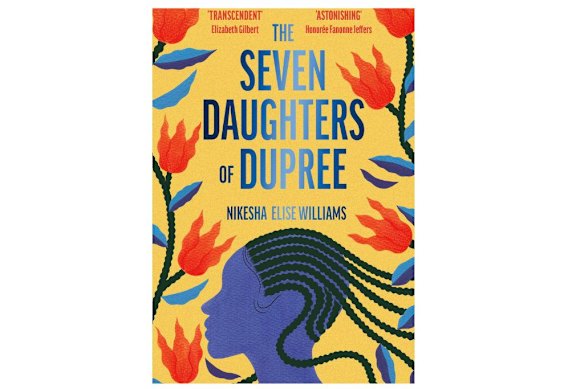
Nikesha Elise Williams unfurls a secret history of black women’s resilience in the face of slavery, and the long struggle to live against racism in her debut novel The Seven Daughters of Dupree. It’s the mid-1990s, and inquisitive teenager Tati is prone to writing poetry. She yearns to discover the identity of her father – a secret her mother Nadia won’t reveal. Her grandmother Gladys has her own shrouded past, moving from Alabama in the 1950s, and as Tati probes further she finds the stories of seven generations of Dupree women, all “cursed” to give birth to daughters, leading back through the veil of history to an enslaved ancestor in the 1860s. A distinctive story from each generation comes nested within the evolution of race relations in the US, and Williams doesn’t hold back in portraying the racism of each era or the lived experience of being on the receiving end of it. The author writes into a history of bondage and silence and resistance in a sweeping family saga whose characters can be shackled by trauma or drawn together by unspoken bonds of solidarity and care.
Anatomy of an Alibi
Ashley Elston
Headline, $34.99
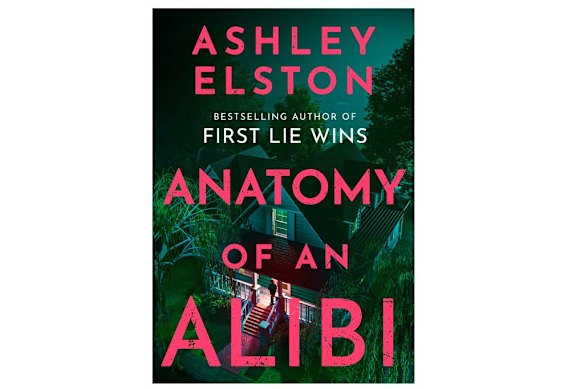
From the author of First Lie Wins comes a murder mystery with an elaborate set-up. Camille Bayliss is wealthy wife who suspects her lawyer husband Ben is hiding a dark secret. She can’t investigate herself – Ben keeps her under 24/7 surveillance in a creepy, stalkerish way that smacks of coercive control. When she meets Aubrey, a woman who wants her own answers from Ben, the two hatch a plan to trade places for 12 hours. Camille will escape her husband’s surveillance long enough to spy on him, giving her and Aubrey the truths they seek. Trouble is, Ben is murdered in that window, and only one woman has an alibi. The tale plays with chronology and unfurls from both women’s perspectives, alongside that of Hank (a partner in Ben’s law firm with his own axe to grind) and that of Ben himself. It’s a twist-riddled and intricately plotted crime fiction, steeped in paranoia and perversity, and you’re never sure quite who to trust as the psychological game unfolds.
Iluka
Cassie Stroud
HQ, $32.99
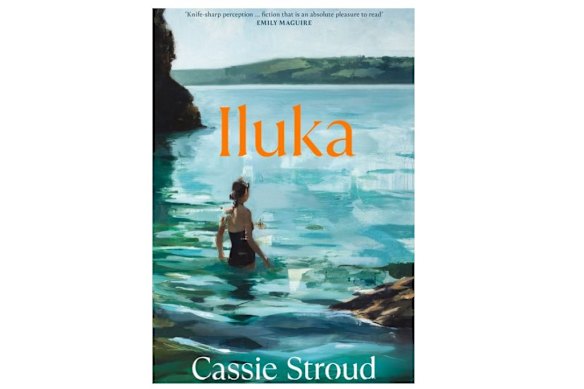
Upon their grandfather’s death, middle-aged siblings Helen, Sylvie and Brendan return to Iluka, the beach house they grew up in with their grandparents, to clean up and prepare it for sale. There’s more mess than they realise, with a history of parental neglect swept under the carpet. Their parents were heavily involved in theatre in the 1970s, and style did not triumph over substance abuse, leading to the kids being taken away and raised at Iluka. Aspects of the story remain behind the curtain, and when letters from their mother Marguerite are unearthed, it seems she might have been living under a pseudonym, long after her children were told she had died. She might even still be alive. Cassie Stroud’s debut crafts a vivid sense of family, of characters credibly shaped by slightly different perspectives on common experience, and the presence of Helen’s daughter Tig, a film student, adds a fresh pair of eyes on events. A layered narrative shifts between the 1970s and the present day, with Marguerite’s backstory revealed, and her adult children struggling to adapt in the face of belated revelations.
NON-FICTION PICK OF THE WEEK
Giorgione, Dante and the Sydney Incunable
Edited by Jaynie Anderson and John Gagne
MUP, $55
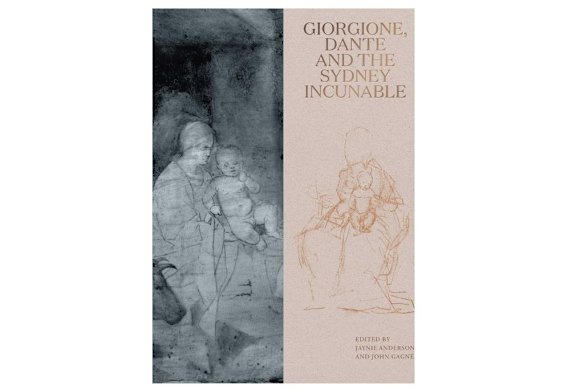
One evening in 2017 at the Fisher Museum, Sydney University, librarian Kim Wilson discovered at the back of an incunable (book published before 1501, in this case Dante’s Commedia) a red drawing and an inscription in Italian. What followed rocked the international art community. The drawing is now recognised to be by Renaissance master Giorgione (although some scholars dispute this), and the inscription, giving Giorgione’s cause of death, the date and his age, supplied vital information regarding his biography. All of which changed Giorgione scholarship internationally. And, was it Giorgione’s personal copy? Like something from the TV series Fake or Fortune, this is a fascinating exploration of the repercussions of that discovery, among other things, raising the question of how on earth nobody had noticed before, the book having been in Sydney University’s possession since about 1928. Which raises the vital question of provenance – and just who did donate the incunable to Sydney Uni. Remarkably, it’s still a mystery. Contributors, all expert in their field, include Giorgione scholar Jaynie Anderson. It’s a thoroughly engaging, beautifully illustrated record of a genuine art world event.
Righting My World
Dennis Altman
Monash University Publishing, $39.99

In the preface to this collection of essays and articles from 1969 to the present day, academic and cultural commentator Dennis Altman talks of his “fortune” in connecting with three political groups: the gay movement, the HIV/AIDS world, and, as a secular Jew, his connection with fellow Jews “who share with me an abhorrence of what Israel is doing in our name”. They’re weighty and serious issues, but there is also a significant element of the playful and a strong sense of capturing a historic moment. Such as his descriptions of the counter-culture of the late 1960s, his interview with theatre director Jim Sharman and the opening of the musical Hair in Sydney (a confronting event to a still fairly staid country). His interests are wide, though, and he is possibly at his most playful in offering a queer perspective on Agatha Christie, while also being wary of the limits of cultural theory. Outspoken yet circumspect, the writing is lively, fresh and relevant.
New Beginnings
Stefan Klein
Scribe, $32.99
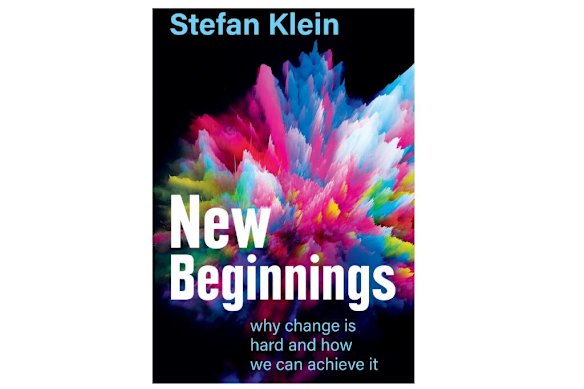
Some time around the year 850, the Mayan city of Copan was abandoned and became a ruin. A mystery for centuries, until recent science claimed to have solved it: deforestation, mega-drought, collapse. But the difference between us and the Mayans, says German science writer Stefan Klein, is that the Mayans knew not what they did. We do – a contention he examines in relation to three interrelated challenges: climate change, an ageing society and the repercussions (good and bad) of AI. But knowing what we’re doing doesn’t necessarily translate into the change required to avoid the Mayan scenario. In poll after poll in Germany, for instance, people recognised the reality of climate change, but when the government tried to phase out fossil fuelled cars it met with massive resistance.Why? This is his central thesis. People may recognise the need for change, but deep down they don’t want change. That can and must change, for, in the end, he remains positive.
When Books Go Bad
Alex Johnson
British Library, $29.99
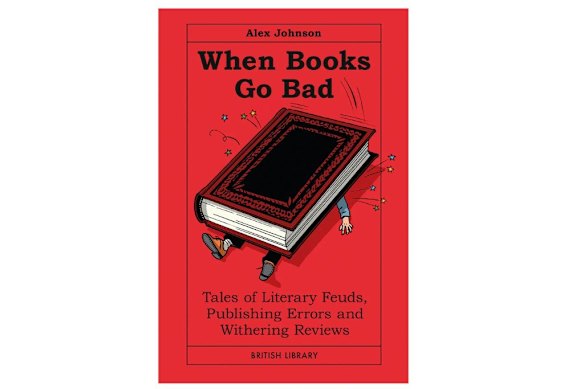
In 1949, not long before he died, George Orwell submitted a list of 140 names (all fellow writers) to the British Foreign Office, warning that these people (including EH Carr and JB Priestley) were, basically, suspicious. It’s just one of the many examples found in this catalogue of literary betrayals, insults and fights. Most of the time the feuds were verbal – as in Gore Vidal’s comment on the death of Truman Capote – “A brilliant career move”. Other times they came to fisticuffs, usually involving Hemingway and anybody who crossed him. And death! William Burroughs shot his wife dead in a William Tell prank gone wrong. Then there are the nasty reviews, like the US critic who said of Xavier Herbert’s Capricornia, “Don’t read it, and don’t drop it on your foot”. Or Virginia Woolf’s reaction to James Joyce’s Ulysses: “Under-bred … the book of a self-taught, working-class man and we all know how distressing they are …” Duels, the CIA, family break-ups and more. A timely reminder that controversy has never been far from the literary world.
Dare to be Wealthy
Melissa Browne
Allen & Unwin, $34.99
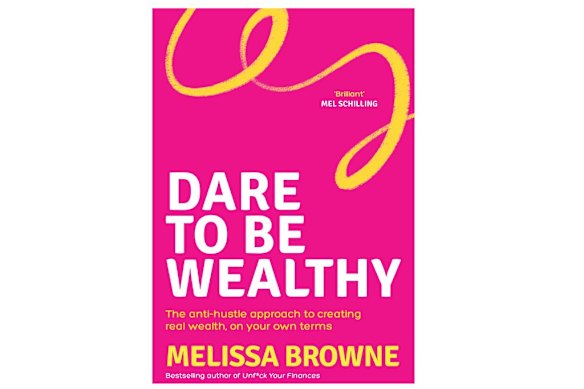
The underlying assumption in this self-help guide to becoming wealthy by financial educator Melissa Browne – addressed to women from a woman’s point of view – is that everybody can be wealthy. That there is always room at the top, if you know how. Browne is determined to break down patriarchal capitalism, so that women – historically seen as financially incompetent – feel empowered and educated enough to pursue financial independence. To this end, she incorporates her own story: penniless after divorce in her 30s, to multi-millionaire businesswoman, as well as the stories of other women. Part of this requires women to have faith in themselves, to be the “heroine” of their own stories. In entertaining writing, she goes into the nitty-gritty of making money (not to be considered a dirty word). It reads like a coach revving up the team, but is also full of practical advice learnt over years.
The Booklist is a weekly newsletter for book lovers from Jason Steger. Get it delivered every Friday.
Disclaimer : This story is auto aggregated by a computer programme and has not been created or edited by DOWNTHENEWS. Publisher: www.smh.com.au