Wooden barrels are what make the magic happen in your favorite bottle of whisky. They’re also the source of a long-standing problem in the spirits industry: They leak. A lot.
At Bacardi Limited, the world’s largest privately held spirits company, barrel leakage is a massive headache. Consider the company’s Dewar’s blended Scotch whisky brand (just one of the dozens it owns). Most of the time, Dewar’s will have over 100 warehouses full of aging barrels of whisky, 25,000 casks in each one. Barrels will mature for three to 12 years, and according to Angus Holmes, Bacardi’s whisky category director, many of those barrels will develop a leak at some point in their life.
That’s not great for business, says Holmes. “How do we make sure that when we come to get that cask, it’s got as much whisky in it as possible?”
Given the imperative to find so-called leakers before a decade has come and gone—and taken all the whisky with it—Bacardi engaged the National Manufacturing Institute Scotland. NMIS was presented with the problem, and came up with a surprising solution: Why not adopt a robotic dog?
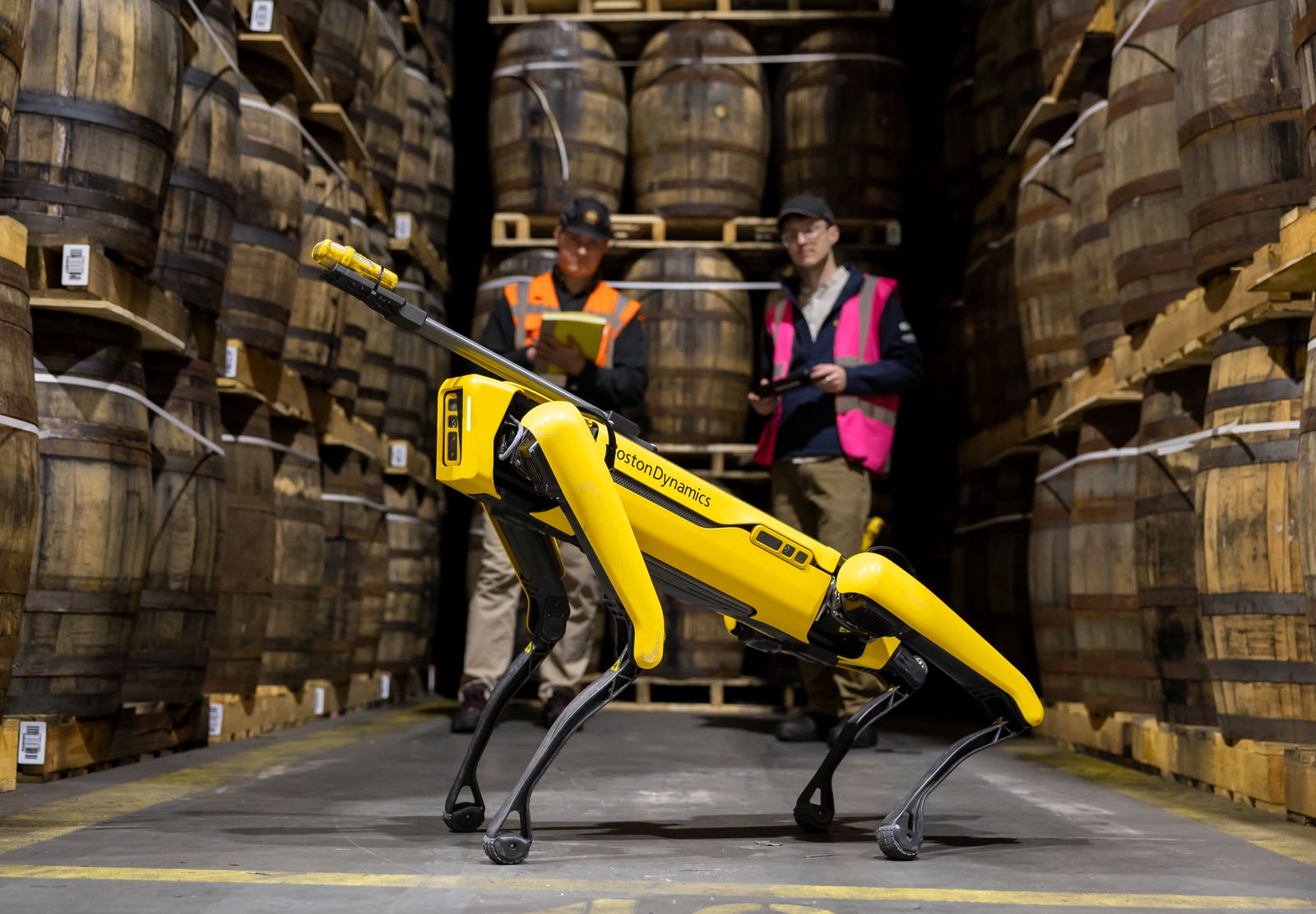
Andrew Hamilton, head of the Digital Process Manufacturing Centre for NMIS, says the group’s first suggestion was that Dewar’s might try a Boston Dynamics Spot robot which could roam the warehouse on the prowl for leaking barrels.
But to be a truly effective hunter, the robot dog would need to adopt one of the actual canine family’s most well-honed skills: an elevated sense of smell.
Vapor Trails
There are two kinds of leaks: liquid spilling or seeping out of the barrel, and loss of liquid through vapor evaporation. A barrel leaking liquid is fairly easy to identify, but if it’s losing more than it should through evaporation, that’s harder to suss out.
Evaporation is an expected part of whisky maturation, “the angel’s share” being a well-understood phenomenon that is widely considered a key part of a whisky’s evolution. In Scotland, the angels take about 2 percent of a cask’s volume each year, and while some enterprising distillers have attempted to deny the angels their due through experimental techniques like covering barrels in plastic wrap, by and large distillers are happy to give a little whisky back to the universe as a cost of doing business.
The problem is when those angels get greedy. High levels of evaporation can invisibly drain a barrel while changing the flavor of what’s left inside, and evaporation can speed up when barrels are damaged during handling, the metal hoops holding the staves together come loose, or the stopper sealing the bunghole pops out of place. The natural expansion and contraction of wood over the years can also result in these invisible leaks.
“In a traditional warehouse, workers walk around the racks of barrels and physically knock on the casks,” says Holmes. They can tell by the sound of the thump how full the barrel is and whether it might be in need of inspection or repair.
But at Dewar’s, that strategy doesn’t work. Workers can’t knock on barrels because they’re stacked to the ceiling and jammed in together tightly to maximize usage of the available space.
“Our warehouses are palletized, essentially very high stacks of barrels standing upright instead of on their sides,” Holmes says. There’s currently no feasible way for human workers to detect most leaking barrels until they’re pulled for blending.
Here’s where the robot dog is unleashed. Rather than knocking on barrels, it was engineered to detect ethanol vapor in the air.
“Our engineers developed a 3D-printed arm integrated with an ethanol sensing ‘nose’ to test how ethanol vapor could be detected,” says Hamilton. The idea is simple: The dog sniffs each barrel, logs the level of ethanol nearby, and reports back with the location of any barrels that are losing too much booze. It sounds costly and complex, but Holmes reports that the price of the robot is less than $100,000.

The modified Spot was first tested on a small selection of controlled barrels to ensure it could properly sniff out the difference between a barrel aging normally and an overly leaky one. Later it was unleashed on the floor of a Dewar’s warehouse to further the proof of concept. Holmes says early trials have been a success, with the dog—named Royal Barkla as an ode to Bacardi’s Royal Brackla distillery near Nairn, Scotland—being set on a programmatic path. In the field, the robo-pup identified a shocking 10 percent of casks in need of some level of remediation.
Naturally, Royal Barkla has taken the distillery by storm. “It moves with some pace. And it makes that horrible, horror-movie, floor-scratching sound as it chases after you,” Holmes jokes. But seriously, the experiment has been wildly successful. “We found enough leaks to make it worthwhile to continue the work we’re doing.”
Hamilton agrees. “If this kind of monitoring can be done in a repeatable, data-driven way, it adds real value,” he says, “helping producers better understand loss rates and plan for the future value of the spirit.”
Son of Royal Barkla
While the early trials have been successful, Royal Barkla is unfortunately an imperfect solution to the leaker problem for one key reason: It can’t climb vertically. “The dog can only reach 1.5 meters in height,” says Holmes, “so for now only the lowest level of barrels can be examined. While he’s proved he can work there, now we’re taking the proof of concept further.”
On the table are a couple of possibilities for Royal Barkla 2.0.
“We’ve found a spider robot that can climb,” says Holmes, evoking a much scarier future for leak detection. The other idea is a more familiar one: an ethanol-sensing drone that can fly around inside the warehouse in search of boozy hot spots. Bacardi already uses drones for things like security and roof and fencing examinations, so it would be a natural extension of a technology the company already has access to.
Ultimately, we’re still in the early days for leak detection, and Bacardi is eager to find more help on this front—and anything else that might improve efficiency.
“We’re open for innovation,” says Holmes. “Come and chat with us.”
Disclaimer : This story is auto aggregated by a computer programme and has not been created or edited by DOWNTHENEWS. Publisher: wired.com