
A ‘revolving door’ for prisoners?
For Armas, the joy of his homecoming has been dulled by the fear of continued persecution.
The trouble largely began after he served as an organiser for Venezuela’s opposition during the contested 2024 presidential election.
Protesters had denounced the vote as rigged after Maduro’s government failed to provide the official results of the election. The opposition, meanwhile, published evidence suggesting its candidate had won by a considerable margin.
That prompted a sweeping government crackdown on dissenters.
In December 2024, Armas was arrested. He said he was taken to a house where he was blindfolded, tied to a chair for days and suffocated with a plastic bag.
Later, he shared a dingy cell with dozens of other prisoners – and rats. Once he was transferred to El Helicoide, his friends and family had no contact with him for 10 months.
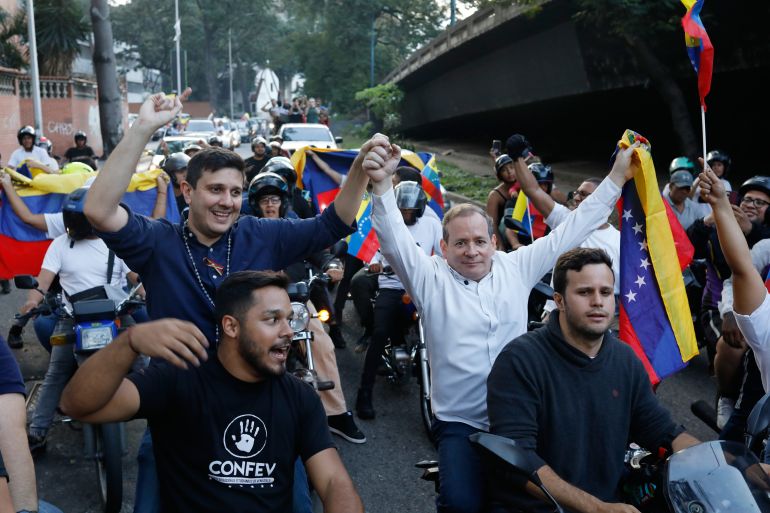
His release, however, has not meant freedom. The day he stepped out of prison, he celebrated by joining a motorcycle parade with Juan Pablo Guanipa, a prominent politician who had also been freed.
There was a feeling of energy and optimism, Armas recalled, as they visited the families of other political prisoners. But within hours, Guanipa was abducted by masked individuals. No one knew where he had been taken.
“I couldn’t sleep because I was scared,” he said. His first night home was spent lying in bed, checking for news about Guanipa.
“I had all this adrenaline, all these mixed emotions. I was happy because I was with my parents, but there was also fear.”
Officials accused Guanipa of breaching the rules of his release, although it is not clear what those limits were. He was held incommunicado for hours before being fitted with an electronic ankle monitor and placed under house arrest.
Only after the passage of the amnesty bill on Thursday was Guanipa released from house arrest, according to a statement from his brother Tomas Guanipa.
Still, Guanipa himself warned that the amnesty law would not end the government’s oppressive tactics. He highlighted its exclusions and loopholes.
“What was approved today in the legislative palace is no amnesty,” Guanipa wrote on social media after his second release in less than two weeks.
“It is a flawed document intended to blackmail many innocent Venezuelans and excludes several brothers and sisters who remain unjustly behind bars.”
For Tineo, cases of re-arrest like Guanipa’s show that Venezuela is not sincere about ending government repression.
“As long as judicial restrictions remain in place for those released and the ‘revolving door’ practice continues – new detentions following releases – it can’t be said that there is an end to the policy of persecution,” she said.
Disclaimer : This story is auto aggregated by a computer programme and has not been created or edited by DOWNTHENEWS. Publisher: aljazeera.com







