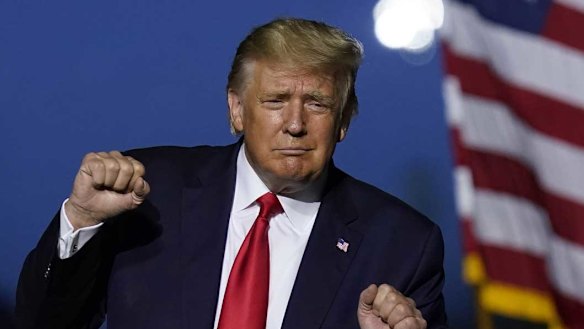

In the seconds after the US Supreme Court ruled against Donald Trump’s tariff war on his own people, financial markets did one thing – bet that American interest rates would go higher.
Despite the political brouhaha around Trump and his more-than-colourful criticisms of the Supreme Court’s decision, the president’s tariff policy is a deadly serious economic story.
So much has transpired in the 12 months of the Trump presidency that it can be difficult to remember it all. But if you cast your mind back to April, and “Liberation Day”, you’ll recall the turmoil Trump’s tariff announcements caused.
Not only were the penguins and seals of Heard and McDonald islands targeted for tariffs, share markets collapsed, the Australian dollar sank like a stone and the Reserve Bank considered a half percentage point interest rate cut.
The world recovered as Trump walked back his actions (but not his rhetoric).
But there was always a strong suspicion that it could come undone if the Supreme Court backed the arguments of tens of thousands of businesses (and several states) that the tariffs were unconstitutional.
That’s where we find ourselves now.
The removal of tariffs, which have collected about $US176 billion since their introduction, should be good for the American economy. No matter what Trump says, that $US176 billion ($249 billion) was a dead weight on consumers and businesses.
Interest rates went up for two reasons. One was the expectation that the removal of tariffs could act like a fiscal stimulus to an economy already struggling with inflationary pressures.
They also went up for what the end of the tariffs mean for the US budget deficit.
Trump has consistently argued that the tariffs will repair a budget that by any measure is a disaster. Through 2025, tariff revenue surged from $US98 billion to almost $US290 billion.
Despite that increase, the budget remains deep in the red, with a cumulative deficit so far this American financial year of $US700 billion. Government debt is north of $US38 trillion, with the interest bill alone more than $US1.5 trillion.
Remove tariff revenue and the budget gets worse. The administration was expecting to collect $US3.6 trillion in tariff revenue between this year and 2035. The court’s decision reduces that to $US2.3 trillion.
In anyone’s money, a $US1.3 trillion shortfall is a problem. It means that the Trump presidency has to start selling more bonds to cover that debt.
More bonds usually mean higher interest rates to encourage investors to give their cash to Uncle Sam. And those higher interest rates increase the interest bill paid by American taxpayers.
Trump immediately said he would reimpose tariffs. He has a right to impose one tariff rate across all countries for six months before having to get congressional approval.
Congress has shown a growing unwillingness to back tariffs. In six months’ time, most members of Congress will be in the heat of their re-election campaigns and the thought of supporting a price hike on voters would surely make most baulk at supporting Trump.
Then there is the network of trade deals, with their varying levels of tariff rates, that were hammered out after “Liberation Day”.
While the wildlife of Heard and McDonald islands are likely to be spared another round of trade talks, the confusion of coming months will weigh on the economy.
As Oxford Economics lead US economist Bernard Yaros noted, the uncertainty of months of tariff discussion would affect businesses, investors and households. “This uncertainty is a key downside risk that could ding, rather than derail, growth this year,” he said.
The court’s decision followed less-than-stellar pieces of economic data over recent days.
America’s trade deficit, which Trump’s tariffs were supposed to erase, reached $US901 billion through 2025. It was almost exactly the same as 2024, and is one of the largest on record.
Inflation data showed core price growth at 2.5 per cent, partly because of the tariffs imposed by Trump. The Federal Reserve, as far from hitting its inflation target as the Reserve Bank is from hitting its own, is not about to embark on a round of rate cuts, even with Trump ally Kevin Warsh as its new head.
And late this week, GDP data showed American economic growth slowing through the final months of 2025. This was caused by both the US government shutdown plus a slowdown in consumer spending that was partly caused by Trump’s tariffs.
Trump’s tariffs remain the biggest economic own goal since British voters backed Brexit. The UK economy has never recovered from that decision.
The Supreme Court has given Trump a chance to reverse his own economic policy folly.
Get a note directly from our foreign correspondents on what’s making headlines around the world. Sign up for our weekly What in the World newsletter.
 Shane Wright is a senior economics correspondent for The Age and The Sydney Morning Herald.Connect via X or email.
From our partners
Disclaimer : This story is auto aggregated by a computer programme and has not been created or edited by DOWNTHENEWS. Publisher: www.smh.com.au