
Every Event. Every Medal in 4K.
Watch live & on demand.
Livigno: It’s been 67 years since snowfall was last recorded in Brisbane, the Bureau of Meteorology’s official records show. But you can see an Olympic skier in action there.
If you time your drive into the Sleeman Sports Complex, you might even spot one in a wetsuit – skis attached, poles in hand – popping up into the sky, performing a gravity-defying trick above the gum trees and shrubbery that ring the precinct.
It’s an utterly surreal sight, completely out-of-place in subtropical Queensland.
Which is precisely why it exists.
The thing that vaults them into the air is a huge part of the reason why Australia is enjoying its best Winter Olympics in history. And it cost only $6.5 million to build: the Queensland government provided the location, the federal government and Australian Institute of Sport (AIS) tipped in $4.5 million, and the Australian Olympic Committee (AOC) provided the balance.
Of Australia’s six medals (so far) at Milano Cortina 2026, four can be at least partially credited to the existence of this structure – and one of them wholly because without it, silver medallist Danielle Scott says she would have walked away from aerials years ago.
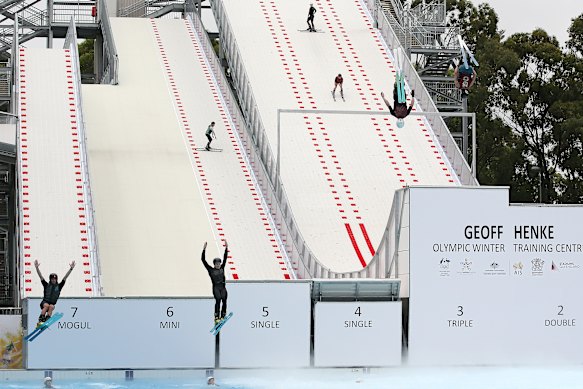
Water and skiing: The Geoff Henke Winter Olympic Sports Training Centre in Queensland is a game-changer for Australian mogul and aerial skiers.Credit: Getty Images
It’s impossible to identify the “cost” of an Olympic medal, but it’s certainly cheaper for Australia to buy one in the winter than the summer. Either way, said Snow Australia president Daniel Bosco, the ramp has paid for itself “thousands” of times over.
So it’s a bargain, really.
The Geoff Henke Olympic Winter Training Centre opened almost five years ago and is a marvel of Australian sporting ingenuity. Its core feature is a 37-metre steel tower leading into a swimming pool, featuring seven different ramps that enable freestyle skiers to train without having to travel to the other side of the world – and without exposing their bodies to the unforgiving landing pad that is hard snow. Or the muddy, frog-infested dam on Melbourne’s outskirts at Lilydale, which for years was the country’s only alternative.
There are other ramps like it around the world, but this is the only one of its kind in the Southern Hemisphere, enabling year-round practice for elite athletes and an otherwise impossible talent identification platform to feed Australia’s thriving pipeline. Even the United States is planning to bring out its best freeskiers to train in Brisbane.
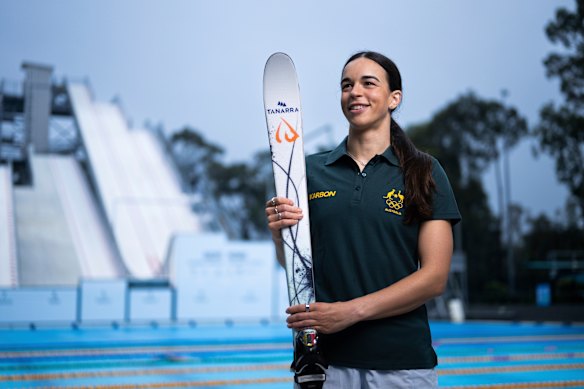
Jakara Anthony at the Geoff Henke training centre in Brisbane.Credit: Dan Peled
That medals have followed is not a happy accident, but the culmination of a long-term plan – one that has systematically dismantled Australia’s obvious disadvantages in winter sport and replaced what could have been easy excuses with sustained success.
“We’re quietly chuffed that what we thought we saw in the data, and what we knew about the culture of that program, has produced what we thought,” said Matti Clements, an AIS director.
“Are we surprised? No. Are we really pleased? Absolutely.
“And I think the other cool bit is 54 per cent of the team are newbies, first-time Olympians – that shows a real pathway, I think, for future Games as well. I think the Australian public should have quiet expectations that this is going to keep going in this direction.”
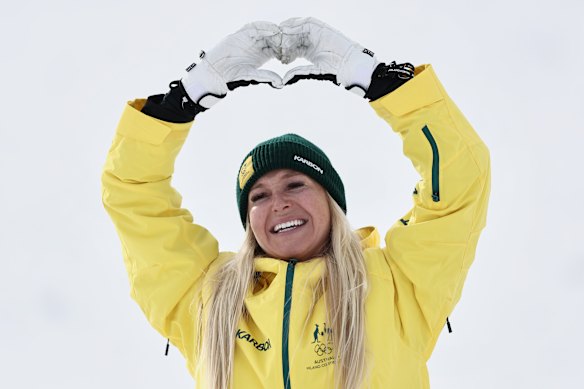
Danielle Scott says the water ramp in Brisbane kept her in the sport. Credit: AP
To properly understand how all this has happened, and how it can continue, it’s helpful to briefly strain the alphabet soup of acronyms involved and identify which organisation is responsible for what. Somehow, they all appear to be on the same page.
The Australian Sports Commission (ASC) is the federal authority that controls high-performance funding and distributes it to sports based on data, results and future medal potential; for winter sports in this four-year cycle, that number was $37.5 million.
The ASC also owns and operates the AIS, which delivers that money in different ways, including athlete development, infrastructure such as the Henke ramp, teams of engineers based in Canberra who work on bespoke equipment, and the AIS European Training Centre in Varese, on a lake in Italy’s north, a little slice of home where 225 athletes stayed between January 2022 and last month, using the facilities to break up long trips back to Australia and refuel their bodies mid-season.
“We live in a country that’s got 12 to 14 weeks of snow a year, compared to European countries that have got five to six months of snow,” Clements said.
‘If we want to keep bringing home medals in this discipline, we have to match [other countries] when it comes to facilities.’
Scotty James, Olympian
“I think we’ve got a dozen ski resorts in Australia; Italy’s got something like 300, some astronomical number. We are the underdogs by tenfold in terms of winter sport. So in order to be competitive, you’ve got to be innovative, but you’ve also got to be smart about what you’re prioritising.”
The AOC sits at the other end of the food chain and receives the athletes when they are ready for the Olympic stage, selecting and sending teams, and working in tandem with the Olympic Winter Institute of Australia that focuses solely on high-performance in winter sports.
Then there’s Snow Australia, the national body for snow sports, which looks after everything from grassroots participation, to interschool competitions (all of Australia’s medallists at these Olympics came through that program), to domestic pathways. Snow Australia decided to dismantle its federated model in 2017 and fold all state bodies into one national entity, ruled by one board with a singular strategy – and it’s probably no coincidence that Australia’s standing in winter sport has improved since.
“That was just a game changer because it took all the politics out,” Bosco said. “You just end up with these factions that pull against each other, rather than uniting to speak with one voice to government, to their spectators, to their fans.”
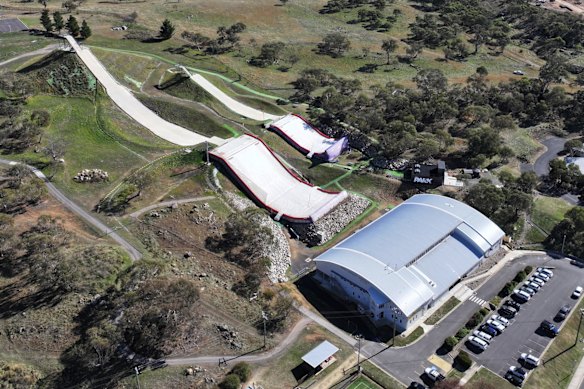
The National Snowsports Training Centre in Jindabyne.Credit: Snow Australia
Using that united voice, Snow Australia convinced the NSW government to commit more than $10 million towards building a national training centre in Jindabyne, with the balance provided by a “significant private donation” from John Hancock, son of Gina Rinehart.
The facility was a vision and more than a decade in the making before it was finally brought to life. The key feature is a world-class dry slope airbag that enables snowboarders and freeskiers to try out their tricks risk-free, not unlike the Henke water ramp.
“Half these kids that are here wouldn’t even be here if they hadn’t had that airbag to train with,” Bosco said.
“We are most competitive in the sports that can be trained well off snow. Wherever an airbag and those sorts of things are important, then that’s where we can be competitive – aerials, moguls, all those things.
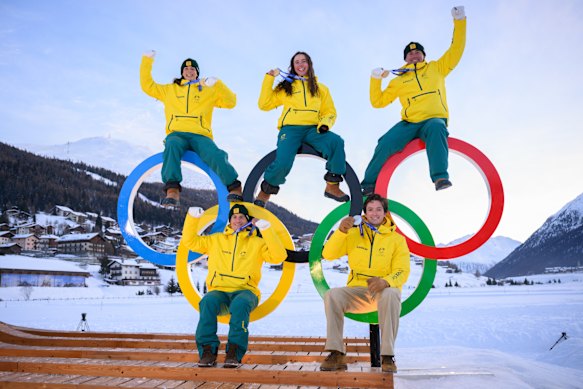
Australian Winter Olympic medallists Jakara Anthony, Josie Baff and Cooper Woods (top), Matt Graham and Scotty James at Livigno, on day 8 of the 2026 Winter Olympics in Italy last Sunday.Credit: AAPIMAGE
“Twenty years ago – that was when I was first starting to come into it – we sat back and said, what can we do to improve the sport? Infrastructure was way, way down [the list]; missing, totally missing. Everyone wanted to build this water ramp, and we had five or six attempts at it; all failed.
“Eventually, we finally got the Henke ramp up and running, and then this opportunity came up.”
Taken together, these investments form a deliberate pattern. Australia hasn’t tried to compete with the mountains of Europe or the snowfields of North America because it can’t.
Instead, in defiance of our climate, we have methodically built our own winter.
So, what now? How does Australia’s Olympic momentum keep rolling? How does the next giant thing get built? How do our snowboarders, for example, keep pace with the spectacular contingent of Japanese stars who are dominating their sport?
“For us to keep up in the next four years, we need to match them every step,” said Scotty James. “That’s the same in any sport. And that’s what we have to do as a country. If we want to keep bringing home medals in this discipline, we have to match them when it comes to facilities.”
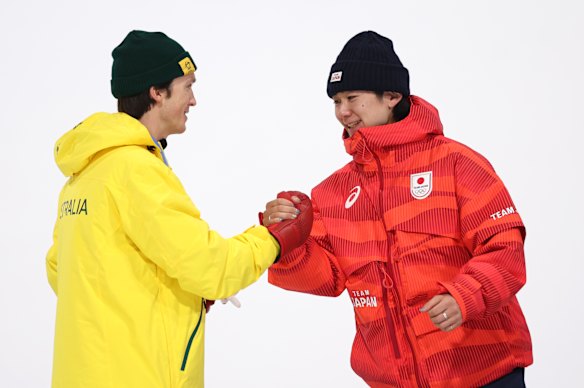
Scotty James congratulates Yuto Totsuka, the Japanese gold medalist in men’s halfpipe.Credit: Getty Images
Those conversations have already begun.
Snow Australia has asked all the disciplines that fall under its umbrella to submit 10-year plans, to define what success looks like at the end of that period, and what resources and infrastructure will be required to get there. If their proposals stack up, they’ll be backed in.
“If I want to start planning to have a medal in a sport that barely exists now, like skimo [ski mountaineering] … there’s no point saying I’m going to win one tomorrow,” Bosco said. “The athletes that are going to be winning those medals are probably eight years old right now.”
Decisions on how taxpayer money will be spent on the next four-year cycle, ahead of the 2030 Winter Olympics in the French Alps, will be reached in coming months.
The AIS is “unashamedly” in the business of high performance, Clements said, which means tough calls will be made.
“We do not have endless pits of money,” she said.
“We can’t fund everything, and we do not fund everything. We have to make decisions because if we give $5 to one sport, one high-performance program, that $5 is coming off another. If you fund everything at $5, you’ll get beige.”
News, results and expert analysis from the weekend of sport sent every Monday. Sign up for our Sport newsletter.
Most Viewed in Sport
Disclaimer : This story is auto aggregated by a computer programme and has not been created or edited by DOWNTHENEWS. Publisher: www.smh.com.au


