I’ll be honest. Testing out the latest OLED gaming monitor or eye-popping 6K monitor is a lot more fun than the cheap stuff. But I’m not delusional. I know that when it comes to computer monitors, most people just want something affordable that gets the job done. Not miserable to look at or use. But also not expensive.
The truth is, I don’t come across as many affordable monitors as I’d like. They’re not the hottest and most exciting thing that monitor manufacturers want to talk about. So I had to do a bit of hunting to find cheap monitors that are actually good.
The Best Monitors Under $200
When you’re shopping in the “budget” tier for monitors, you’re looking at anything under $200. And in today’s landscape, monitors under $100 will still always be 1920 x 1080 resolution. These are usually 23.8-inch or 27-inch size options, while even the cheapest 32-inch monitors will cost you over $100. (For more information, check out our How to Choose a Monitor guide.)
I will get to this lower price point in a second, but I think most people should aim to start slightly higher. Here’s where you find lots of different options that give you flexibility to trade higher resolution for a USB-C hub or higher refresh rate or better adjustability. Here are a few options in $100-$200 range that I was really impressed by.
%25203%2520source%2520Luke%2520Larsen.png)
%2520source%2520Luke%2520Larsen.png)
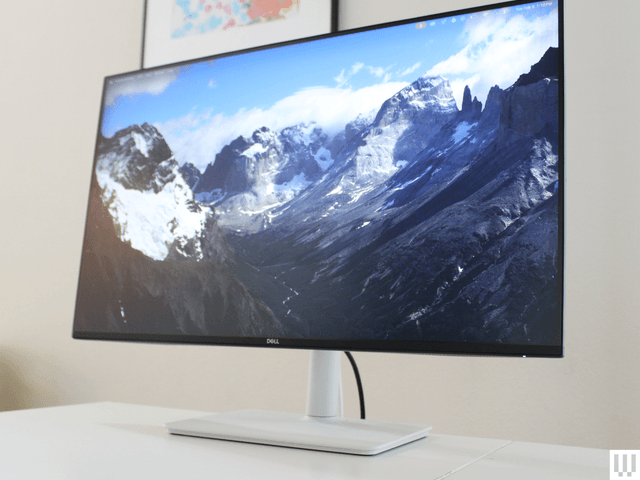
I have to start with the Dell 27 Plus (S2725HSM). I had a feeling I would like this monitor, as I’m a big fan of the 4K model, which remains at the top of my list for best overall monitor. This cheaper version has everything I liked about that model, including the highly adjustable stand, the sleek white design, and the really solid image quality.
For $175 (or sometimes on sale as low as $140), it has really solid color performance and hits 300 nits of brightness. The most important feature the Dell 27 Plus has is its stand. You can adjust the height and swivel, with a built-in VESA mount, which would make it a very practical addition to your current workstation. The biggest thing it’s missing is ports. It only has two HDMI ports, so you’ll need to plug accessories directly into your laptops or into a USB hub. Still, when it comes to full-featured 1080p monitors, the Dell 27 Plus ranks among the best for the price.
The one monitor that compares to the Dell 27 Plus, only with a built-in USB hub, is the Samsung Essential Monitor S4. I haven’t seen it in person yet, but it’s also 1080p and has height adjustability at the same price. It has a lower claimed brightness as the Dell 27 Plus, though, at only 250 nits.
But like I said, if you’re shopping between $150 and $200, you’re not necessarily stuck with 1080p. I tested out the MSI Pro 27 (MP273QW E14), which has a 2560 x 1440 resolution and sells for $190. Not only does this MSI monitor offer more pixels per inch, it also has really fantastic image quality, almost so good it could be used for content creators and photographers. For a monitor of this price, that’s pretty incredible. It’s also brighter than any other monitor I’ve tested in this range, reaching all the way up to 427 nits.
The main drawback is the adjustability and ports. No built-in USB ports for connecting peripherals and no ability to adjust the height or swivel. The built-in stand is in a static position, so if the height isn’t perfectly suited for your desk, chair, and body, you’ll need a monitor stand. And while it technically supports VESA to connect it to a monitor arm, it doesn’t come with an included mount.
The Best Cheap Gaming Monitor


Another monitor I came across in my journey through cheap displays was the Lenovo Legion R27fc-30. This would my pick for the best budget gaming monitor and really surprised me with its image quality. I’m used to having to complain about the janky screens on cheap gaming laptops, but this far exceeded my expectations. Brightness is over 300 nits, and color performance is just as good as the MSI Pro 27.
The difference with the Legion R27 is the refresh rate, which is cranked all the way up to 280 Hz to support fast-pacing 1080p gaming. It also has a slight 1500R curve, which is subtle. You don’t really want anything more aggressive than that at this size and aspect ratio, but it offers just the slightest feeling of immersion in games.
One really unique thing about the Legion R27 is that it doesn’t have a matte layer over it. It’s glossy, which I tend to prefer just for clarity. I know people worry about glare and reflections, though, so if you are next to a window or under bright lights, you’ll want to keep that in mind. This is also a VA (vertical alignment) panel, which has a couple of issues, most notably the limited viewing angles. Move your head to the side, and you’ll see how much perceived color and contrast you lose. Of course, while gaming at a desk, that isn’t going to be too big of a problem.
The Best Monitor Under $100


If you really want to save some cash and pick a screen around $100, you’ll want to stick with the 23.8-inch size. This is a bit small, but it can work well if you’re at a small desk. One great option I tested in this category was the MSI Pro 24 (MP243W E14).
It’s a 23.8-inch IPS monitor with a 1080p resolution, but unlike the ultra-cheap monitors from yesteryear, this one has really solid image quality. In terms of color saturation, it hits 99 percent of the sRGB and 77 percent of the AdobeRGB color spaces, while the color accuracy comes in with a Delta-E of 1.35. That’s not quite good enough for professional photo editors and color graders, but if you’re typing emails and making presentation decks, it’s got the color performance you need. It hits up to 359 nits of brightness, and the contrast is really solid at 1,380:1. It even has a 144-Hz refresh rate, making it a solid gaming display when it needs to be.
Of course, as a $99 monitor, it has compromises. The primary one is adjustment, as it only has a bit of tilt. That’s it. That means you may need a monitor stand to get it at the right height ergonomically. Overall, though, I was really surprised by just how high-quality the panel was and how clean the monitor’s aesthetic is. Now, if you’d prefer something larger, MSI sells a nearly identical 27-inch version for just $10 more (it’s still 1080p), which has many of the same features.
All that said, if you’re willing to spend a little more, there are some great options in the $300 to $400 range that don’t force you to make as many tough compromises, which you can find in our Best Monitors recommendations.
Disclaimer : This story is auto aggregated by a computer programme and has not been created or edited by DOWNTHENEWS. Publisher: wired.com