Updated ,first published
THEATRE
Art
Roslyn Packer Theatre, February 19
Until March 8
Reviewed by JOHN SHAND
★★★★
Imagine if where you are reading this review was just white space. No words. What if, rather than missing words, the white space constituted a work of visual art? Nothingness would be just as valid as much else that passes for art, after all.
But what if your best friend buys a large painting that’s pure white, and, being painted by a collectible (read “fashionable”) artist, cost an eye-watering sum? Do you accept, question or rubbish this person’s taste? Does the existence of barely discernible (in the right light) diagonal stripes – also white, of course – play into this discourse? Do friendships crack and possibly shatter under such circumstances?
These are the games French playwright Yasmina Reza plays with her three characters in this arch comedy, memorably staged in Sydney in 1999 with Tom Conti, Geoff Morrell and David Wenham, playing Marc, Serge (the painting buyer) and Yvan, respectively.
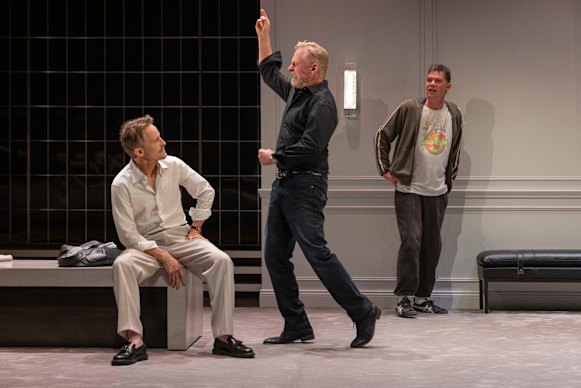
Now, an equally stellar trio of Richard Roxburgh, Damon Herriman and Toby Schmitz attacks these roles, directed by Lee Lewis for producers headed by Rodney Rigby.
It’s expert casting. Roxburgh intrinsically makes us warm to spiky Marc, who believes Serge is crazy to be sucked into buying an expensive joke. Herriman puffs up Serge with ample pomposity, while leaving ajar the door to congeniality enough for us to allow Serge has every right to spend his money as he chooses.
Schmitz, meanwhile, continues his golden run through Hamlet Camp and Grief Is the Thing with Feathers, giving us an Yvan who’s such an affable oaf of an overgrown child that he could just about paper over the cracks in the Liberal Party, let alone a rift between friends.
Charles Davis’ 1990s costumes excessively delineate the differences between the three, however: Serge in the connoisseur’s garb of tailored pale suit over turtle-necked top; Marc casual in denim and leather; Yvan beyond casual in T-shirt and trackies.
It makes them look improbable friends even before the friction starts to sting, as Reza pokes a stick into the wasps’ nest of taste, meaning, pretension and craft in modern art, and the seeming randomness of stardom. She simultaneously interrogates the nature of friendship, and how we may evolve away from the original bonds.
Lewis has beautifully conducted Reza’s finely tuned score of dynamics, as anger, disdain, hurt and, above all, humour play out, Art being glitteringly witty at best, primarily thanks to Marc when he’s not too poisonous, or Yvan when he’s not too angst-ridden.
Schmitz’s Yvan brings the house to tears of laughter in a diatribe about glitches in devising his wedding invitations. His chums, of course, tell him to pull the plug: they don’t want Yvan lost to the dreaded Catherine any more than Marc wanted to be usurped in Serge’s heart by a blizzard of whiteness.
If the world is piling weights upon you, this will provide blessed relief.
MUSIC
Stella Donnelly
Oxford Art Factory, Sydney, February 19
Reviewed by BERNARD ZUEL
★★★★
She is that enthusiastic best friend who’s always got something excellent to tell you. Grinning as she approaches maybe, furrowed brow on another day, but always tapping you on the arm or chest like she is bursting to share or to dance. Or both. At the same time. Not surprisingly, you find yourself doing it too, unintentionally mirroring at first, then succumbing to the mood, joining in comfortably.
A bit like the night’s opening song, Standing Ovation, which began as a soft, slow mood piece of uncertain colour that opened out to febrile bass and a skipping rhythm, and all of a sudden we were all singing as if this kiss-off of regrets was a party we did want to attend.
Or maybe it’s the flipside, Year of Trouble, a newish “sad old ballad”, done alone at the keyboards, as forlorn as the night she went back – to regret or rework or just understand – and “Parked far away from your new place/I needed the walk”.
Appropriately communal, this was being done with a reasonably full-figured band of multiple keyboards, multiple guitars and multiple voices – enabling a choice of boy backing vocals stage right or girl backing vocals stage left – and eventually multiple collaborations with the audience, vocally and onstage.
Obviously, it’s not always a pretty story – though Stella Donnelly would probably apologise each time, as if it’s her fault it happened – and sometimes it can get downright ugly. The (appropriately) bitter slicing through offensive men of various shades in the older trio, Boys Will Be Boys, Beware of the Dogs and Old Man, made for a bracing bracket, the first of them coming with a content warning, though for subject matter, not language.
But even then, Donnelly’s not-so-secret weapons, a flair for melodies that could keep a cruise ship buoyant and a turn of phrase that can’t help but catch the ear, will usher you along even the darkest path. It’s why, the Chappell Roan cover in the encore notwithstanding, the best way to think of her wares is to imagine a cross between the sad-eyed adulthood of Holly Throsby and the perpetual teenhood of Ben Lee.
As a final note of serendipity, the fact that Old Man – a song where the sheath is velvet, but the blade is Japanese steel for a certain type of predatory male – was being performed at the same time as a former prince was being taken into custody elsewhere was quite piquant. I reckon that could be a story for her to tell next time. Enthusiastically.
MUSIC
Baroque Masters, Australian Brandenburg Orchestra
City Recital Hall. February 18
Reviewed by PETER McCALLUM
★★★½
In an age when Bach’s Brandenburg Concertos are busked on street corners, piped into shopping malls and ubiquitously sampled on playlists, it is easy to forget the astonishing originality of Bach’s musical thought in what he modestly called these six Concerts avec plusieurs instruments (concertos with several instruments), humbly submitted to the Margrave of Brandenburg.
Even though most listeners have heard them more frequently than Bach (or the Margrave) ever did, the variety of arrangements and subtlety of musical conversations he found for his “several instruments” remain a wonder and delight.
The Australian Brandenburg Orchestra chose two of their namesakes as mainstays to open their 2026 season. The first half ended with the Concerto No. 4 in G major for violin and two recorders (Bach used the elusive term fiauti d’echo, the exact interpretation of which has provided gainful employment for generations of musicologists).
Concertmaster Shaun Lee-Chen played the virtuosic violin part with freedom and fire, while recorder players Melissa Farrow and Mikaela Oberg provided a glowing aura of sweet sound.
After a haunting slow movement with simply shaped cadenzas from Farrow, the wonderful fugal finale surged with growing exhilaration. Immediately after interval, the Brandenburg Orchestra arranged themselves in an arc for the playful Concerto No. 3 in G for three violins, three violas and three cellos with continuo accompaniment.
Between the bristling outer movements, played with spiky articulation at speed, ABO artistic director Paul Dyer inserted, somewhat incongruously, the theme of Bach’s Goldberg Variations (also in G major) to fill out the two chords Bach wrote to indicate an improvised slow movement (Bach’s chords could be taken to mean he was thinking of a passage in E minor).
To the works by Bach, the ABO added an additional solo concerto in each half. Baroque oboist Adam Masters played Marcello’s Oboe Concerto in D minor with neat seriousness in the first movement and ornate expressiveness in the second. After a genial reading of Pachelbel’s famous Canon in D major, played like an after-dinner jam session, Farrow returned with transverse flute to play, with bright, bird-like agility, a movement of a concerto by Quantz.
The evening’s most carefully shaded and graciously shaped performance was the concert’s opening work, Handel’s Concerto Grosso in G major, Opus 6, No. 1 in which Lee-Chen led the concertino group with intimate attention to line and expressive nuance.
The program closed with a fiery and energised approach to Vivaldi’s Trio Sonata in D minor, Opus 1, No. 12, La Folia, set here in a concerto style, with some variations played by a trio led by Lee-Chen and others delivered by the full orchestra with dramatic abandon.
MUSIC
Lorde
Qudos Bank Arena, February 18
Reviewed by MICHAEL RUFFLES
★★★½
Pants on, pants off, pants on again. A thesis could be written about how Lorde lets cameras and lasers scan her body, focusing on navels and eyes and glitter and scratches, and what the Ultrasound Tour says about being a young female pop star in the aftermath of Brat summer.
But fundamentally, this is intimacy on a grand scale: dancing in the dark like no one is watching, be it a nightclub or a bedroom, just with 16,499 others at Qudos Bank Arena on a school night.
That the 29-year-old singer-songwriter was able to take us along on the alternately hedonistic and voyeuristic journey using mainly downbeat, introspective pop songs is a testament to how good the tunes are.
The staging was simple but effective: two dancers provided engagingly shambolic company, the band had a cameo, and Lorde put her entry in for the award for Best Use of a Treadmill in Pop Since OK Go. But it was essentially a one-woman show, a great singer with top pop songs.
Concussive beats and piercing lasers signalled the start, as Hammer launched proceedings in blunt and invigorating fashion. A cappella start to megahit Royals showcased Ella Yelich-O’Connor’s vocal prowess, and gave a refreshing twist to a classic heard a million times since it launched her career (and half a dozen others) 12 years ago.
Buzzcut Season was also an early highlight, and the risk was it might be all downhill from there.
The new material was patchier: all of 2025’s Virgin album got an airing and while What Was That, Man of the Year and GRWM can stand alongside her best, others were less successful. The robotic Clearblue was an admirable experiment, but unless you’ve had the album on repeat it could have stayed there.
Not that stretching herself as an artist has served Lorde badly: two tracks from the divisive third album Solar Power were among the night’s highlights and gave the setlist nuance and diversity. Lorde finished with early hit Team, the euphoric Green Light and oldest song Ribs, a safe but very sound conclusion.
Get the day’s breaking news, entertainment ideas and a long read to enjoy. Sign up to receive our Evening Edition newsletter.
 John Shand has written about music and theatre since 1981 in more than 30 publications, including for Fairfax Media since 1993. He is also a playwright, author, poet, librettist, drummer and winner of the 2017 Walkley Arts Journalism AwardConnect via X.
 Bernard Zuel is a freelance writer who specialises in music.Connect via X.
From our partners
Disclaimer : This story is auto aggregated by a computer programme and has not been created or edited by DOWNTHENEWS. Publisher: www.smh.com.au