Sophia Yan
On the edge of a vast desert in north-west China lies a dried-up salt lake.
Its remote, barren location offers little support for civilisation but makes it the perfect site for secret nuclear testing.
This area, known as Lop Nur, or Lop Lake, is where the US government has alleged China has been conducting hidden nuclear explosive tests.
The revelation potentially signals a new phase in China’s ambitions to win the global nuclear arms race, just as the last remaining treaty between the US and Russia, aimed at preventing catastrophic nuclear war, expired this month.
China wants to expand its arsenal of 600 nuclear warheads to 1500 by 2035, according to official US estimates. This makes it the only party under a global non-proliferation treaty that is significantly expanding its stockpile.
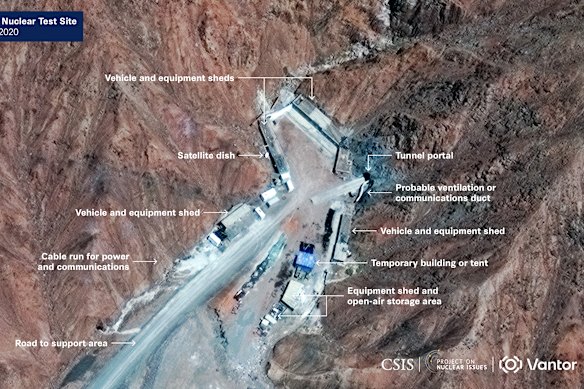
Some of this expansion may be supported by a flurry of construction that has taken place at Lop Nur in recent years, including improved transport infrastructure that could facilitate the transfer of material to the site’s probable eastern testing area, which is visible in satellite imagery.
For China, “geopolitically, having a large nuclear weapons arsenal serves the ‘swagger’ idea,” said Renny Babiarz, a geospatial intelligence expert who specialises in China’s nuclear weapons program.
Nuclear weapons present “a strategic capability to have in the background to help negotiations or to keep other powers out”, he said. “It is a backstop for trying to keep other countries from intervening in the event there is any coercion in the Taiwan Strait. The war on Ukraine has only underscored the importance of that.”
Concerns over China’s nuclear expansion have been around for decades, though allegations of testing related to an apparent nuclear build-up that surfaced in 2020 in a series of arms-control reports by the US State Department.
While details provided by the US government at the time were scarce, Babiarz’s research released the following year revealed extensive expansion at Lop Nur, the site of China’s first nuclear tests in the 1960s.
New construction included large drill-rig activity, a probable underground facility, and numerous “adits” visible in satellite imagery. Adits are excavated areas on the side of a hill or mountain that can serve as an entrance to other underground facilities and chambers, where explosive tests could be conducted.
“Taken together, these observations suggest that China may be preparing for future nuclear weapons testing, which would mark a new phase in the modernisation and/or expansion of China’s nuclear weapons stockpile,” Babiarz wrote in a 2021 report to the State Department, noting that more analysis and study was needed.
Further details about China’s testing activities came from the US government this month, just one day after the nuclear arms control agreement, known as the New Start treaty, between the US and Russia expired.
US officials have since revealed that they believed an explosive nuclear weapons test was conducted on June 22, 2020. They said curious seismic activity registered in neighbouring Kazakhstan indicated such a test and that the Chinese military was preparing for more tests achieving supercritical yields in the range of hundreds of tonnes. Such activity, they said, was being purposefully and expertly concealed.
Experts have rushed to find clues that might present a clearer picture of what China was up to six years ago.
But satellite imagery focusing on the easternmost tunnel test area at Lop Nur analysed by the Centre for Strategic and International Studies, a US think tank, have been inconclusive, as not much activity or change is visible before and after the alleged June 2020 test.
The “Tunnel 5” area, or T5, has been of particular interest given construction and excavation activity in recent years.
Still, CSIS experts noted that it is possible China conducted an underground nuclear test at another tunnel area, or was able to mask the explosion, conducting a covert “decoupling” test, as US officials have alleged.
“Decoupling” is a method in which a device is detonated underground, reducing the magnitude of shockwaves coursing through surrounding rock, and therefore lowering the chance of registering seismic activity.
In other words, it’s one way for China to evade or minimise detection.
An exact determination of what happened on June 22, 2020 could be key in the future, as a test might indicate a “potential violation of the Comprehensive Test Ban Treaty, which China signed but never ratified, and might become justification for taking more action later”, noted Babiarz.
That China never ratified the treaty is part of Beijing’s playbook: to have plausible deniability, as it allows the government to say it had agreed in theory on the world stage but never in principle at home.
All this comes as President Donald Trump has pushed the US to resume nuclear testing after such activities ended in 1992, and as he continues to seek curbs on China’s nuclear weapons program. Trump has made clear that any renewed nuclear weapons agreement between the US and Russia, given the recent treaty expiry, ought to include China.
Aside from Lop Nur, China has several other secretive nuclear sites, a number of which are located in Sichuan province.
Satellite imagery has captured an increase in construction, including bunkers and facilities that suggested a capability for nuclear weapons production. Two of those sites – Zitong and Pingtong – are just 113 kilometres apart.
Nuclear ambitions in China, Russia, North Korea and Iran – all states hostile to the West, with the first three located in relative proximity – may mean the US seeks to divert resources to counter aggression, leaving Europe exposed.
That “could create uncertainties over the ability of US strategic forces to simultaneously deter aggression in two theatres”, wrote Darya Dolzikova, a senior research fellow specialising in nuclear proliferation and deterrence at UK defence think tank Rusi in a recent report.
“Growing US requirements to deter both China and Russia raise concerns over just how much the US nuclear umbrella can stretch in terms of capabilities before it starts to leak.”
China has vehemently denied US allegations over nuclear testing in 2020, claiming it adheres to a policy of never being the first to use nuclear weapons. Sources have also told the London Telegraph that Beijing refuses to engage on the issue diplomatically.
In 2020, Christopher Ford, the then US under-secretary for arms control, and author of the initial reports raising explosive testing concerns, confronted Fu Cong, the then Chinese ambassador to the European Union, about Beijing’s nuclear activities.
“Fu’s answer was telling: he did not deny that [China] was expanding its arsenal – claiming merely that ‘China will not expand its nuclear arsenal to a large extent’, but declared that Chinese policy was a reaction to China facing ‘more threats from the US’.”
As the US had been reducing its arsenal, Fu thus admitted to Ford that Beijing regarded its stockpile as a deterrent for other nuclear weapons, but also key for countering non-nuclear threats.
The Telegraph, London
Get a note directly from our foreign correspondents on what’s making headlines around the world. Sign up for our weekly What in the World newsletter.
From our partners
Disclaimer : This story is auto aggregated by a computer programme and has not been created or edited by DOWNTHENEWS. Publisher: www.smh.com.au