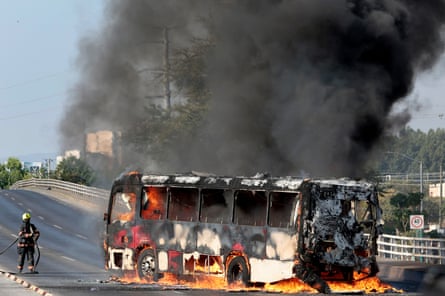
The drug lord “El Mencho”, who was killed on Sunday by Mexican special forces, was the co-founder and leader of a gang that in recent years had become the country’s most powerful criminal organisation: the Jalisco New Generation Cartel (CJNG).
While less internationally famous than the Sinaloa cartel of the now imprisoned Joaquín “El Chapo” Guzmán, the CJNG is a household name in Mexico, where it is known for its displays of ultraviolence and its big, military-style arsenal.
The cartel, based in the state of Jalisco, has been one of the most aggressive in its attacks on the military – including on helicopters – and is a pioneer in launching explosives from drones and installing mines. An effort to capture El Mencho, real name Nemesio Rubén Oseguera Cervantes, a 59-year-old former police officer, ended badly in 2015, with cartel gang members shooting down an army helicopter with a rocket launcher.
In 2020, it carried out a brazen assassination attempt with grenades and high-powered rifles in the heart of Mexico City against the then head of the capital’s police force and now the federal security secretary.
The security specialist Eduardo Guerrero said in 2021 that the authorities north and south of the US border considered the group to be a national security threat. “They have huge amounts of money, the latest generation weapons, military-style paramilitary groups and vehicles … and they represent a very severe challenge to the [Mexican] government – above all in small and mid-sized cities where a detachment of 50 cartel operatives can obviously defeat any local police force.”
The US Drug Enforcement Administration (DEA) considers the cartel to be as powerful as the Sinaloa cartel, with a presence in all 50 US states. It is one of the main suppliers of cocaine to the US market and, like the Sinaloa cartel, earns billions from the production of fentanyl and methamphetamines. Sinaloa, however, has been weakened by infighting after the loss of its leaders Ismael “El Mayo” Zambada and Guzmán, who are both in US custody.
El Mancho was originally from Aguililla in the neighbouring state of Michoacan. He had been significantly involved in drug trafficking activities since the 1990s. When he was younger, he migrated to the US where he was convicted of conspiracy to distribute heroin in the US district court for the Northern District of California in 1994 and served nearly three years in prison.
He returned to Mexico after his release and re-engaged in drug trafficking activity with the drug lord Ignacio Coronel Villareal, alias “Nacho Coronel”. After Villareal’s death, El Mencho and Erik Valencia Salazar, alias “El 85”, created the CJNG about 2007.
Initially they worked for the Sinaloa cartel but they eventually split and for years the two cartels have battled for territory across Mexico.
One underworld yarn suggests the split was caused by a Guadalajara narco spilling a glass of hibiscus tea over a rival during a gathering in the city’s east. The apparently mundane incident reputedly prompted a bloody and bewildering sequence of betrayals, gun battles and massacres.
Unlike El Chapo, who sought Sean Penn’s help to turn his criminal life into a Hollywood blockbuster, El Mencho prefers the shadows. Few photographs of him exist.
Since 2017, El Mencho had been indicted several times in the United States district court for the District of Columbia.
The most recent superseding indictment, filed on 5 April 2022, charged him with conspiracy and distribution of controlled substances (methamphetamine, cocaine and fentanyl) for the purpose of illegal importation into the US and use of firearms during and in connection with drug trafficking offences. El Mencho was also charged under the Drug Kingpin Enforcement Act for directing a continuing criminal enterprise.
With Associated Press
Disclaimer : This story is auto aggregated by a computer programme and has not been created or edited by DOWNTHENEWS. Publisher: theguardian.com