History doesn’t always repeat, but it often echoes itself. So there’s something deeply resonant about Ford’s choice of team partner for its comeback as an engine supplier.
Red Bull Racing was born out of what’s easily the nadir of FoMoCo’s involvement in Formula 1. Having supported Jackie Stewart’s entry into F1 as a constructor in the late 1990s, Ford then bought the team ahead of the 2000 season, rebadged it Jaguar Racing as a marketing tool for one of its premium car brands – then found the following five seasons so bruisingly expensive that it ended up selling the outfit to Red Bull for a nominal £1.
The partnership between Red Bull and Ford therefore represents an opportunity for the Blue Oval to re-attach itself to an enterprise which is now one of the most successful teams in the business. Not only that, it can provide a timely reminder of Ford’s status in F1 history – as the motive force behind 174 grand prix wins, of course, but an influence which goes beyond more than just numbers. Throughout the 1970s it powered most of the teams on the grid, driving innovations in tyre science and aerodynamics as Ford-powered competitors strove to establish an edge on each other.
Low-key debut
Traditional histories enshrine Ford’s maiden appearance as the Dutch Grand Prix in June 1967, where Jim Clark rose from a relatively humble eighth on the grid to win, demonstrating the transformative nature of the new Lotus 49 with its structurally integral Ford-Cosworth DFV. But Ford had actually made a fleeting appearance on the grid a season earlier, in the back of McLaren’s first F1 entry.
As F1 transitioned from the unloved 1.5-litre cap to the much-trumpeted ‘return to power’ with 3-litre engines in 1966, McLaren bought five examples of the 4.2-litre, quad-cam Ford V8 which had powered Jim Clark to victory in the 1965 Indy 500 and shipped them to Californian tuning specialist Traco Engineering to be downsized. Despite experimenting with several bore/stroke combinations, the company was unable to liberate enough power reliably to overcome the engine’s size and weight.
By the time McLaren was ready to make its grand prix debut at Monaco in May 1966, the planned two-car entry for the new M2B had been slimmed down to just one, for Bruce McLaren himself.
McLaren was the fifth of six finishers in the 1966 US GP
Photo by: Getty Images
“It looks as though we’re going to have to make some fairly drastic moves in the engine room,” was McLaren’s verdict after he qualified 10th, 2.9s off pole. In the race he parked the car rather than blow the engine after an oil leak.
Swapping to an Italian-built Serenissima V8 didn’t improve matters so McLaren returned to the Ford V8 later in the season and picked up fifth at Watkins Glen, albeit three laps down.
Enter Cosworth
Co-founded in England in 1958 by Mike Costin and Keith Duckworth, Cosworth had by the mid-1960s carved out a reputation for preparing powerful, reliable racing engines based on Ford production blocks. Still, it would probably not have been the first destination for a client wanting a new 3-litre F1 engine designed from scratch – still, as the ‘return to power’ loomed, desperation was beginning to set in.
Lotus’s Colin Chapman was one of several team bosses caught short by the new regulations when Coventry Climax ruled itself out of designing an engine for them. He knew Duckworth and Costin well – they had met while working for Lotus – and sounded them out. Duckworth was confident he could design a competitive engine, but it wouldn’t come cheap.
Ford was one of several car manufacturers Chapman approached for the necessary finance but the initial answer was a firm no. Still, he found a way in via Ford of Britain’s Walter Hayes, the journalist-turned-marketing-guru who had the ear of no less an eminence than Henry Ford II. After the success of the Lotus Cortina, Hayes had faith in Chapman – and, by extension, Cosworth.
Hayes persuaded Ford management to sign off on a £100,000 payment to Cosworth to develop two engines: the first a four-cylinder twin-cam based on the 116E block used in Ford’s Cortina, and destined for Formula 2; the other was what would become the Double Four Valve (DFV) V8. Hayes assured Henry Ford II that it was “fairly likely” to to win the world championship.
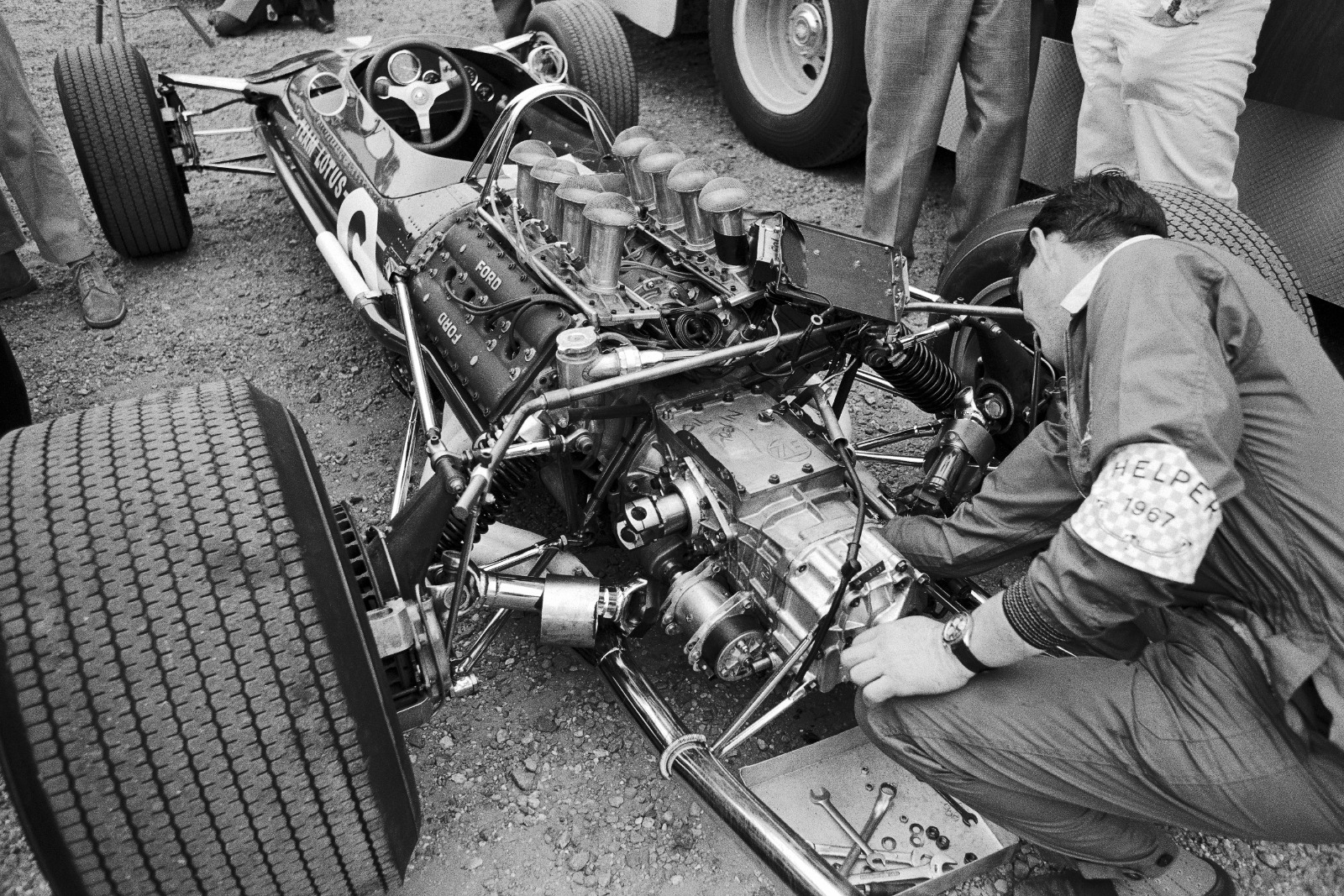
DFV V8 was designed to bolt directly to the Lotus 49’s monocoque and act as a load-bearing element of the chassis
Photo by: Getty Images
The DFV block itself was a custom design, mated to cylinder heads which were a derivative of those prototyped for the F2 engine. Unlike rivals it was designed to be strong enough to function as a load-bearing element of the chassis, removing the need for weighty subframes. This wasn’t the first time the philosophy had been seen in grand prix racing – the V8 in Lancia’s 1954 D50 had been a partially stressed element of the structure – but Cosworth’s was the first to go all the way.
Although Clark won the 1967 Dutch GP commandingly, car reliability cost him the championship and, after Clark’s death in an F2 race in early 1968, team-mate Graham Hill galvanised the team and went on to become the first Ford-Cosworth-powered world champion. By then Ford had opened up supply to other teams besides Lotus and Cosworth’s order books duly swelled.
Until Niki Lauda won the 1975 world championship for Ferrari, every drivers’ and constructors’ title fell to Ford-Cosworth clients. Demand was such that customers would resort to peculiar extremes to lay their hands on a DFV: when German caravan company Eifelland called time on its F1 project in 1972, Brabham owner Bernie Ecclestone bought the assets. Not for the car – a bizarre creation based on a March 721 chassis – but its Cosworth engine.
Ford had essentially democratised grand prix racing: if you could build or buy a car and lay your hands on a DFV, you could go racing. BRM and Matra’s V12s sounded glorious but were less powerful and reliable, while Ferrari was never going to sell its flat-12 to anybody else. Late in the decade Alfa Romeo pitched in with a flat-12, then a V12, but it was the arrival of turbos which ultimately knocked Cosworth off its pedestal.
Not before it had claimed 10 constructors championships with Lotus, Matra, Tyrrell, Brabham and Williams, and 12 drivers’ titles: Hill, Jochen Rindt, James Hunt, Mario Andretti, Alan Jones, Nelson Piquet and Keke Rosberg, plus double wins for Emerson Fittipaldi and three for Jackie Stewart.
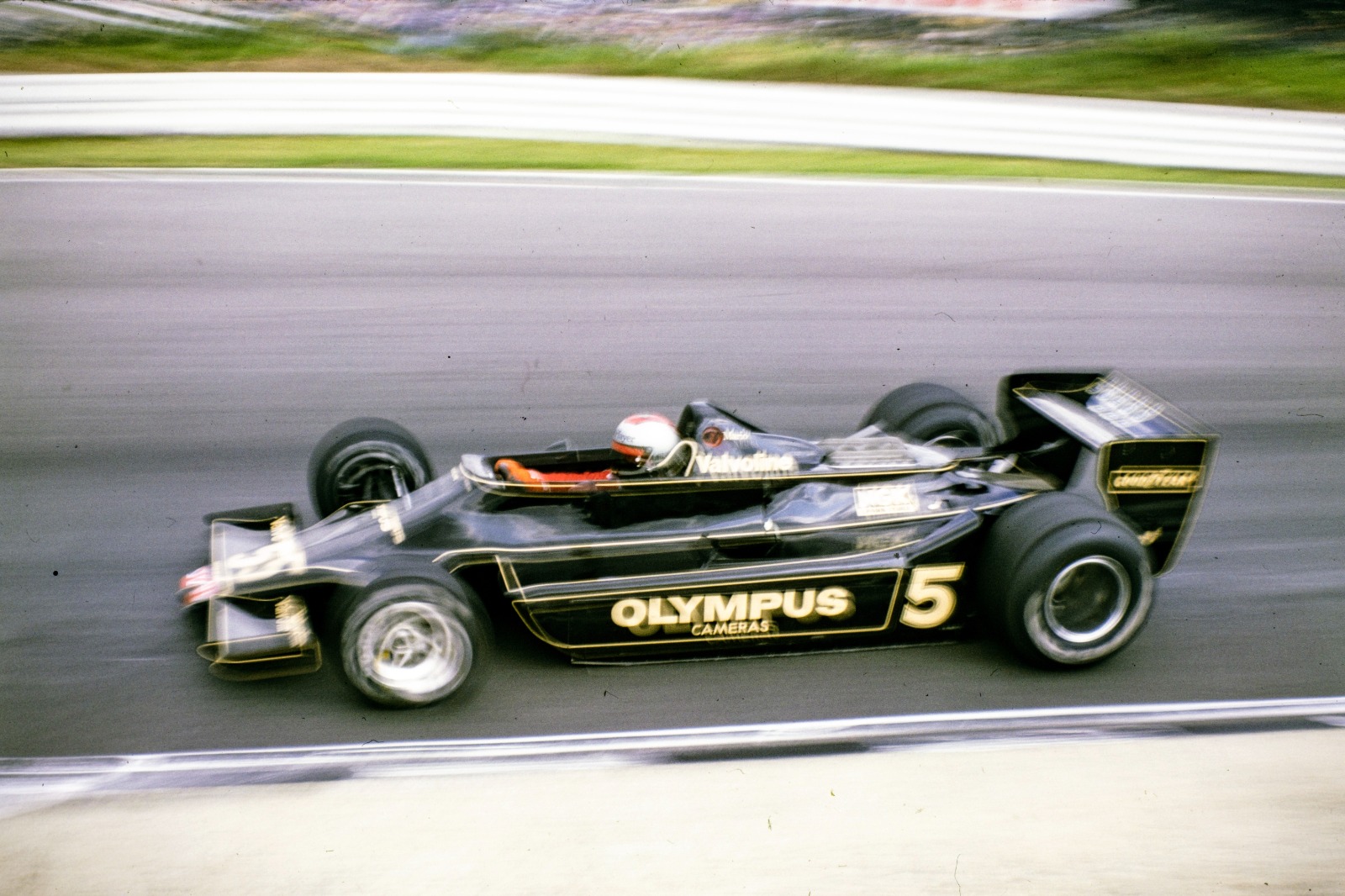
Ground-effect aerodynamics, as used to great effect by Mario Andretti in the Lotus 79, was to some extent a response to the ubiquity of the DFV in the late 1970s.
Photo by: Getty Images
Turbo blow-out
Duckworth had a curious blind spot with turbocharging, viewing the philosophy of forced induction with some disdain, so Cosworth was very late to develop a turbo engine – only doing so after much lobbying from Ford. When a four-cylinder, 1.5-litre turbo based on Ford’s venerable Kent block proved insufficiently powerful and reliable, Cosworth developed a bespoke alloy-block V6.
By the mid-1980s, though, the FIA was plotting the end of turbos and staging ever more draconian interventions to cut power outputs. In 1986 Ford did a deal to supply the new Haas-Lola F1 team exclusively, but the newness of the project, allied to Duckworth’s unwillingness to join the trend of creating high-boost ‘grenade’ engines specifically for qualifying, held the team back. Title sponsor Beatrice pulled the plug and the project fizzled out.
Benetton took the Ford-Cosworth turbo for 1987 and Teo Fabi and Thierry Boutsen claimed podium finishes in the neat Rory Byrne-designed B187, but with the end of the turbo era in sight Cosworth pivoted to adapting the DFV concept to create a new normally aspirated engine, the DFR, for 1988.
The HB has lead in its pencil
Designed by Geoff Goddard, Cosworth’s HB V8 was a new architecture for the 3.5-litre naturally aspirated formula which followed the banning of turbos in 1989. Alessandro Nannini won the 1989 Japanese GP in his HB-powered Benetton B189 after the infamous fracas between McLaren team-mates Ayrton Senna and Alain Prost. Piquet then claimed two further wins in 1990, plus a memorable one in Canada the following year when Nigel Mansell lost the lead on the final lap, missing a downshift while waving to the crowd and causing his Renault V10 to shut down.
Customers were once again flocking to Cosworth’s door and it would be in an HB-powered Jordan 191 that a young Michael Schumacher made his grand prix debut. Very few people in the F1 paddock knew or cared who the Mercedes-backed youngster was at the time, but he came with money team boss Eddie Jordan needed to pay his engine bills amongst other mounting debts.
What the HB lacked in horsepower against the likes of Renault’s V10, and V10s and a V12 from Honda, it gained in lightness and the agility this conferred on cars using it. After Honda’s departure Senna claimed five poacher’s victories for McLaren in 1993, a season dominated by Williams-Renault.
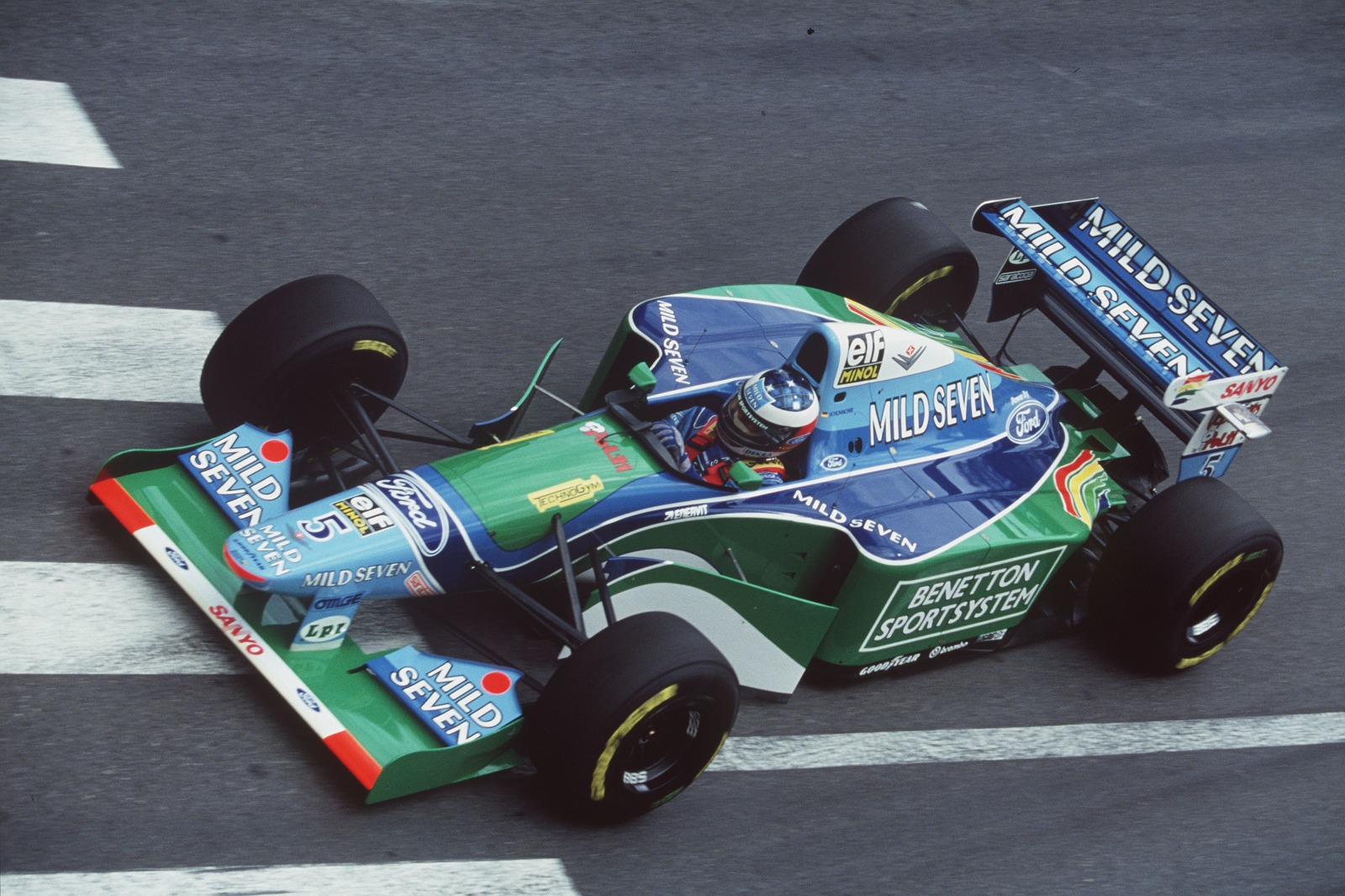
Relatively light Ford V8 gave the B194 excellent balance
Photo by: Getty Images
The following season Schumacher won the world championship for Benetton in the neat, agile B194 powered by Goddard’s new Ford-badged Zetec-R engine. Benetton then swapped to Renault power, craving horsepower above all else, but the French V10 was heavier and emitted more second-order vibrations, triggering balance and reliability issues which made Schumacher’s 1995 title defence something of a slog.
For 1996 Cosworth introduced a V10 version of the Zetec-R and the following season Stewart’s eponymous team joined the grid with prominent Ford branding on its SF01 car and the Zetec-R in the engine bay. The first two seasons were problematic in terms of both pace and reliability but by year three, 1999, the car was quick enough to score podiums and a win in the hands of Rubens Barrichello and Johnny Herbert.
By then, though, Ford had bought Cosworth outright – and was about to do the same with Stewart Grand Prix.
Jaguar Racing – to nowhere
On the eve of the new millennium Ford was contemplating what to do with the results of a shopping spree in which it had acquired the likes of Jaguar and Volvo and rolled them into its so-called Premier Automotive Group (PAG). Jaguar was deemed the logical choice to front Ford’s F1 presence and benefit from its association with high performance at a time where the Blue Oval was trying to transform the brand’s rather fustian image.
Accordingly it threw money at every aspect of the project, including the annual stipend of Eddie Irvine, formerly Schumacher’s team-mate at Ferrari. When results were not instantly forthcoming, the infighting set in.
Over the following seasons Jag Rac’s management resembled a microcosm of the wider political battles being fought in Ford’s boardroom. C-suite denizens and their preferred associates came and went at an extraordinary pace: when Stewart’s son Paul had to step away from his management role while undergoing treatment for cancer, HQ slotted the corporation’s chief technical officer Neil Ressler into the CEO role. Ressler’s sole qualification for the position was that he had been installed as chairman a few months earlier.
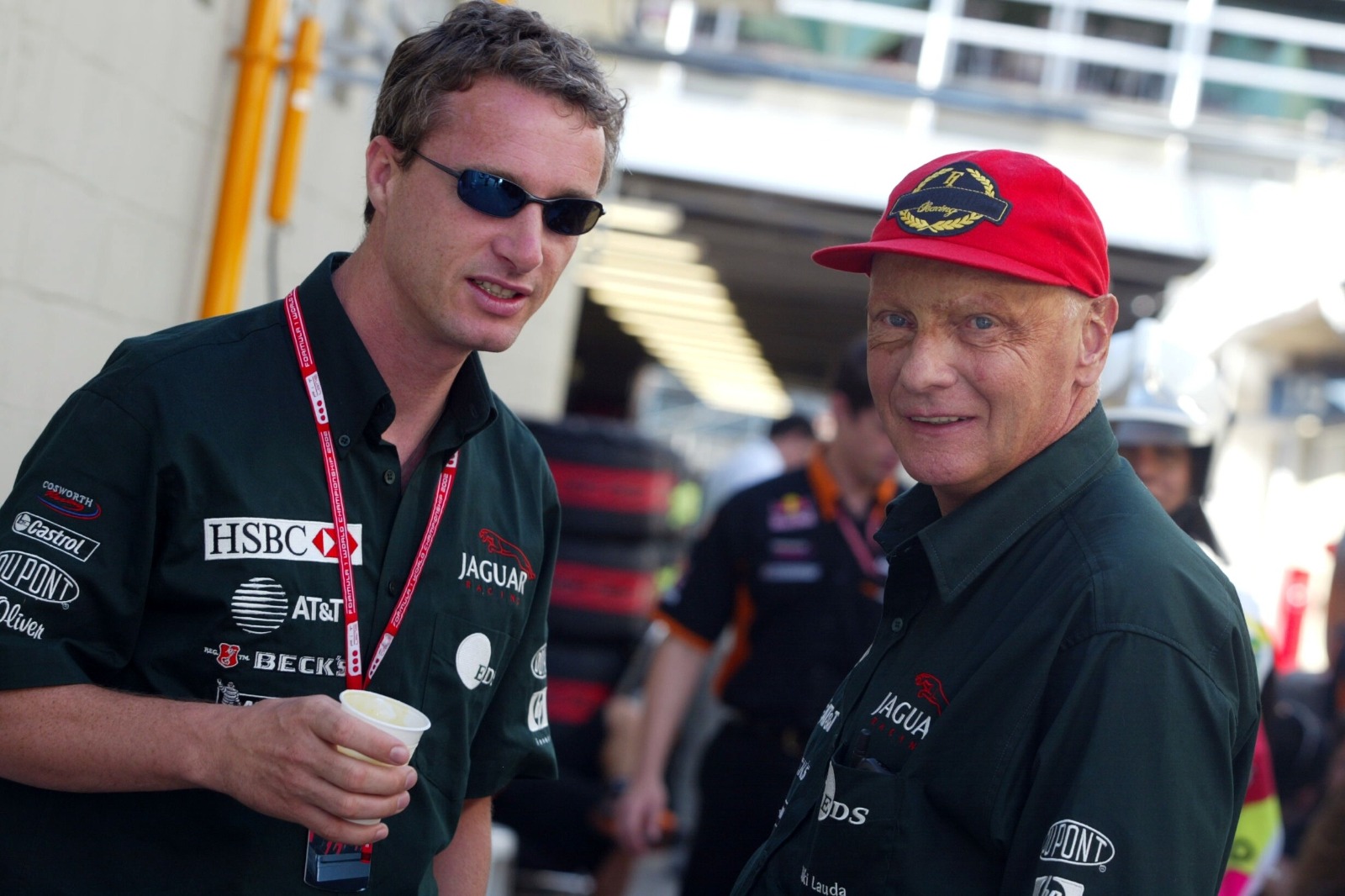
Eddie Irvine and Niki Lauda
Photo by: Getty Images
Ressler and PAG boss Wolfgang Reitzle then in effect engaged in a civil war by proxy, with Ressler bringing in Indycar veteran Bobby Rahal to run the team while Reitzle recruited Niki Lauda to do more or less the same job. Ressler had made a pitch to Ferrari technical director Ross Brawn, but Ross wisely swerved the offer. Rahal then got as far as obtaining Adrian Newey’s agreement to leave McLaren and become Jaguar’s new technical director, only for McLaren boss Ron Dennis to successfully convince Newey that with Lauda circling, Rahal would soon be out of a job.
That prognostication proved to be right.
Meanwhile, new overall Ford boss William Clay Ford Jr was leafing through a spreadsheet of employee salaries and, famously, demanding to know “Who the hell is this Ed Irvine?” – FoMoCo’s most generously salaried employee.
Come 2004, Ford was losing in the region of $50million a year on the Jaguar Racing project, despite its attempts to ramp down its investment and increase its commercial revenue to compensate. The team became rather better known for bizarre publicity stunts, such as the mounting of a Steinmetz diamond in its cars’ nose cones for the Monaco Grand Prix to publicise the film Ocean’s Twelve.
At the end of the 2004 season Ford announced the team would close or be sold – and it got the deal over the line to sell to Red Bull for £1, with the soft drinks empire also taking on the team’s prodigious debts. The deal was formally concluded just hours before the deadline for the team to lodge its entry for the following season.
Ford also sold Cosworth to the owners of Champ Car racing, severing a historic link. During the Jaguar Racing era a Ford-Cosworth powertrain had won a grand prix – but not in the back of a Jaguar.
Even that was a most peculiar state of affairs; McLaren’s Kimi Raikkonen was initially proclaimed winner of a chaotic 2003 Brazilian Grand Prix which was red-flagged owing to a dramatic crash involving Fernando Alonso’s Renault. The Jordan team then successfully appealed the result with the aid of a VHS video recording it had made of the live timing and scoring screens, and Giancarlo Fisiechella was elevated from second to first place after the fact.
So the last Ford-powered grand prix winner didn’t even get to stand on the top step of the podium…
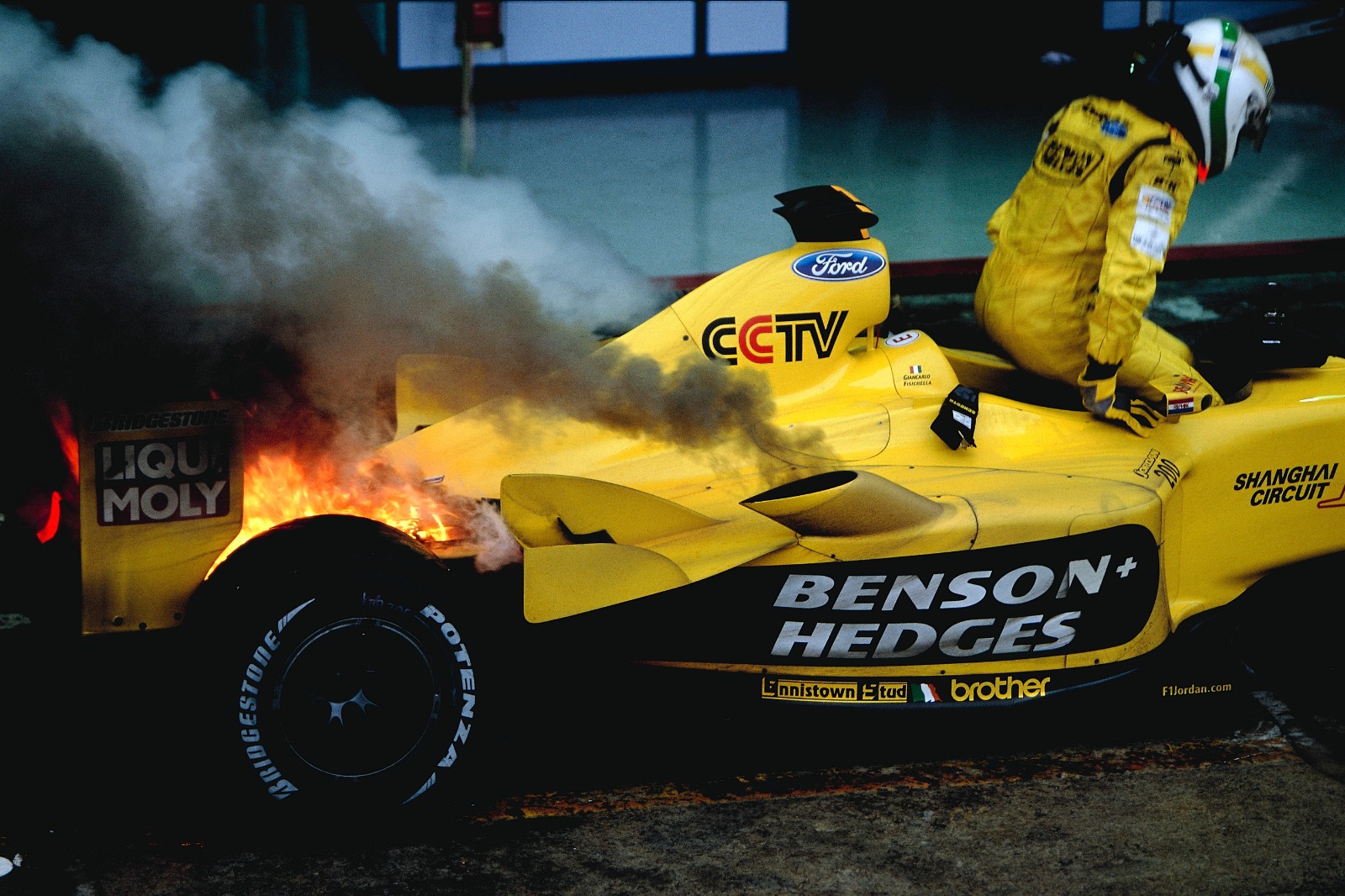
Fisichella’s car overheated and caught fire in parc ferme after the 2003 Brazilian Grand Prix, though he was promoted from second place to victory after a post-race appeal
Photo by: Getty Images
We want your opinion!
What would you like to see on Motorsport.com?
– The Motorsport.com Team
Disclaimer : This story is auto aggregated by a computer programme and has not been created or edited by DOWNTHENEWS. Publisher: motorsport.com