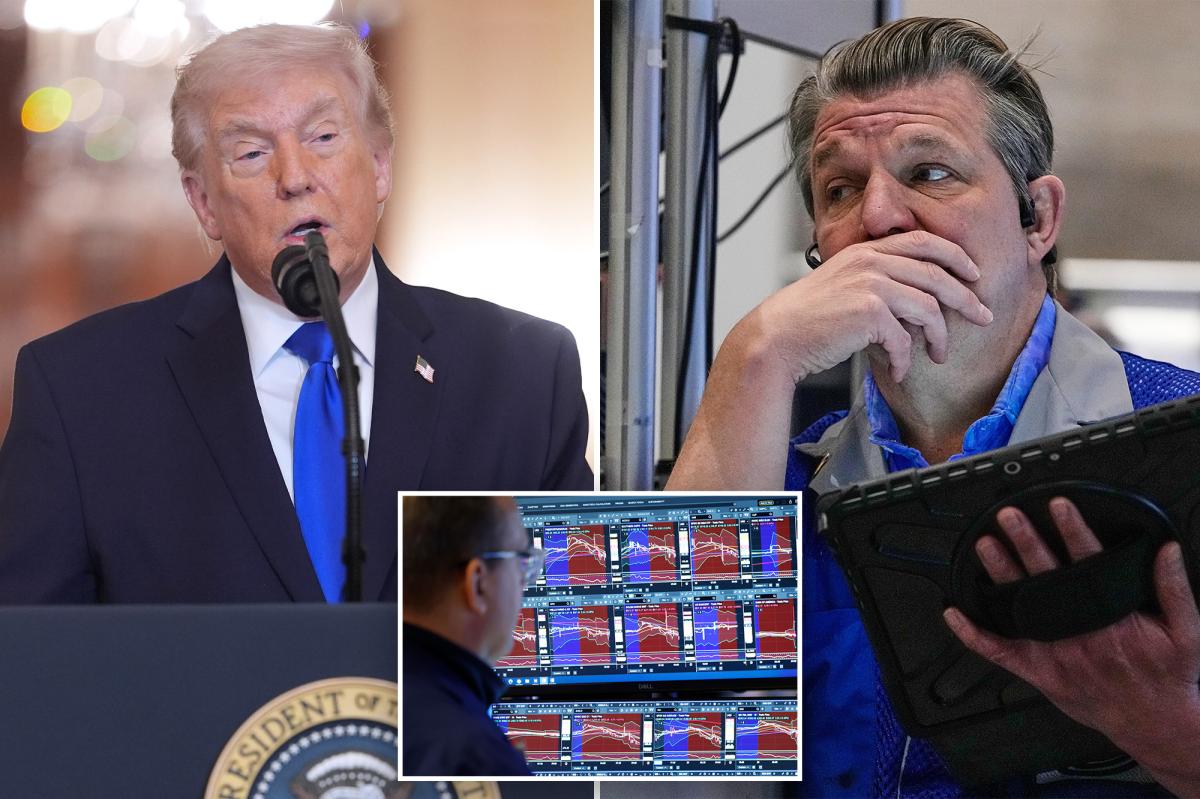
US stocks fell in the wake of tariff tumult that saw the Supreme Court cancel a key part of President Trump’s tariff policy — only for him to vow new levies over the weekend — stoking fresh trade jitters as investors dumped companies seen as potential AI losers.
The Dow Jones Industrial Average had fallen 800 points, or 1.6% as of a little after 1 p.m. Eastern Time. The S&P 500 was down 1.2% and the Nasdaq Composite dropped1.3%.
Trump’s surprise move on Saturday — bumping a new 10% global tariff to 15% under Section 122 — came hot on the heels of the Supreme Court’s Friday smackdown of his sweeping “reciprocal” duties.
That emergency-powers ruling wiped out broad import taxes, but Trump’s temp surcharge holds until late July, paving the way for tougher, lasting hits.
His policy has put global partners are on edge. The EU slammed the breaks on approving its recently-struck trade deal with Washington.
Monday’s dip pales in comparison to April’s “Liberation Day” panic, when Trump’s initial tariffs sparked a Wall Street bloodbath.
This time around, the dollar dipped slightly, Bitcoin dipped below $65,000 before steadying, and gold prices climbed by $100 to $5,226.90 as investors sought traditional safe-haven assets.
“Stocks got a boost Friday from the Supreme Court’s tariff ruling, but it quickly became clear that the decision was simply going to open a new chapter in the trade saga, not end it,” said Chris Larkin, a managing director at Morgan Stanley.
Wall Street’s AI purge also hit hard: CrowdStrike cratered 8.4%, now down 24% for the year, amid buzz over Anthropic’s new code-scanning tool threatening cybersecurity firms.
AppLovin sank 8.2%, joining software stocks hammered by fears AI rivals will snatch customers.
Nvidia’s earnings loom Wednesday, fueling angst over Big Tech’s massive chip spends — will Alphabet and Amazon ever profit from the AI gold rush?
Airline stocks also nosedived amid Northeast blizzards that grounded thousands of flights nationwide. Among the big three US carriers, United fell 4.8%, American 4.5%, and Delta 3.5% in afternoon trading.
Meanwhile, the 10-year borrowing rate on Treasury bills dipped to 4.03% from 4.08% as Fed Gov. Christopher Waller called March’s rate decision “a coin flip” between a cut or hold, a pivot from his January dissent against steady rates.
It comes as economists from Goldman Sachs released a note to clients that downplayed fears of another bumpy ride for the US economy after the Supreme Court nuked President Trump’s trade levies.
The paper said the Wall Street giant’s research team had crunched the numbers after the commander-in-chief announced a 15% global surcharge on all imported goods in response to the ruling on Friday.
Goldman’s Alec Phillips, Elsie Peng, and David Mericle said that uncertainty could still hamper business investment but stressed that much of the long-term trade disruption had already been priced in by firms worldwide.
The authors said their forecasts on “the effects of tariffs on inflation and growth are consequently little changed.”
“Our estimates of passthrough from tariff costs to consumer prices suggest that the bulk of the passthrough had already occurred before the Supreme Court ruling,” they wrote in the study released Monday morning.
Disclaimer : This story is auto aggregated by a computer programme and has not been created or edited by DOWNTHENEWS. Publisher: nypost.com