
Aldrin Castillo was drinking outside his sister’s house in the Manila night when several men, their faces covered, turned up on motorbikes and forced him to kneel in the road with his hands behind his head.
They asked him his name, and then he was dead. One bullet went through his temple. Others went into his chest, neck and ear.
His mother, Nanette, informed by frantic phone calls that her son had been shot, could see some of the holes when she rushed to embrace his body.
“I was looking for signs of life,” she recalled. “If Aldrin showed any signs of life, I’d rush him into the hospital. I was asking for an ambulance. The authorities just said, ‘Nanette, he’s gone’.”
It was October 2, 2017. Ever since, she has been waiting for Rodrigo Duterte to pay.
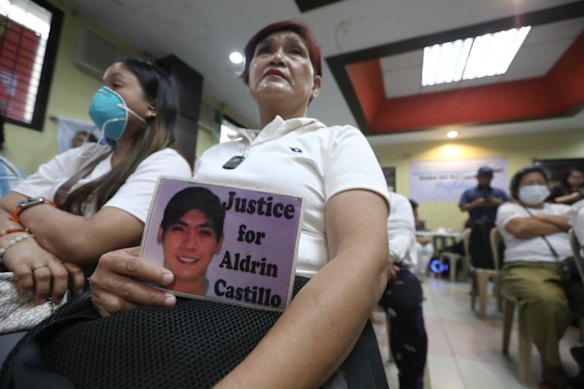
Nanette, 58, was among about 50 people, mostly mothers and wives with similar stories, who gathered at a Manila NGO on Monday night to watch the livestream from the opening day of the former Philippine president’s committal hearing for alleged crimes against humanity.
Duterte’s case in the International Criminal Court stems from his “war on drugs”, a deadly crackdown on perceived criminals initiated during his time as mayor of Davao City from 1988, and expanded nationwide when he was elected president in 2016.
He has been in custody at The Hague, in the Netherlands, since he was arrested and extradited from the Philippines in March last year.
The scheduled five days of hearings were “a reminder of the court’s unwavering commitment … to bring justice to the thousands of victims of the mass crimes and atrocities perpetrated in the Philippines”, ICC deputy prosecutor Mame Mandiaye Niang said.
This was “also a reminder that those in power are not above the law”.
Rights groups claim as many as 30,000 people were murdered, including children, by police officers, opportunistic hitmen and members of the so-called Davao Death Squad (DDS). Prosecutors say the killers were acting on Duterte’s express wishes and, in some cases, financial incentives.
The allegations at the ICC relate to 76 of the alleged murders spanning from when the Philippines became a party to the court’s Rome Statute in 2011 through to March 2019, when Duterte, as president, withdrew the nation from the statute amid preliminary ICC investigations.
His lawyer Nicholas Kaufman told the chamber Duterte was innocent and that the charges were politically motivated, a view shared by millions of die-hard supporters in the Philippines – particularly in his home city of Davao – who view him as a martyr for the everyman exasperated by crime and corruption.
His daughter is Vice President Sara Duterte, who once threatened to have president Ferdinand Marcos jnr assassinated. Wielding her father’s brand, last week she announced she would run for president in 2028.
Kaufman argued that those who carried out the killings during the war on drugs were either acting in self-defence or against what he claimed were Duterte’s warnings to his law enforcement personnel not to abuse their powers.
“His rhetoric was calculated to arouse fear and obedience, to instil fear in [would-be criminals’] hearts and to inculcate a respect for the law in their minds. Nothing more, nothing less. That was his intent, and it was not criminal,” he said.
The defence’s efforts to have the 80-year-old released on the grounds of age and declining health failed. It did, however, successfully argue that he should not be forced to appear in person, angering victims.
“The sight of Mr Duterte being read and being confronted with the grave and horrible charges against him would have constituted a vital component of justice for the victims,” Joel Butuyan, for the families, said in court.
“This case represents the last boat the victims can board on a journey in search of justice for their loved ones, who were brutally killed upon the orders of Mr Duterte.
“If this chamber prevents the boat from sailing by not confirming the charges, the victims will forever be moored on an island where the nights are filled with the screams and cries of their massacred loved ones.”
Aldrin Castillo, 32 when he died, was a welder with plans to move to Saudi Arabia for a better-paying job within months. He promised his mother he would send money home to help support the family.
He was a “mamma’s boy”, but also flawed.
“There was a problem with Aldrin, I won’t lie,” Nanette said.
“My son used shabu [methamphetamine]. But that was not a big problem for us because he could control it. We could control it as a family. I am not hiding the fact that my son used drugs. I know that, and that saddens me as a mother, but I tried to find ways.”
She believed the main target was another neighbourhood man, but that Aldrin was shot anyway in someone’s pursuit of a quota, perhaps before he even had a chance to say who he was.
No one had been held responsible, and Nanette still did not know if it was undercover police officers or vigilantes, though she suspected the former.
She was never even shown a police report, she said.
“It is just the start of the justice,” she said at the viewing on Monday night. “Even though Duterte is at The Hague, his co-conspirators are still in the Philippines.
“I want to be part of this because I know that my son is also here watching. Maybe he sees this, these steps towards justice.”
The confirmation-of-charges hearing in the Netherlands will continue for the rest of the week. The panel of judges will then have 60 days to decide whether the case goes to trial.
Get a note directly from our foreign correspondents on what’s making headlines around the world. Sign up for our weekly What in the World newsletter.

From our partners
Disclaimer : This story is auto aggregated by a computer programme and has not been created or edited by DOWNTHENEWS. Publisher: www.smh.com.au