Updated ,first published
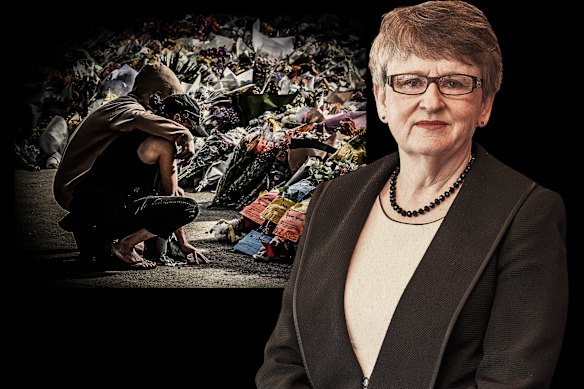
The head of the royal commission into the Bondi Beach terror attack and antisemitism has vowed to deliver her final report before the one-year anniversary of the massacre, but has ruled out hearing evidence about the attack from eyewitnesses.
Former High Court judge Virginia Bell, SC, who was appointed in January as royal commissioner, delivered a short opening statement in Sydney on Tuesday and revealed the definition of antisemitism she would apply.
Bell said the commission “must do its work without risking any prejudice” to criminal proceedings relating to alleged gunman Naveed Akram, who has been charged with 15 counts of murder and 40 of attempted murder after the mass shooting on December 14.
She said that hearing evidence from “people who may be witnesses in the criminal proceeding would create that risk and, for that reason, it will not occur”.
“The trial of that individual will be the occasion to lead evidence of the attack,” Bell said.
Bell said she was “required to deliver my final report … not later than the first anniversary of the Bondi massacre”.
“Anniversaries are important,” Bell said, and the first anniversary of the attack would be “a difficult time”.
“I acknowledge that for some it will never be right to speak of closure, but one small part of coming to terms with the events of that evening will be the work of this commission.
“I regard the delivery of my report on or before the first anniversary as a matter of critical importance. This imposes a tight timeframe, and it’s going to impose limitations on how the commission approaches its terms of reference.”
Bell said she would apply the International Holocaust Remembrance Alliance working definition of antisemitism, namely, “a certain perception of Jews, which may be expressed as hatred toward Jews”.
“Rhetorical and physical manifestations of antisemitism are directed toward Jewish or non-Jewish individuals and/or their property, toward Jewish community institutions and religious facilities,” the definition continues.
Bell said the definition itself was “uncontroversial” but it was “accompanied by eleven examples of conduct which could amount to antisemitism”.
“At least two of the examples are controversial, and have led some critics to argue that the IHRA working definition wrongly labels as antisemitic the expression of political views which do not reflect a hatred of Jews.
“While I’m open to receiving submissions on the issue, my current view is that these concerns pay insufficient regard to the terms of the definition itself, and they’re apt to overlook the requirement to take account of the overall context in which conduct occurs before making any determination that the conduct is antisemitic.”
Bell said it was uncontroversial that criticism of policies pursued by the government of Israel was not, of itself, antisemitic.
Bell said she was interested in hearing from Jewish Australians who had experienced antisemitism, “whether at school or at university or in the workplace, or elsewhere”, and making a submission online did not commit them to giving evidence in public.
She was also “mindful that while antisemitism may be the oldest religious and ethnic prejudice, other religions and ethnicities are also subject to prejudice in Australia”.
“I expect that social cohesion will be advanced by measures that address discrimination against religious faiths, ethnicities and cultures generally,” Bell said.
“Nonetheless, against the background of the massacre of innocent people who appear to have been targeted simply because they were Jewish, I trust everyone will appreciate why the focus of this commission will be on tackling antisemitism as a starting point in strengthening our bonds of social cohesion.”
Senior counsel assisting the commission, Richard Lancaster, SC, described the mass shooting in Bondi as a “truly horrifying event”, and said the counsel assisting team “acknowledge with great sadness the immense trauma” the attack had caused Jewish Australians.
Avoiding prejudice to the ongoing criminal process would “reduce the scope of the commission’s public hearings and the commission’s public reports on some issues”, Lancaster said.
He said the evidence would fall into four broad topics: identifying antisemitic conduct in various forms, including hearing from Jewish Australians about their lived experience, identifying the drivers of antisemitism, examining how law enforcement and security agencies have been tackling antisemitism, and inquiring into the circumstances surrounding the Bondi attack.
“This will include an inquiry into threat assessments and information-sharing by agencies, the steps taken by agencies in response to the planned event at Bondi and to secure it, and steps taken in response to the attack itself,” Lancaster said.
The federal government’s special envoy for combating antisemitism, Jillian Segal, was among those attending the first day of hearings, held in the Law Courts building in Sydney’s CBD. There was no sign of protesters or large crowds.
The commission is required to deliver an interim report by April 30, dealing with matters requiring urgent or immediate action.
Former ASIO and Defence department boss Dennis Richardson, was present on Tuesday and will lead the security and intelligence review that forms part of the commission’s work.
The terms of reference are lengthy and Bell is expected to make recommendations “to counteract and prevent manifestations of antisemitism”.
The commission will also examine the adequacy of existing security arrangements for the Jewish community.
The hearing on Tuesday opened with a Welcome to Country by Uncle Allan Murray, chairperson of the Metropolitan Local Aboriginal Land Council.
“We know that atrocities have been committed against us, and we’re still wanting a reckoning,” Murray said.
Hearing dates for the commission have yet to be set.
Be the first to know when major news happens. Sign up for breaking news alerts on email or turn on notifications in the app.
 Matthew Knott is the foreign affairs and national security correspondent for The Sydney Morning Herald and The Age.Connect via X, Facebook or email.
From our partners
Disclaimer : This story is auto aggregated by a computer programme and has not been created or edited by DOWNTHENEWS. Publisher: www.smh.com.au