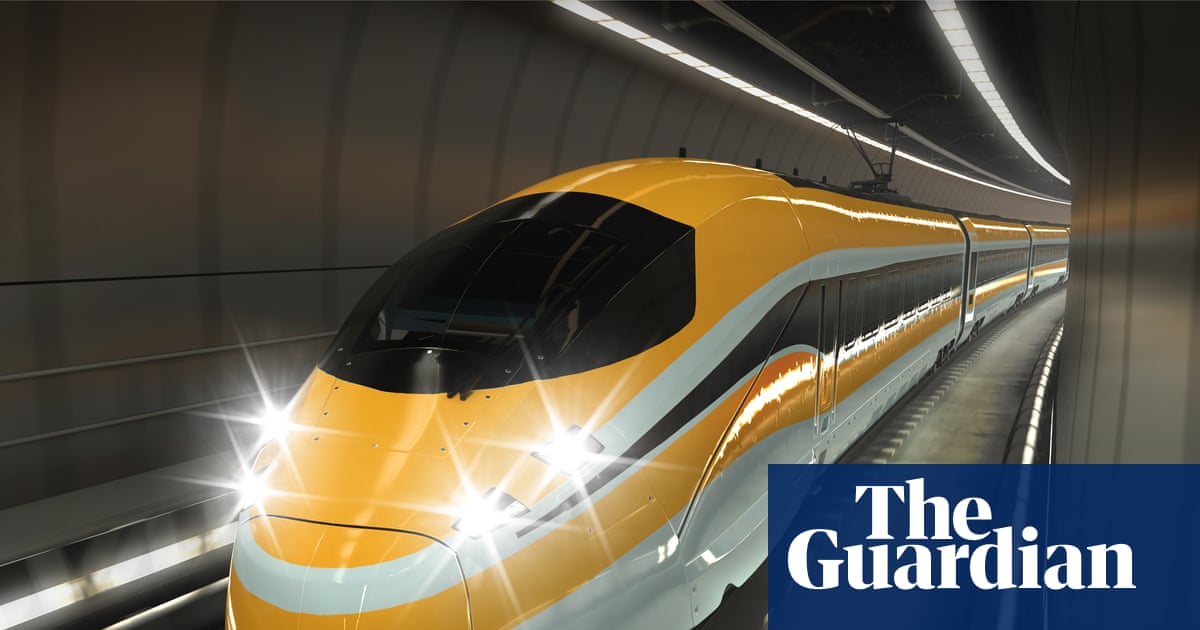
Australians would pay $31 for a 60-minute high-speed train between Newcastle and central Sydney from 2039, costing taxpayers $61.2bn, according to a business case provided to the government.
The next stage of the project, which would see the rail line go to Parramatta and Western Sydney international airport, would cost an extra $32.4bn and open by 2043.
The government released the business case for the project on Tuesday, prepared by the High Speed Rail Authority, which cost more than $70m. It has promised another $230m for planning and development work to get the project “shovel ready” within two years, if final investment approval is granted.
The government said the total price tag of more than $93bn would be inclusive of stations, signalling, as well as a domestic advanced manufacturing facility to produce rail parts.
On Tuesday, the infrastructure minister, Catherine King, said high-speed rail would deliver a $250bn boost to the economy over 50 years, create more than 99,000 jobs, and open up 160,000 homes along the rail corridor.
“This is a project whose time has come, and that stacks up in Australia … we know the costs of this project are high. You can’t build a rail project without significant costs,” King said.
“What this means is doing all of the detailed design work, getting early contractor involvement to make sure we have got this project right, getting the design of the tunnels, [and] getting the design of the stations.”
Sign up: AU Breaking News email
The train between Newcastle and Sydney currently takes more than two hours and 40 minutes. The line was originally planned for steam trains and has “barely changed” since its completion in 1899, according to the business case.
High-speed rail has been a promise of federal election campaigns for decades. It would cut the journey to one hour, while travel between the Central Coast and central Sydney would be cut to 30 minutes.
The business case estimates up to 16 million people could use the rail soon after the whole corridor between Newcastle and western Sydney opens, with up to 53,000 trips made every day and up to 16,800,000 trips made per year by 2041. The rail line would also contribute to the net zero by 2050 goal by cutting down road and transport emissions.
Professor David Levinson, professor of transport at the University of Sydney, said the project is “very expensive” per kilometre of rail, particularly as 115km of the line would have to run through an underground tunnel.
“It’s not surprising that it would be expensive as high-speed rail projects go, because a lot of it is mountain tunnelling, and tunnelling is classically more expensive than building at-grade or elevated segments,” Levinson said.
“The costs are estimated assuming everything goes right, the timelines are estimated assuming everything goes right. They build in a little bit of fudge factor, but very few of these projects come in on time [and on budget].”
Levinson pointed to the Snowy Hydro project, which has also required extensive tunnel boring, and whose budget blew out from $2bn to $12bn at the last estimate.
Opposition frontbencher Jonathon Duniam said he supported the idea of high-speed rail but raised concerns over the price tag.
“It’s a great project, [a] great idea in terms of being able to link the nation up,” he told Sky News. “I think the key question here is while it is important to build these things, it’s also important to be able to pay for them.”
The government said the project “stacks up” from a cost benefit point of view, with the report determining a benefit cost ratio of 0.8 to 1.2. In comparison, a Sydney council project to build a bike network has a ratio of 2.68 to 1.
Levinson said benefit cost ratios comes with “optimistic” assertions on jobs and housing opening up, but that it’s lower than it should be.
“It’s a positive [ratio] in that it’s above zero but it’s supposed to be above one … if you were going to go forward with it, it should be well above one.”
Disclaimer : This story is auto aggregated by a computer programme and has not been created or edited by DOWNTHENEWS. Publisher: theguardian.com