
A fight is brewing about the cost of supported camping in NSW national parks, while an updated government document reveals commercial motorbike tours and quad biking could be allowed in hundreds of parks across the state.
Environment Minister Penny Sharpe repeatedly declined to cap the amount that private operators can charge to offer supported camping in national parks during budget estimates on Tuesday, describing it as “hypothetical”.
She indicated the scheme, which would allow businesses to provide services such as prebooked tents and campervans, was relatively small and was only expected to earn about $32,000 in revenue for the National Parks and Wildlife Service. Sharpe said this also occurred under the previous Coalition government.
Coalition environment spokeswoman Jacqui Munro repeatedly asked Sharpe whether she would cap the amount the private operators could charge members of the public.
“Operators are potentially making money off access to public land,” Munro said. “So I’m asking if you have any limitations on the price that people will have to pay in relation to these contracts. But the answer is, you don’t know.”
Sharpe responded: “At this point, on these proposals, I don’t know because I haven’t seen the business proposals.”
The call for expressions of interest says private operators would pay either $830.40 a year and 5 per cent of turnover, or $1245.60 and 10 per cent of revenue, depending on the popularity and facilities of the park. It does not stipulate how much the businesses can charge the public.
The supported camping proposal has been controversial because it could give private operators exclusive or priority access to parts of campgrounds, limiting access to the public. Sharpe has said previously that the goal is to broaden access to parks, since not everyone could carry a tent on a long bushwalk.
Gary Dunnett, chief executive of the National Parks Association, said staying overnight in national parks was an important way of connecting people with nature and building appreciation for parks.
“Clearly, having for-profit operations that are charging excessive fees is not conducive to providing that sort of widest possible access to good, environmentally sustainable camping experiences,” Dunnett said. “We’re disappointed to hear that at the moment, the government’s not focused on making sure that those experiences can be as cheap as possible, as affordable as possible.”
Munro told this masthead the lack of a pricing cap meant there was no assurance that private operators would not be able to charge as much as they wanted for the use of public land.
“National parks are more important than ever for people’s health and wellbeing,” she said.
The government is also reviewing the fee structure and booking system for NPWS-managed campsites.
The debate comes as NPWS published its updated list of activities permissible by location under the Eco Pass licensing system for commercial operators. NPWS head Alex Graham told the estimates hearing it was usually updated quarterly, and any licences would be considered on a “case by case basis”. Previous versions are not available, so the extent of change is unclear.
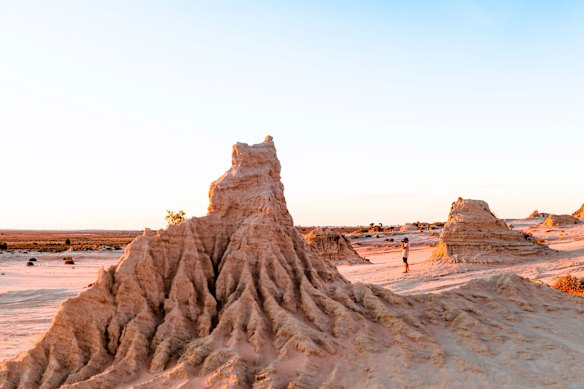
The November version lists 256 locations where commercial motorbike tours could be permitted, including Mungo National Park in south-western NSW and Dorrigo National Park on the North Coast, and wilderness areas such as Barrington Tops and Blue Mountains national parks. Another 72 locations are permitted to have commercial quad biking activity.
An NPWS spokesperson said the Eco Pass program outlined where activities could be considered, but was not broad approval. At present, 40 parks were licensed for motorcycle tours and only one – Worrimi Conservation Lands – for quad biking.
“Private operators offering guided tours and equipment hire have been licensed to operate in NSW national parks since 2009,” the spokesperson said. “Licensed operators help more people visit national parks, learn about nature and heritage, and stay safe.”
Dunnett said some of the inclusions in the list were surprising.
“For instance, one of the sites that they have notionally available for quad biking would be Bents Basin State Conservation Area, which is an incredibly popular swimming and picnicking site in the south-western corner of Sydney – it would be totally and utterly inappropriate for quad biking,” Dunnett said.
“Brunswick Heads Nature Reserve is another one where quad biking is theoretically permissible, and again, that’s just totally inappropriate. Nature reserves should not be listed for that sort of purpose.”
Get to the heart of what’s happening with climate change and the environment. Sign up for our fortnightly Environment newsletter.
 Caitlin Fitzsimmons is the environment and climate reporter for The Sydney Morning Herald. She was previously the social affairs reporter and the Money editor.Connect via email.
From our partners
Disclaimer : This story is auto aggregated by a computer programme and has not been created or edited by DOWNTHENEWS. Publisher: www.smh.com.au