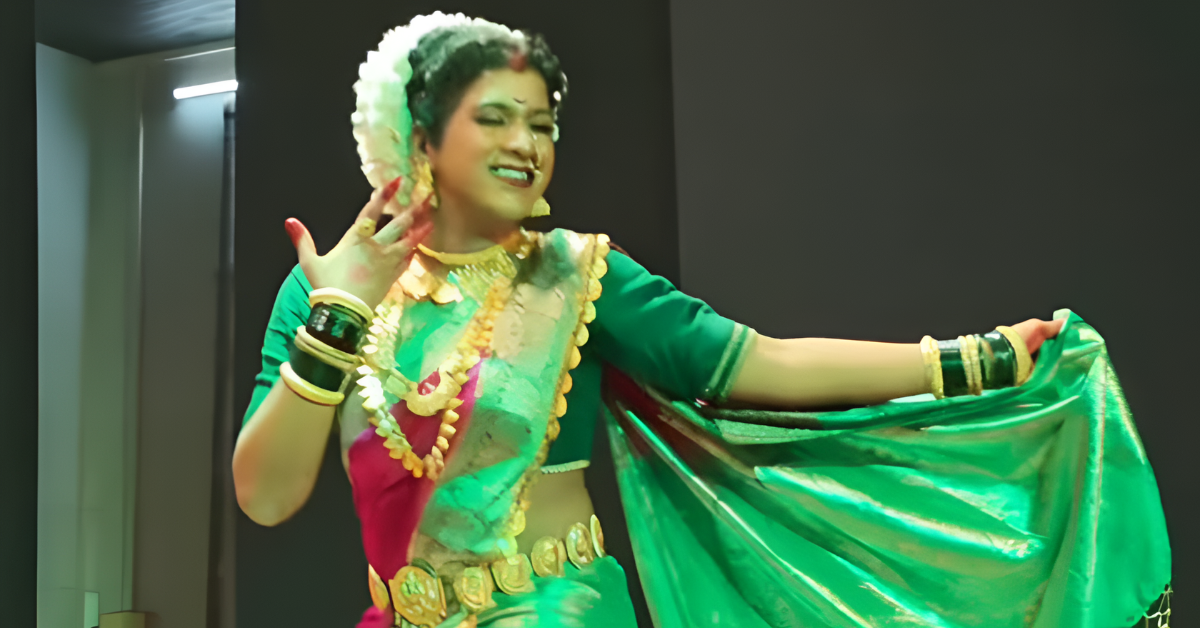
The lights warm the stage as a young man in anauvari saree adjusts his ghungroos (ankle bells worn by Indian classical and folk dancers). His kohl-lined eyes hold focus, and when the music begins, 19-year-old Shrey Panchal does not hesitate. He moves with precision and grace, embodying the spirit of Lavni with a confidence that has unsettled long-held assumptions.
From hiding backstage to proudly taking centre stage, Panchal’s journey has been one of self-expression and resolve. “With every step in my saree, I prove that art knows no gender — only devotion,” he says.
He first stepped onto a stage at the age of three, dressed in a saree by his mother. “I had no training, but my body knew rhythm, and that was the day dance chose me,” he recalls.
Though he learned by observing others and practising before mirrors, Lavni entered his life much later. At seventeen, he performed it in a simple kurta. The applause surprised him. “Something awakened in me,” he says. “But without proper shringaar, Lavni felt incomplete.”
Gathering courage, he draped the nauvari. His parents stood by him, even as others did not.
“Men don’t do Lavni,” people told him. “What you’re doing is vulgar.” The comments escalated into bullying and questions about his sexuality.
Yet Panchal remained steady. “Whenever I step onto the stage wrapped in nine yards of tradition, the noise fades, leaving only rhythm, expression, and art.”
Breaking gender norms in Lavni
Lavni, a traditional dance form from Maharashtra, has historically been performed by women, often associated with powerful abhinaya, expressive storytelling, and elaborate costumes.
Over time, rigid gender and caste expectations shaped who could claim space within it. Panchal is part of a small but growing group challenging that idea.
“Lavni chose me, and I now carry it forward with pride and defying stereotypes,” he says. For him, wearing the saree is not provocation, but authenticity.
An elderly audience member once told him he saw Saraswati in his performance, a moment Panchal describes as a blessing he carries with him.
Recently, he returned to his college not as a hesitant student, but as a judge at Dimensions, the intercollegiate fest of V G Vaze Kelkar College of Arts, Science & Commerce in Mumbai.
“This stage once held my nervous steps and big dreams; today it holds my growth,” he wrote in a social media post.
Panchal balances hours of practice with his studies and directs his own shows, hoping to take Lavni to wider audiences. “Dance is my voice, and I wear it with honour, wherever it takes me,” he says.
As more young performers step forward, perhaps the stage for Lavni will grow more inclusive, reminding us that dance, like all art, should never be restricted by gender.
Disclaimer : This story is auto aggregated by a computer programme and has not been created or edited by DOWNTHENEWS. Publisher: thebetterindia.com