Berlin reported a new record of naturalisations in 2025, with more than 39,000 people gaining German citizenship in the capital. However, nearly five percent of applications were rejected.
Berlin saw its highest number of naturalisations last year, with a total of 39,034 people becoming German.
The number is almost twice as many as the previous year when 21,811 naturalisations took place in the capital, and nearly four times the number issued in 2023 (9,041).
But the rejection rate was also high: around one in 20 applications for naturalisation in Berlin were not accepted.
While reporting the number of naturalisations in the Interior Committee of the House of Representatives, Interior State Secretary Christian Hochgrebe (SPD) said that 1,931 applications (4.9 percent) were “negatively concluded”, meaning they were rejected.
Hochgrebe said reasons for rejection included missing or incorrect information, forged documents or contradictions in statements. He added that any forgeries found are reported to the State Secretary.
Foreigners have to get through a number of hurdles to naturalise, including passing a citizenship test and proving they have B1 level German.
As The Local has reported, investigators have been uncovering schemes involving people submitting fraudulent language and citizenship tests.
READ ALSO: German police investigate ‘large scale’ fraud in language and citizenship tests
Why are the number of naturalisations – and rejections – higher?
The high figures can partly be attributed to Berlin’s restructuring of its naturalisation process.
Since the beginning of 2024, responsibility shifted from district offices to a newly created central authority within the Landesamt für Einwanderung (LEA).
As part of the reform, many procedures were digitised while staff numbers doubled.
Previously, district offices struggled to handle the number of paper applications, with backlogs growing year by year.
In fact, when the new central office took over two years ago, they had to get through a backlog of around 40,000 unprocessed paper applications.
To put the numbers into perspective, in 2023 Berlin received 15,000 citizenship applications in the first nine months of the year alone, on top of a backlog stretching into the tens of thousands. They were able to process just 7,000 during that time.
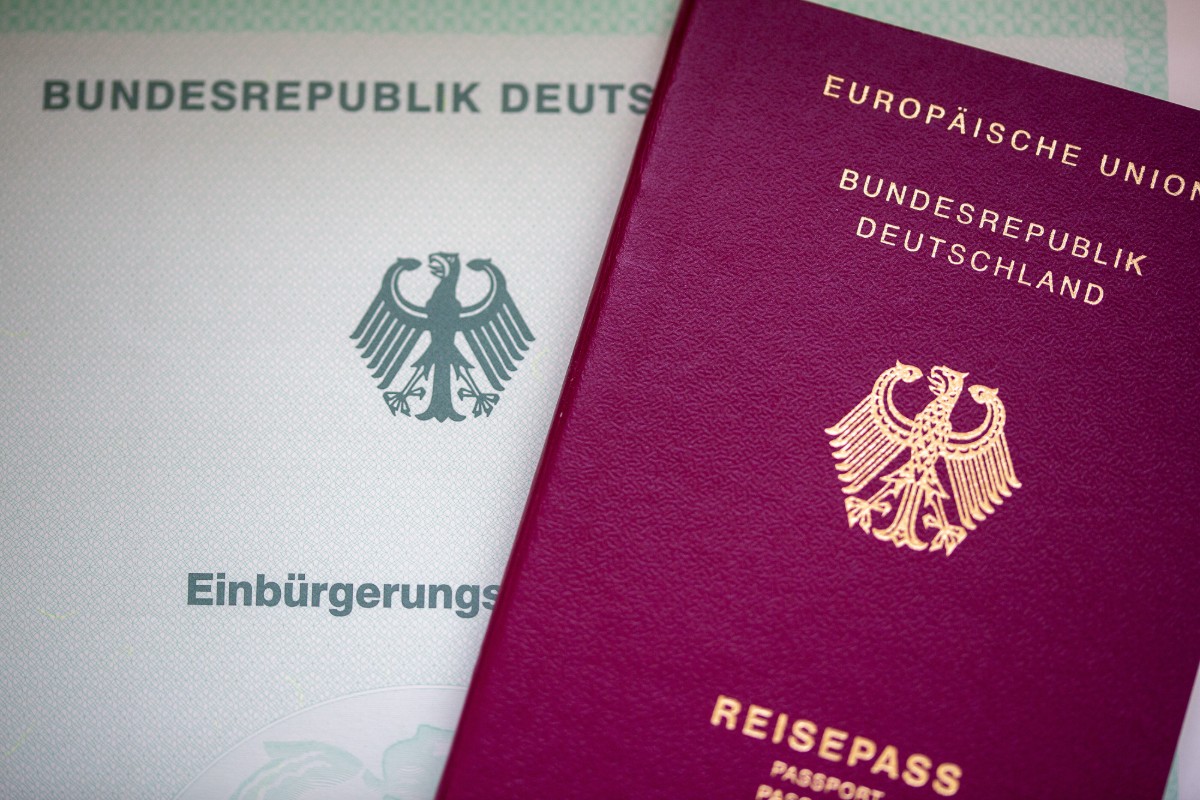
A German passport and naturalisation certificate. Photo: picture alliance/dpa | Fernando Gutierrez-Juarez
The new department originally aimed to process at least 20,000 applications a year – a number it has exceeded.
Citizenship applicants no longer attend in‑person consultation appointments, with identity and security checks now carried out digitally.
According to Hochgrebe, the new system allows authorities to identify potential grounds for exclusion more quickly. He said security standards have become “significantly higher” due to the new process.
READ ALSO: How many newly naturalised Germans have their citizenship revoked each year?
Changes to the citizenship law
Another reason for the hike in naturalisations is that Germany relaxed its citizenship laws in 2024, making it easier for many foreigners to qualify.
The reform – brought in by the previous SPD-led coalition government – allows for people to hold multiple nationalities. Previously, many applicants from non-EU countries had to renounce their original passport to become German.
Under the newest legislation, requirements include having lived in Germany for five years, rather than the previous eight years, and having B1 level German skills.
READ ALSO: Germany sees record number of foreigners gaining citizenship
The Local has contacted Berlin’s immigration authorities for more information on the reasons why citizenship applications in Berlin were rejected. We’ll keep you updated.
Disclaimer : This story is auto aggregated by a computer programme and has not been created or edited by DOWNTHENEWS. Publisher: thelocal.de