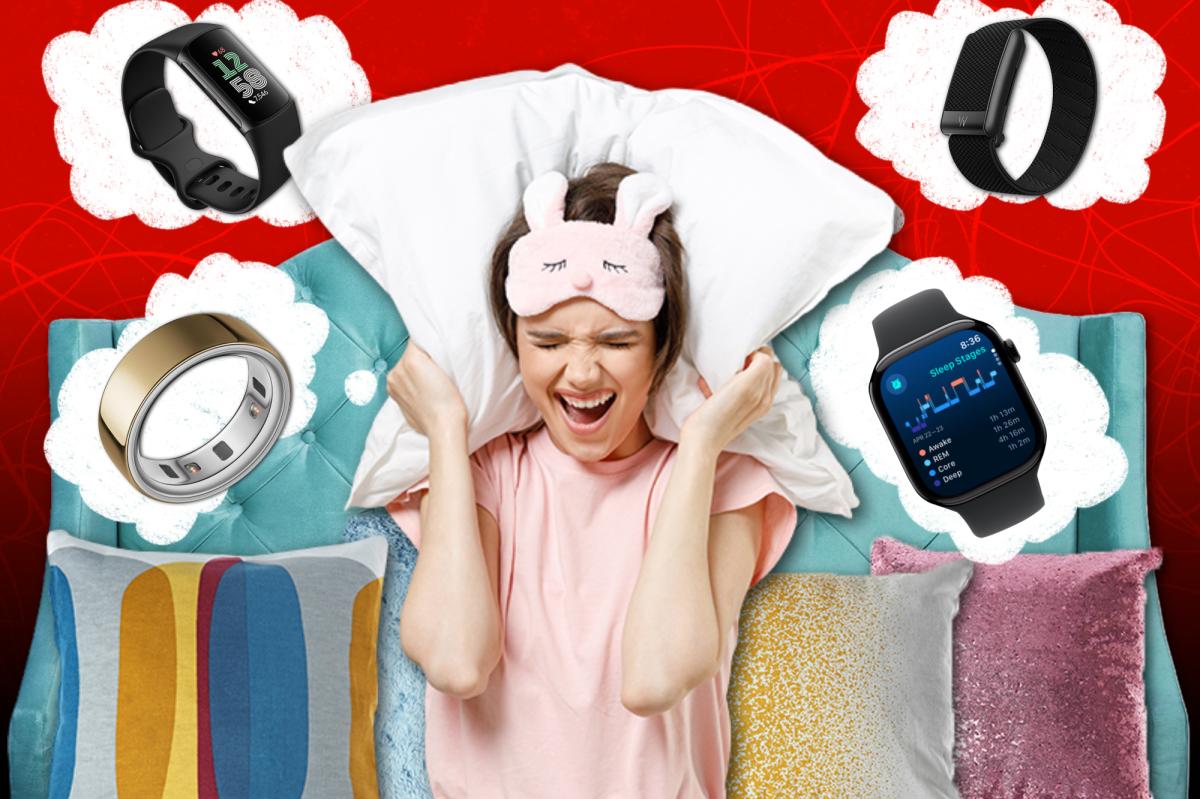
For Leah Martin, a 48-year-old attorney and mother, running on three to five hours of sleep felt normal until headaches and fatigue made her realize she wasn’t performing at her best.
“I wasn’t happy, I wasn’t healthy,” Martin told The Post.
As a competitive runner, she’d already been using devices like Fitbit and Oura to track fitness and soon found herself fixated on her sleep scores.
“I wanted that 100%,” she said. “I always wanted to be the optimal sleeper. But what got me there sometimes wasn’t healthy.”
Over the many years during which Martin describes herself as a “terrible sleeper,” she experimented with her sleep hygiene, including white noise machines, melatonin, teas and other natural sleep aids. She wore an eye mask, got blackout curtains, limited screen time and even tweaked her diet, all in the pursuit of better sleep data.
And it became exhausting.
“I do feel like the tracking, unlike other steps to create a positive sleeping environment, was detrimental,” Martin said. “I would check the tracker during wake-up periods, which definitely didn’t help with sleep. I would worry about how much sleep time I was getting, what cycles I was in, or missing.”
In the morning, she would wake up and check her tracker first thing to see how she performed.
Why sleep feels broken
Martin’s experience isn’t unique. According to the CDC, more than a third of adults get fewer than the minimum recommended seven hours a night.
“We’re spending more time on our phones, and that light exposure diminishes melatonin production,” Dr. Andrea Matsumura, a sleep medicine physician, said.
Blue light and social media often push bedtimes later, a trend especially common among Gen Zers. Overscheduling and work stress also play roles, as do mental health challenges like anxiety and depression, which frequently disrupt sleep for those with insomnia.
And wearable health trackers have made people more aware, and sometimes more anxious, about the length and quality of their rest.
“People are simply becoming more attentive because they can now track their sleep,” Dr. Alon Avidan, director of the UCLA Sleep Disorders Center, said.
While it may feel intuitive to do everything possible to improve sleep, experts say the pressure to achieve “perfect” rest can become a problem, causing stress that can ultimately lead to more trouble sleeping — a phenomenon known as orthosomnia.
What is orthosomnia?
A term first coined in 2017 by clinical researcher Kelly Glazer Baron, orthosomnia describes an unhealthy preoccupation with perfecting sleep.
Though not a formal psychiatric diagnosis, it can cause increased anxiety, excessive monitoring and rigid bedtime routines, according to Dr. Ashwini Nadkarni, an assistant professor of psychiatry at Harvard Medical School.
The rise of wearable trackers like Oura, Garmin and Whoop has unintentionally fueled that fixation, experts say, causing some users to treat sleep as something to perform.
“They often become concerned when their data shows a problem, especially when they compare their results to someone else in the household,” Avidan said.
Nearly half of Americans have used a sleep tracker, according to a 2025 American Academy of Sleep Medicine survey, and 55% of users say they’ve changed their habits because of the data.
“Sleep is a passive biological process, not a skill to be perfected,” Liz Ross, a clinical psychologist at The Coping Resource Center, said. “When people begin grading or striving to improve nightly sleep scores, it often increases worry and pressure at bedtime.”
What’s going wrong — and why the data isn’t foolproof
While anyone can fall for the score-chasing trap, experts say people who already struggle with insomnia are especially vulnerable.
“People start treating a wearable like the authority on whether they slept well,” Mollie Eastman, founder of Sleep Is A Skill, said, describing behaviors like checking scores immediately and worrying about REM (the sleep stage during which we dream) or deep sleep.
“I sometimes found myself canceling plans or skipping a glass of wine just to protect the number. It mostly just gamified which days I decided to wear the ring.”
Cindy Yan
The rumination itself, she notes, becomes counterproductive. The harder someone tries to control sleep, the more they activate the stress response, turning sleep into a problem to solve rather than a natural process.
Therapist Hillary Schoninger said people often find that their own sleep doesn’t match device data. That disconnect matters because metrics like sleep stages are among the least accurate on consumer trackers, which can’t directly measure brain activity — meaning users may attach too much meaning to unreliable numbers.
When tracking turns into score chasing
Cindy Yan, a 28-year-old wellness entrepreneur and co-founder of The Protocole, said working in health and longevity made it easy to get swept up in trying every new gadget.
“The typical lineup looks something like an Eight Sleep, a Whoop or Oura ring, an Equinox membership, peptides and a stack of supplements,” Yan said. “I jumped on the Oura ring bandwagon.”
She began checking her score every morning, and felt validated when the numbers climbed. But life in New York meant busy work hours, social obligations and late nights, which hindered her results. She began wearing the ring selectively on “good” nights and leaving it off when she knew she’d be out late to avoid seeing her numbers drop.
“I sometimes found myself canceling plans or skipping a glass of wine just to protect the number,” she said. “It mostly just gamified which days I decided to wear the ring.”
Do sleep trackers ever help?
For some people, tracking your sleep can be significantly beneficial, especially for those who don’t prioritize sleep hygiene or a regular bedtime routine. But the key to avoiding obsession is to treat the data as a reference point without losing sight of your own biological cues.
“When we shift the focus from ‘winning sleep’ to using the day as a tool for overall health and well-being, tracking can be incredibly helpful,” Eastman said. “It can function like a check-engine light. It can flag patterns you might otherwise miss.”
Working with a physician who can accurately interpret the data and determine whether anything needs further investigation is also a concern. Clinicians are less concerned with precise measurements of sleep stages or oxygen levels than with overall sleep duration and consistency, according to Avidan.
“I like to use these devices to estimate sleep duration and sleep regularity, because that’s the number one issue,” he said.
The best way to use a sleep tracker is to understand its limitations. “Metrics such as sleep stages, efficiency, or awakenings are estimates, not direct measurements, and they naturally fluctuate from night to night,” Ross said. “Human sleep is inherently variable, and that variability is completely normal.”
Consumer devices can also lag or show data variability, making nightly scores unreliable. For people with certain sleep conditions, trackers can be especially misleading.
Jackie Sumsky, a 33-year-old publicist with a genetic circadian rhythm disorder, found that her Oura ring often misreported her sleep because her schedule falls outside traditional nighttime hours.
“My sleep score is deflated even when all the other bars are completely full,” Sumsky said. At one point, she tried to hack the behavior to improve the numbers, only to realize the tracker wasn’t built for nontraditional sleepers and began viewing the data neutrally.
For those who find themselves becoming obsessive, things like taking breaks from tracking, focusing on long-term patterns and checking in with how you actually feel before turning to a device for validation can help.
Matsumura also recommends ditching wearables altogether and simply journaling sleep habits without the added pressure of constant metrics. “That gives me a much better idea because they’re relying on their own perception.”
Schoninger agrees. “There’s a mind-body connection that we’re missing,” she said. “At the end of the day, a device isn’t going to tell you how you feel when you wake up and put your feet on the ground. When we try to force something, that’s usually when it backfires.”
For Martin, the mother and lawyer who became fixated on her sleep score, giving up her metrics obsession and focusing instead on simply getting rest made all the difference.
“I’m not worried about it. I know if I feel good, that’s what’s important,” she said.
/our
Disclaimer : This story is auto aggregated by a computer programme and has not been created or edited by DOWNTHENEWS. Publisher: nypost.com