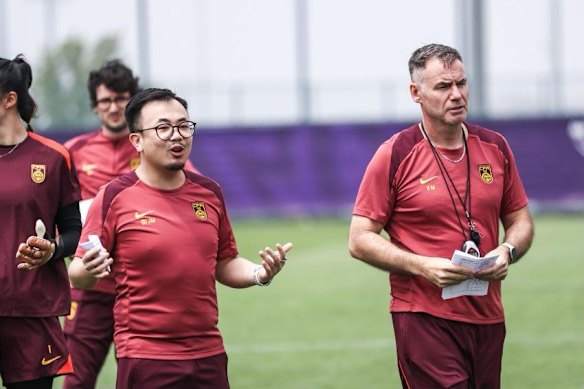
When Ante Milicic started managing China’s women’s football team two years ago, he briefly considered taking Mandarin lessons. Tracy said no.
“I haven’t learned Mandarin because my translator told me that the girls will just laugh at me,” says Milicic, the Australian who coached the Matildas at the 2019 World Cup.
Tracy is the Chinese national team’s translator, and it would not be a stretch to say he is carrying the hopes of 1.4 billion people at this Asian Cup.
China coach Ante Milicic with his interpreter, Tracy Gu (left).
“We just call him Tracy,” says Milicic of Gu Jiangmin, who chose his English name himself in dedication to NBA Hall of Famer Tracy McGrady.
For an English-speaking coach operating in China, the language barrier can be borderline insuperable.
During the boom of the men’s Chinese Super League some 10 years ago, when astronomical transfer fees were luring the likes of Hulk, Oscar, Alex Teixeira and Jackson Martinez, a host of high-profile European and South American managers also made the move with varying degrees of success.
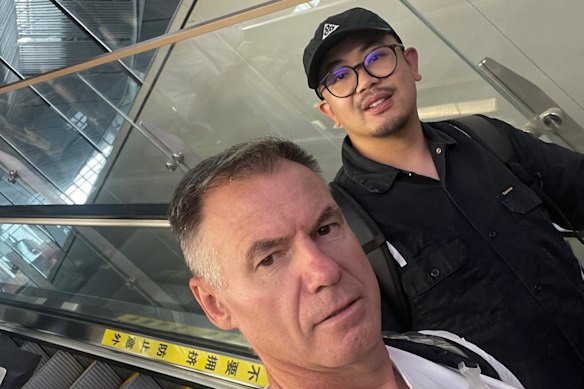
Ante and Tracy enjoy hanging out away from football.
But none of them – not Luiz Felipe Scolari or Marcello Lippi, Fabio Capello or Rafa Benitez – would have had any hope of communicating with their players without a translator fluent in several spoken languages and also the language of football.
Lippi, Italy’s 2006 World Cup-winning manager who led Guangzhou Evergrande to three domestic titles and an Asian Champions League, lamented “the most problematic aspect of working with the team was the difficulty and stress of communication”.
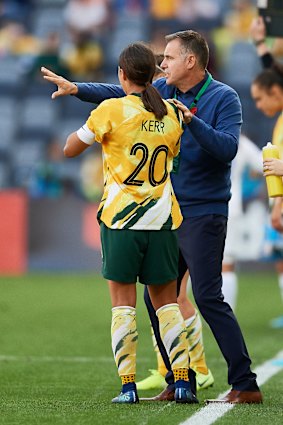
Ante Milicic with Sam Kerr in 2019, during his tenure as Matildas boss.Credit: Getty Images
Tracy worked with Manuel Pellegrini at Hebei China Fortune, among others, and is an indispensable member of Milicic’s backroom staff.
“Your translator is your most important staff member, Milicic says. “He’s so important for me because it’s one thing translating, but translating in football terminology and the speed that he does it is impressive.
“It’s been very consistent because of his messaging, but also I think how quickly he can get that across during a game when you need it to come across. He’s there at half-time as well, even at training and day to day.
“And at the same time, when I travel to all these places [with the team], he organises things very quickly. He’s adaptable, and he’s a guy I can spend time with away from football as well.”
Tracy has also been imperative to integrating Milicic into an environment culturally very different to previous roles in Australian football, including with the Matildas, Socceroos, national youth teams, Macarthur FC, Western Sydney Wanderers and Melbourne Heart.
“When I first started the job, probably one of the first things I did was spend three weeks going over 50 players from the local league trying to put them together, getting clips together, gathering my thoughts. And then when you sit with them one-on-one to introduce yourself, show the clips and talk about the way they play and how you want to play, they automatically think that there’s something wrong, that they may be in trouble … it was just getting them to open up.
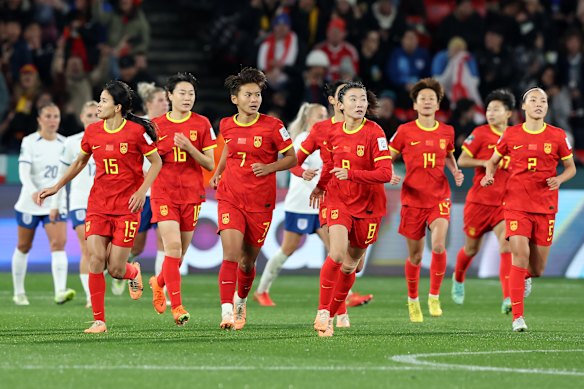
China during their 2023 World Cup group meeting with England.Credit: Getty
“Now when we have individual meetings, you can’t shut ’em up because they really see the benefits … and they are a lot more comfortable now one-on-one speaking than what they would be in larger groups. So that’s just me adjusting to the way they are, which is fine – there’s no right or wrong way.
“Do many of them speak English? A couple of words here and there. Maybe a couple understand more than what they make out they do. What is it … Duolingo? Some of them use it and just giggle and smile at a few words.”
China begin their Asian Cup campaign in Sydney next week against tournament debutants Bangladesh, in a group also containing North Korea and Uzbekistan.
They are reigning champions and the most successful team in the competition’s history, but results since lifting the 2022 trophy in India have been underwhelming. It exited in the group stage of the 2023 Women’s World Cup before failing to reach the Paris Olympics.
China suffered an 8-0 hammering by European champions England in November and arrive in Australia after a month-long training camp in Shenzen ironing out tactics and improving match fitness.
On the surface it sounds like a major advantage over the Matildas, who will have five days to recover from jet lag and prepare for their opener against the Philippines in Perth on Sunday. However, unlike many Matildas stationed at clubs throughout Europe and the US, most of China’s squad play in the country’s domestic league, which Milicic views as a limitation.
“The women’s game is moving very quickly,” he says. “There’s more investment, more popularity, the levels have gone up higher. For countries like China, they have to keep up because the gap is there.
“China and a few other countries in Asia need to concentrate and focus on building players for national teams to play at a higher level. The development in Europe has gone to a different level now and that’s clear for everyone to see when you follow football in that region.”
News, results and expert analysis from the weekend of sport sent every Monday. Sign up for our Sport newsletter.
Most Viewed in Sport
Disclaimer : This story is auto aggregated by a computer programme and has not been created or edited by DOWNTHENEWS. Publisher: www.smh.com.au