
Updated ,first published
The bomb threat that forced the evacuation of Anthony Albanese from The Lodge is the latest sign of a political climate growing steadily harsher, where threats are becoming more frequent, more visible and harder to dismiss as isolated incidents.
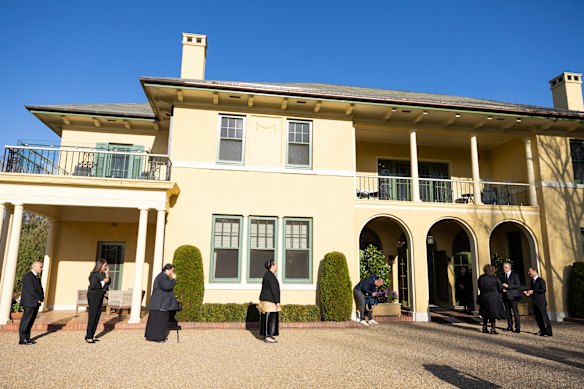
The prime minister was on Tuesday night whisked awayfrom his official residence on Canberra’s Adelaide Avenue, which was later declared safe after a three-hour search by the Australian Federal Police found nothing suspicious. But the episode has sharpened concern about the broader rise in politically motivated hostility across the country.
According to The Epoch Times, an international news outlet with strong links to the Falun Gong religious movement, the threat appeared in an email sent in Mandarin to performers of a classical Chinese dance and music group banned by Beijing and currently touring Australia.
It warned that “large quantities of nitroglycerine” had been planted around Albanese’s official residence, vowing that “blood will flow” and the building would be “blown into ruins” unless scheduled performances by Shen Yun Performing Arts were scrapped.
While the threats appear designed to sabotage the troupe, police have not yet publicly identified the source of the emails.
The AFP investigated 950 politically motivated threats in the 2024–25 financial year – a 63 per cent increase on the combined total of the previous four years – reinforcing intelligence warnings that the risk of political violence is likely to remain elevated.
The Australian Security Intelligence Organisation has also warned that the threat environment is “already flashing red” and expected to stay volatile through the decade, as Australians lose the ability to “converse with civility and debate with respect”.
The targeting is not limited to senior figures. During the 2025 federal election, threats against parliamentarians and candidates reportedly increased by 17 per cent, reflecting intelligence assessments that elections and other democratic events are flashpoints, with heightened visibility increasing vulnerability.
AFP Commissioner Krissy Barrett says that politicians – already subject to a polarised, combustible political climate – are increasingly vulnerable.
Much of the concern centres on the role of social media in accelerating grievance and radicalisation. Barrett told Senate estimates earlier this month she receives a daily report every morning that captures the last 24 hours in terms of threats and offensive, vile communication to parliamentarians.
“You could imagine how long that report is some days,” she said.
A 2023 University of Melbourne study found almost all Victorian state MPs using social media experienced online abuse, predominantly relating to their political positions or general defamatory commentary. Gendered abuse was particularly acute: 85 per cent of female MPs surveyed reported experiencing it.
International analysis aligns with that finding. The Inter-Parliamentary Union has reported rising online gender-based violence against women in parliament globally, with 60 per cent of women surveyed affected by hate speech, disinformation, image-based abuse or doxing.
In Australia, the hostility has been directed at electorate offices. Smashed windows, abusive graffiti and threatening messages have targeted Liberal and Labor representatives alike. An Independent Review of Resourcing in Parliamentarian Offices in August last year found 85 per cent of electorate offices experienced high levels of abusive or violent behaviour from constituents, with nearly half encountering such incidents multiple times per month.
Common incidents included verbal threats, intimidation, spitting and objects thrown at staff. Seventy-two per cent of respondents reported an increase in security incidents. The review pointed to a need for reinforced infrastructure, upgraded surveillance systems and tighter access controls.
Security agencies have responded by strengthening investigative capabilities. In 2025, the AFP created a national team focused on individuals causing high levels of social harm, including those targeting parliamentarians and minority communities. Twenty-one people have since been charged for, among other things, threats to kidnap, kill or maim.
International events continue to influence Australian security thinking. The murders of British MPs Jo Cox and David Amess and assassination attempts on US President Donald Trump are frequently cited by authorities as reminders that political hostility can escalate into lethal violence.
“I think it’s just a reminder to take every opportunity to tell people turn the heat down, for goodness sake, we can’t take these things for granted, just turn it down,” Albanese told an event in Melbourne.
Some parliamentarians have reportedly been advised to reduce public appearances or screen constituent meetings, measures that may gradually weaken direct engagement between voters and their representatives.
Researchers have also warned that sustained intimidation risks discouraging people — particularly women and minority Australians — from entering public office, potentially narrowing the diversity of representation.
Barrett said the AFP has a fixated threat assessment team, which monitors the behaviour of those targeting MPs and senators and determines whether authorities need to intervene.
“That may not always be a police intervention,” she said. “It might be a mental health intervention or some other joint intervention by authorities.”
But technology is complicating enforcement. Anonymous communication channels and globalised social media networks allow threats to spread rapidly beyond traditional surveillance boundaries.
The deeper risk is cultural. If hostility toward public officials becomes normalised, the political system itself may slowly change. Democracy depends not only on institutions and laws but on the shared expectation that disagreement will not be expressed through intimidation.
Liberal deputy leader Jane Hume said a critical feature of Australian democracy was the ability for MPs to be among the community without fear of violence.
“This is a country that is built on civilised debate. That’s how we get to policy outcomes, not through violence and not through threats,” Hume said.
For now, the latest threat against the prime minister has passed. But it sits within a wider story – one in which Australia’s political stability remains intact, even as the social cohesion underpinning it grows more strained.
Cut through the noise of federal politics with news, views and expert analysis. Subscribers can sign up to our weekly Inside Politics newsletter.
 Rob Harris is the national correspondent for The Sydney Morning Herald and The Age based in Canberra. He is a former Europe correspondent.Connect via email.
From our partners
Disclaimer : This story is auto aggregated by a computer programme and has not been created or edited by DOWNTHENEWS. Publisher: www.smh.com.au