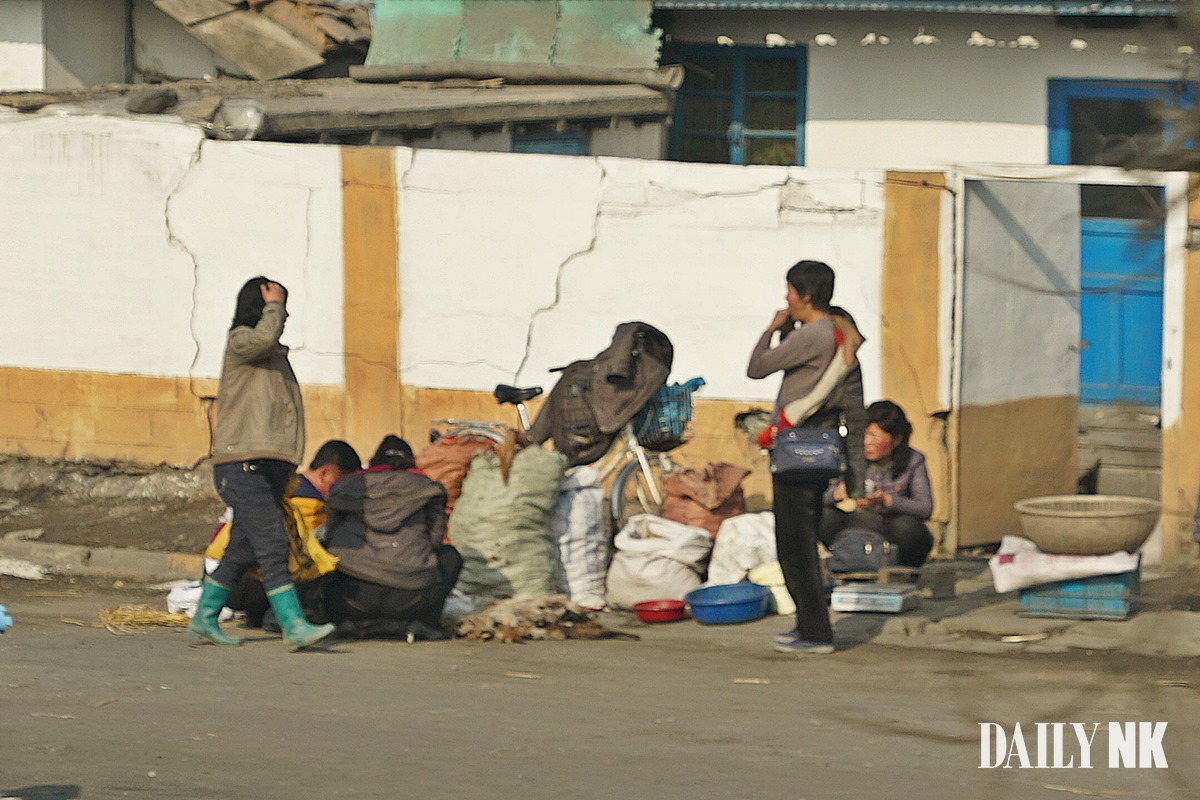
North Korean market prices surged in mid-February 2025 after weeks of decline, as prolonged border restrictions have squeezed supplies of foreign currency and goods across the country, Daily NK’s regular market price survey shows.
According to the survey, a kilogram (2.2 lbs) of rice cost 19,600 North Korean won (approximately $0.48 USD) in a Pyongyang market on Feb. 15, a 29.8% increase from 15,100 won (approximately $0.37 USD) recorded during the previous survey on Feb. 1. In Sinuiju, North Pyongan province, rice reached 19,700 won (approximately $0.48 USD) per kilogram, up 31.3% over the same period.
Corn prices rose even faster. In one Pyongyang market, a kilogram of corn cost 7,300 won (approximately $0.18 USD) on Feb. 15, an 87.2% increase from 3,900 won (approximately $0.10 USD) two weeks earlier. In Sinuiju, the price reached 7,200 won (approximately $0.18 USD) per kilogram, up 89.5%. It was the first time corn had surpassed 7,000 won per kilogram since August of last year.
The sharp price increases follow a rebound in exchange rates, declining grain supplies reaching markets, and growing demand ahead of late North Korean leader Kim Jong Il’s birthday on Feb. 16, one of the country’s biggest national holidays.
Currency crunch drives prices higher
In previous years, grain prices would typically begin climbing after mid-January as demand outpaced supply. This year, however, heavy-handed trade restrictions imposed during major political events such as the Ninth Party Congress pushed exchange rates down and, as a result, dragged import and grain prices lower.
Fluctuations in exchange rates have a direct impact on domestically produced grain prices due to deepening dollarization and yuanization, with foreign currencies serving as a common medium of exchange.
After falling for more than two months since the end of last year, exchange rates for both the U.S. dollar and the Chinese yuan are now rising again. The market exchange rate for the dollar reached 41,000 won in Pyongyang on Feb. 15, up 14.8% from 35,700 won during the Feb. 1 survey. The average yuan exchange rate across Pyongyang, Sinuiju and Hyesan stood at 5,746 won on Feb. 15, up 14.5% from the previous survey.
The tightening of foreign currency supplies appears to be a direct consequence of sustained trade restrictions. A source in Ryanggang province, who requested anonymity for security reasons, said North Korean traders dealing with China have been unable to receive goods or payments from their Chinese counterparts since late last year due to restrictions on border smuggling.
“People predicted that smuggling would restart around mid-January, but with smuggling continuing to be blocked, traders have been unable to receive payments from their Chinese counterparts,” the source said. “Cash isn’t circulating because it’s tied up in China.”
Fuel prices have followed a similar trajectory. Average prices for gasoline and diesel in Pyongyang, Sinuiju and Hyesan reached 49,133 won and 45,733 won per unit, respectively, on Feb. 15, up 22.5% and 19.6% from the previous survey.
If authorities continue to clamp down on border smuggling, exchange rates and prices are likely to keep climbing.
A Note to Readers
Daily NK operates networks of sources inside North Korea who document events in real-time and transmit information through secure channels. Unlike reporting based on state media, satellite imagery, or defector accounts from years past, our journalism comes directly from people currently living under the regime.
We verify reports through multiple independent sources and cross-reference details before publication. Our sources remain anonymous because contact with foreign media is treated as a capital offense in North Korea—discovery means imprisonment or execution.
This network-based approach allows Daily NK to report on developments other outlets cannot access: market trends, policy implementation, public sentiment, and daily realities that never appear in official narratives. Maintaining these secure communication channels and protecting source identities requires specialized protocols and constant vigilance.
Daily NK serves as a bridge between North Koreans and the outside world, documenting what’s happening inside one of the world’s most closed societies.
Disclaimer : This story is auto aggregated by a computer programme and has not been created or edited by DOWNTHENEWS. Publisher: dailynk.com