
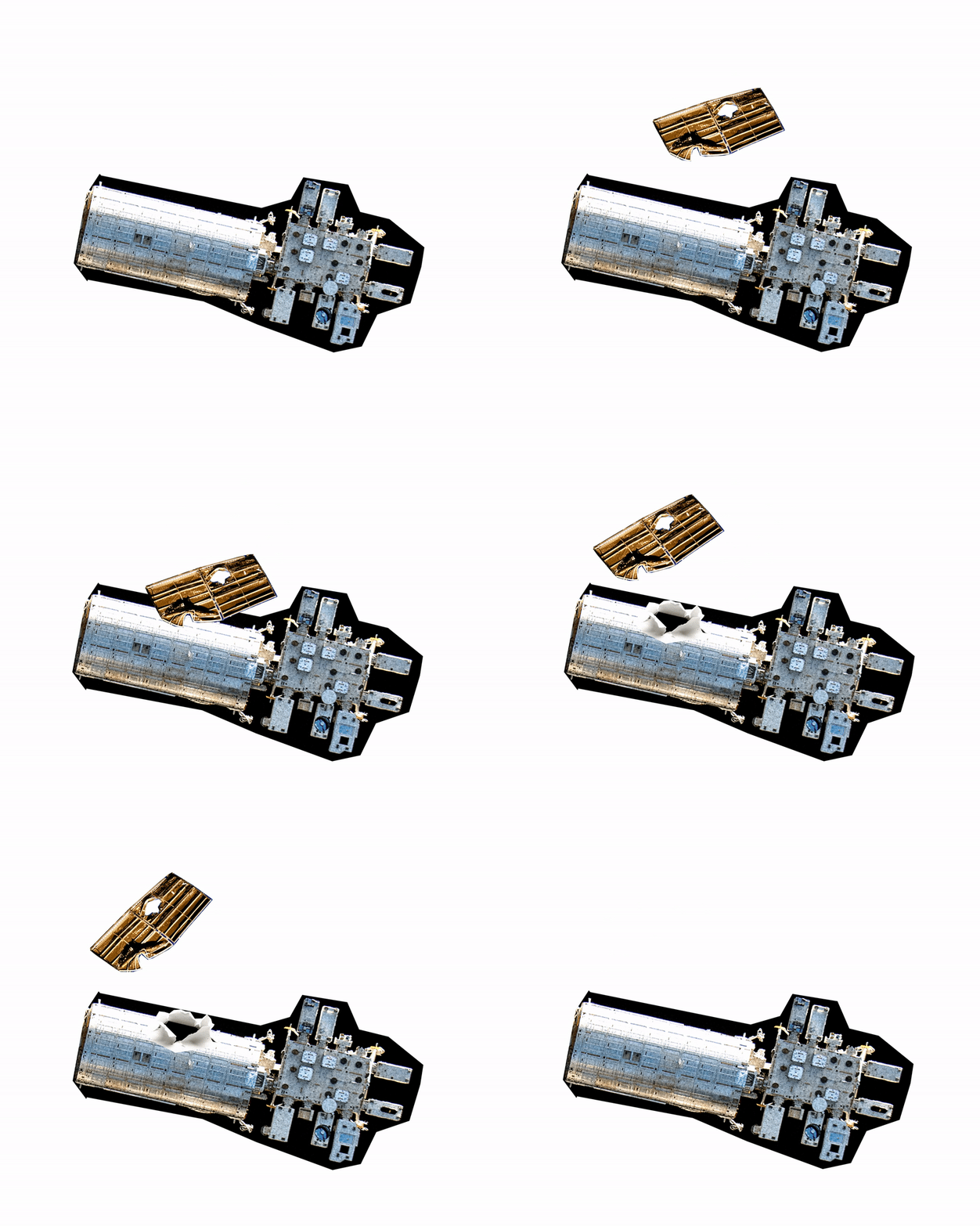
For instance, and this would be very, very bad: a puncture wound.
In the vacuum of space, the amount of debris—spent rocket stages, splintered satellites, micrometeoroids—numbers in the millions, all zooming about, often at 17,000 mph speeds. They’re also constantly hitting each other in a tsuris of exponential littering. Most of these pieces are tiny, and many are not anywhere near the altitude of the ISS. But the area isn’t completely clean.
Debris actually pelts the ISS all the time, and noticeable dents and cracks line the exteriors. But should something fully breach the station, cabin atmosphere will seep into the vacuum of space and alarms will go off. Pressure gauges will confirm to astronauts that the station has, almost certainly, been hit, and the speed of the seepages may indicate how much time the crew has to respond. According to one NASA estimate, a 0.6-centimeter-wide hole leaves 14 hours to plug the leak. A 20-centimeter hole leaves less than a minute.
There is a plan to prevent such a strike—the Space Surveillance Network, a bevy of sensors that the military uses to track space debris. NASA monitors what’s unofficially known as the “pizza box,” a sort of no-fly zone around the ISS. When pieces of debris are predicted to enter the box—if there’s at least a 1 in 100,000 chance of collision—mission controllers order avoidance maneuvers, firing thrusters that move the ISS and dodge the trash. The technique has been used dozens of times since the first ISS module launched in 1998. But the system only tracks about 45,000 larger pieces, and all sensors have noise. Plus, risk thresholds can miss stuff, sometimes badly. In 2025, Chinese astronauts were briefly stranded at their station after debris hit their return vehicle.
The ISS does have its own defenses, of course. Fabric-y buffers envelope some of the systems, and a bumper called the Whipple Shield helps blunt impact. That shield is only built to stop debris up to about 1 cubic centimeter, though, and the debris tracker is only designed to catch pieces 10 cubic centimeters and larger. In other words, there’s a gap in defenses.
Whatever the case, a wounded ISS will have been fairly rotten luck. Back in 2017, scientists from NASA and a Russian space contractor put the odds of this worst-case scenario at 1 in 121. As of late 2025, NASA told WIRED the risk of debris causing a depressurization event in any six-month period was somewhere between 1 in 36 and 1 in 170.
If they have time, astronauts and cosmonauts will look to plug the leak or close the hatch to the leaking section of the station. (That is how they dealt with a minor leak in the station’s PrK module for a number of years, and it basically worked.) Remember, though, that this is the worst-case scenario, and our crew will run into a hard deadline. Once pressure falls to around 490 mm Hg, NASA says, critical systems risk breaking down. Astronauts could suffer hypoxia, oxygen deprivation so debilitating they could become delirious. It will be a heart-wrenching call, but if nothing else can be done, the crew will need to go to their crew vehicles and leave the ISS.
(There are other emergencies that could bring us to this point. One is a fire, which could result from machinery shorting. Another is a toxic ammonia leak. But these are even more unlikely.)
Let’s now imagine that the station is depressurized and, for the first time in decades, empty, operated entirely via computers and remote control. First, NASA and its partners must accept the need to deorbit—there’s no going back to save the ISS. This could be complicated: 23 countries in the European Space Agency, as well as Japan and Canada, are involved in the ISS partnership. And then there’s Russia. The Russians have committed to supporting the ISS only until 2028. But they did agree to help NASA in a contingency deorbit situation.
There is no one single plan for how to abandon ship, since everything will depend on, well, everything. But something has to happen, because a giant piece of space trash will be headed toward Earth—albeit very, very slowly, and with the oversight of the world’s top space engineers and scientists. But still, a worrisome situation. Ideally, the US Deorbit Vehicle, our Dragon, will be ready to shepherd the ISS to the atmosphere, over a safe zone in the Pacific Ocean.

But in the worst-case scenario, the Deorbit Vehicle won’t be ready. Without it, a protocol agreed on in 2024, which relies on the Russian Progress spacecraft, could come into play. There will be vexing trade-offs to consider. Allowing the ISS to descend toward Earth on its own saves gas, which the ISS will need when it’s finally time to eject into the atmosphere and ensure a burial at sea. But a slow descent jeopardizes the machinery needed to maintain remote control.
A controlled deorbit requires the use of several core systems, including those for communications, power, and avionics. Some of the ISS machinery was not specifically certified to perform in a depressurized environment. (NASA believes that critical systems would remain operable, based on technical analyses, and emphasizes that many of these systems are already used in vacuum.) Another thing to worry about: the ISS losing control over its orientation in space. The spacecraft could start tumbling, flipping the station’s solar arrays away from the sun, taking the primary source of power with it.
And no matter what, the plan to use Russian assets remains problematic, since the ISS would have a “shallower reentry,” NASA says, and sprinkle surviving debris over a larger-than-desired area. Still, NASA would retain significant control over where any of these extant shards might plop down. They’ll probably land in the ocean, just as the space agency has always hoped. Sure, the station would have died before its time, but the thing was getting old. Most likely, it will be fine.
But what if it’s not fine? Even back in 1996, before a single component of the ISS was launched into orbit, NASA foresaw the possibility of an even worse worst-case scenario: an uncontrolled reentry. The crux of this scenario involves multiple systems failing in an improbable but not completely impossible cascade. Cabin depressurization could damage the avionics. The electrical power system could go offline, along with thermal control and data handling. Without these, systems controlling coolant and even propellant could break down. Unmoored, the ISS would edge slowly toward Earth, maybe over a year or two, with no way to control where it is headed or where its debris might land. And no, we could not save ourselves by blowing the station up. This would be extremely dangerous and almost certainly create an enormous amount of space trash—which is how we got into this hypothetical mess in the first place.
The atmosphere is a ruthless incinerator, and, no matter how the ISS comes down, most of it would be vaporized. But there’s still that chunk of station that could survive reentry. In the best case, where we’re prepared, air traffic controllers and maritime authorities can issue alerts. The station will shed pieces into the sky, and Australians might get a nice view before things kerplunk into the sea. Then the remains of this historic feat of human engineering will sink to the ocean floor, another carcass left to the algae and the microplastics.

But in the worst worst-case scenario, we don’t have any control. Instead, the station will crack through the atmosphere. Sure, many pieces will likely end up in the ocean, but some might hit people, possibly in a town or a city. The station could break apart across thousands of miles and multiple continents. This would be exceedingly hard to anticipate. As NASA puts it, “Calculating the probability of this penetration cascading into loss of deorbit capability has a very large range of variables, making predictions ineffective.”
This almost certainly won’t happen to the ISS. At the same time, it’s a far more extreme version of the only way an American space station has ever come down. In 1979, after years spent vacant in orbit, Skylab, the US’s first space station, started sinking toward the atmosphere, where it threatened to fall and drop molten spacecraft parts on Earth. At that point, NASA officials had to remotely wake up its computers and, with only limited control of the station, direct it over a location that would endanger the fewest humans.
In the months before, space agency officials were in frequent contact with the State Department, which disseminated the latest predicted trajectories to embassies across the world. In these situations, oops doesn’t cut it: When one of the Salyuts, a Soviet space station model, was deorbited a few decades ago, flaming bits were littered across Argentina, scaring people and requiring the deployment of at least a few firefighters, according to local newspaper reports.
The ISS is far bigger than either the Salyuts or Skylab. In an uncontrolled deorbit, pieces of debris “up to car and train size,” say experts on the official ISS space station advisory committee, will rain down from the sky. NASA confirms this would pose “a significant risk to the public worldwide.”
OK—the nightmare is over. Thus concludes my anxiety-ridden spiral. Here are the facts as they stand in 2026:
As far as WIRED can tell, no one has ever died because a piece of space station hit them. Some pieces of Skylab did fall on a remote part of Western Australia, and Jimmy Carter formally apologized, but no one was hurt. The odds of a piece hitting a populated area are low. Most of the world is ocean, and most land is uninhabited. In 2024, a piece of space trash that was ejected from the ISS survived atmospheric burn-up, fell through the sky, and crashed through the roof of a home belonging to a very real, and rightfully perturbed, Florida man. He tweeted about it and then sued NASA, but he wasn’t injured.
For this story, WIRED reviewed dozens of NASA documents, including backup plans and contingencies for emergencies, and spoke to more than a dozen people, including three astronauts who’ve visited the ISS, and no one seemed that freaked out. One astronaut said the most worrisome scenario that actively crossed his mind in orbit was getting a toothache. The ISS has had some emergencies, including a first-ever medical evacuation in January, but generally things have been remarkably stable. In fact, one of the most impressive things about the ISS is that nothing very dramatic has ever happened to it. No experiment has gone too haywire. It hasn’t been hit by an asteroid.
But there’s also that annoying, gnawing truth: You don’t know what you don’t know. This has, for decades, been an apt adage for describing life in this experimental orbital colony. Eventually, though, different aphorisms will come into play. Yes, it’s true: You don’t know what you don’t know. But we do know that all good things come to an end. And that what goes up must come down.
Mostly. This is because, theoretically, we could still save the ISS and move it into higher orbit. NASA has calculated that propelling the station more than 640 kilometers above Earth would keep it alive for 100 years—and also require at least 18.9 metric tons of propellant. That’s roughly 2,000 airline carry-ons. A thousand years would require at least 36 metric tons. If that doesn’t seem like very much, consider the fact that, right now, no vehicle can transport that amount of gas to the station. The still-in-development SpaceX megarocket Starship might be able to haul a significant percentage, but it would struggle to dock with the station, according to the space agency’s estimations.
Perhaps that’s the biggest irony of all. Space is huge and mostly empty—and yet there’s no easy way to throw things out.
Disclaimer : This story is auto aggregated by a computer programme and has not been created or edited by DOWNTHENEWS. Publisher: wired.com



