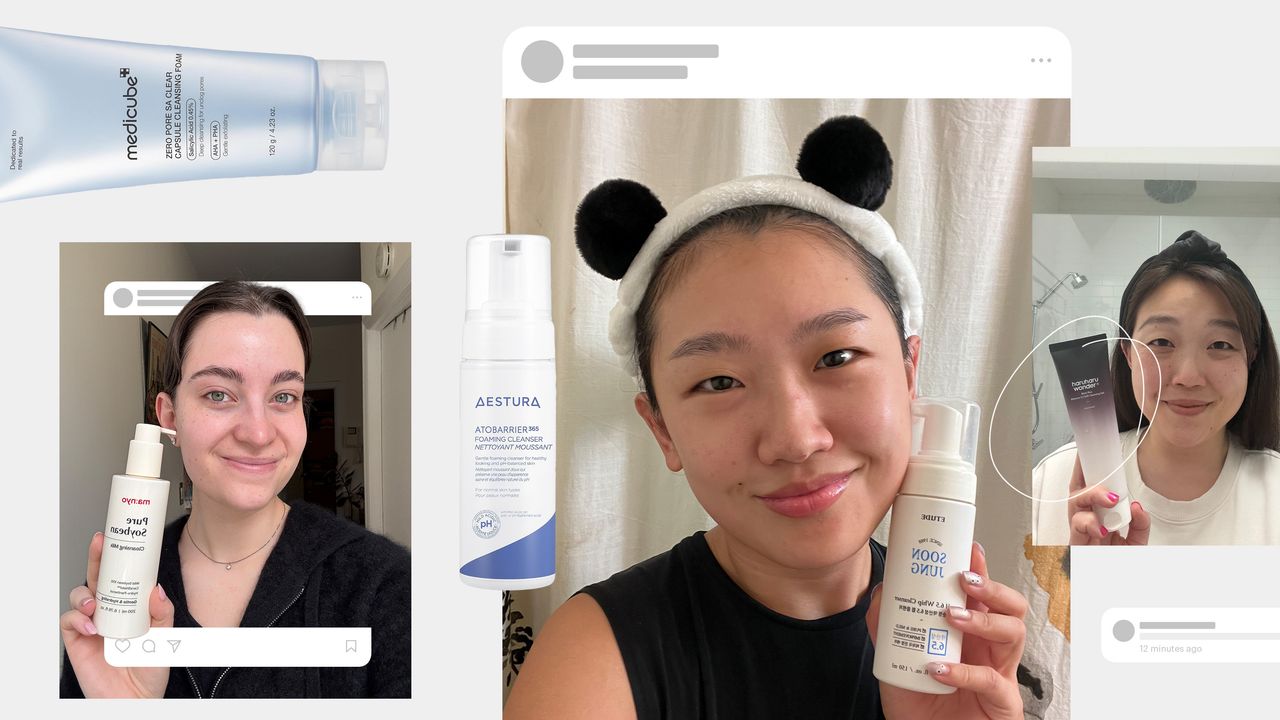
Frequently Asked Questions
Which Korean facial cleanser is the best?
The better question here is: Which Korean facial cleanser is best for your skin type? “Korean cleansers come with a variety of active ingredients that can help with multiple skin types,” says Dr. Chang. “This allows you to customize your skin-care routine based on your skin needs.” If you like perusing ingredient lists, Dr. Chang has a few additional tips to match your skin type to a suitable cleanser.”
Oily skin
For oily skin, it’s important to look for ingredients that help control excess sebum production, reduce clogged pores, and reduce inflammation without stripping the skin of its natural moisture,” she says. “Key ingredients to look for include beta hydroxy acids (like salicylic acid), tea tree oil (which has antibacterial and anti-inflammatory properties), green tea, and niacinamide.”
Dry skin
If you have dry skin, she recommends hydrating and barrier-boosting ingredients, including hyaluronic acid, glycerin, ceramides, and shea butter. Those with sensitive skin should search out “gentle, hypoallergenic, and fragrance-free cleansers” with ingredients like Centella asiatica (cica), green tea extract, allantoin, colloidal oatmeal, licorice root extract, and niacinamide.
If your skin type doesn’t sound like a perfect match for a cleanser but you’re still curious to try, there’s room for experimentation. “Korean cleansers tend to be gentle,” says Dr. Chang. “Even if they include chemical exfoliants, the percentages tend to be low and are typically combined with other skin-calming and -repairing ingredients.” Choi agrees. “Korean cleansers are known for being hydrating and gentle, making them suitable for most skin types without being stripping,” she says. “Many Korean cleansers are formulated to be pH-balanced, typically around 5.5, matching the skin’s natural pH level. This helps maintain the skin’s acid mantle, which is crucial for protecting against bacteria and environmental stressors.” Still, if you have sensitive skin, conduct a patch test first.
What is the Korean cleansing method?
The Korean cleansing method, also known as double cleansing, is “a foundational step in the Korean skin-care routine that has gained worldwide popularity,” says Dr. Chang. “Double cleansing refers to a two-step face cleansing technique, which involves using an oil-based cleanser and a water-based cleanser to thoroughly remove makeup, sunscreen, and other impurities from the skin.” The first cleanse melts away your oil-based impurities, like sebum and makeup. The second takes care of the remaining sweat and dirt.
“In Korea, everyone is obsessed with how to properly cleanse their skin because it’s the first step to the final goal: dewy, soft skin,” explains Cho. “It’s not just a K-beauty staple; many dermatologists recommend the double cleanse as a way to first lift dirt and grime and then properly wash it all away.” Our list above contains both oil- and water-based cleansers so you can build your own double-cleansing duo.
Meet the experts
- Claire Chang, MD, a board-certified dermatologist at UnionDerm based in New York City
- Charlotte Cho, a licensed esthetician and cofounder of Soko Glam based in New York City
- Erica Choi, a licensed esthetician and founder of Superegg based in Seoul and New York City
- Christina Han, MD, a board-certified dermatologist and medical director at Xyon based in Vancouver
How we test and review products
When Allure tests a product, our editors look at it from every angle in an effort to best serve you. We review ingredients, scrutinize brand claims, and, when necessary, examine peer-reviewed scientific and medical studies. In addition to testing each and every product that’s included in each and every review, we rely on experts who shape their fields, including dermatology, cosmetic chemistry, and medicine, to help us vet the ingredients and formulas.
For our list of the best Korean cleansers, we considered each product’s performance across five primary categories: product ingredients and efficacy, packaging, fragrance, texture, and product wear. Every product was determined to have excelled in each category by our editorial team, which is composed of in-house writers and editors as well as contributors—along with special consideration from board-certified dermatologists, estheticians, and brand founders. To learn more information on our reporting and testing processes, read our complete reviews process and methodology page.
Our staff and testers
A beauty product is a personal purchase. You might be searching for a face cream to address persistent dryness or a new nail product to add to your Sunday self-care routine; you may simply be browsing around for the latest launches to hit the hair market. No matter what you seek or your individual needs and concerns, Allure wants to ensure that you love anything we recommend in our stories. We believe that having a diverse team of writers and editors—in addition to the wide range of outside testers and industry experts we regularly call upon—is essential to reaching that goal.
After all, can we really say a skin-care product is the “best” for people over 50 if the only testers we’ve solicited opinions from folks who have yet to hit 30? Can we honestly deem a high-end diffuser worthy of your hard-earned cash if it’s never been tested on curls? We’re proud that our staff spans a wide range of ages, skin tones, hair textures, genders, and backgrounds, which means that we are able to fairly assess any beauty product that comes into the beauty closet.
Disclaimer : This story is auto aggregated by a computer programme and has not been created or edited by DOWNTHENEWS. Publisher: www.allure.com