Sports cards are back in style.
An industry on life support just one decade ago is making a strong comeback in large part thanks to Fanatics buying Topps in a $500 million purchase in 2022, with the sports merchandise giant looking to create core memories for kids as they collect cards of their favorite athletes.
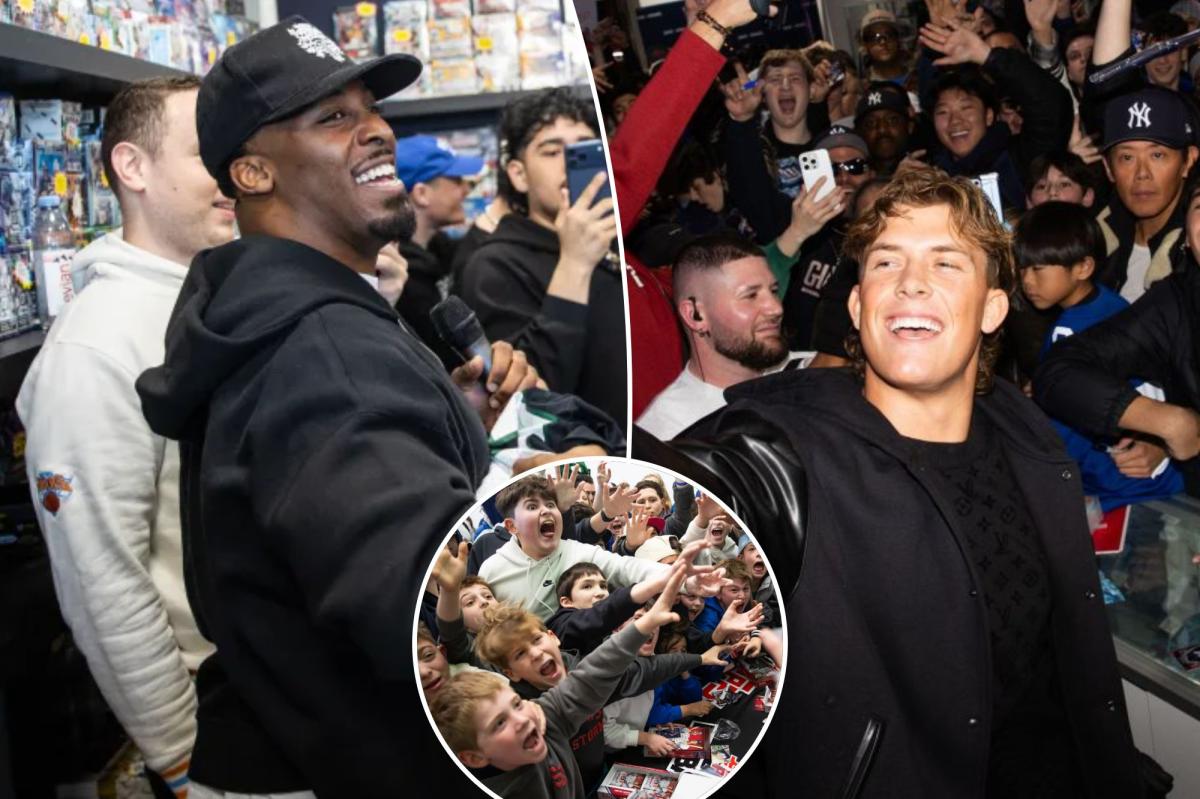
Fanatics CEO Michael Rubin popped in at five shops Saturday, bringing along Jets running back Breece Hall and Giants quarterback Jaxson Dart to entice fans to come to the stores and embrace the hobby.
Rubin’s route started at Grand Slam Collectables in North Babylon, continued to A & S Sports Cards in Westbury, transferred to Long Island Sports Cards in Albertson and made a pit stop at Major Sports Cards in Mineola before concluding at Dave and Adam’s Card World in Manhattan.
“There are many kinds of collectors out there, but the best one is the one who is in it for nostalgia,” Rubin said to a group of parents as kids went wild with free, higher-priced sports card packs being handed out.
Inside Long Island Sports Cards, Rubin walked in alongside Hall to great fanfare, whom he noted has been taking a low profile amid the running back’s pending free agency.
Hall said it was “good to feel some love” from the fans, given all of the uncertainty in his career.
“I really want [my sport card] to say that I am a piece to a championship team,” Hall added. “Whether it’s here or some place else, I just want to be myself in the right situation.”
As for Dart, the line to meet him at Dave and Adam’s Card Store was nearly three blocks long.
Upon entering, Dart removed his black hood to reveal his face — a la Anakin Skywalker in his “Knightfall” moment in “Revenge of the Sith” — and the crowd went crazy.
Dart signed autographs, threw out some cards and told The Post that in 20 years, he wants his sport card to have one thing on the back of it.
“Hopefully there’s an X next to Super Bowl champs,” Dart said.
When asked about the love and support he’s received from New York fans, he said, “This is what you want [when you’re drafted].”
“It was electric walking in here,” Dart added. “I definitely appreciate everyone showing up; it was a lot of fun.”
At each store, Rubin walked in with a loaded briefcase full of high-priced products and graded cards from his personal collection, many worth well over four figures, to give to children who asked a question in the front of the various shops, which were overflowing with kids and their parents.
Christian Ross, a 15-year-old from Manorville who wore a red Buffalo Bills sweatshirt, stepped up to the plate by asking a question about the hobby at the North Babylon shop.
His reward? An innocent-looking, unopened box of four cards called “Cactus Jack,” a limited run from the 2026 NBA All-Star Game that is reselling on eBay for $1,500.
After leaving for Grand Slam Collectables, the Westbury card shop’s owner called Rubin to report the 15-year-old had opened the box and pulled a Cooper Flagg rookie card, currently selling on eBay for $7,500.
That’s a moment Ross won’t forget, but highlights the difficulties these young fans could experience later in life should they continue with this hobby.
Top-priced cards sell for well over five figures, while the lowest-priced products sit in the $20-$40 range.
“Prices are going up for several reasons,” Rubin told The Post. “One, I think as we’ve innovated the product, it’s a much more interesting product. The debut patches and the gold logomans. There’s been a lot of product innnovations and I think there are so many more people in the hobby than there were five years ago. Ultimately, you want to get the cards in the hands of fans who are in it for nostalgia. What we have to keep doing is figuring out how to make the best products. How do we market them the right way? And how do we keep innovating?
“We make boxes that cost 30 to 40 bucks you can buy at Walmart and Target, and we have boxes that cost $25,000 and everything in between.”
The marketing strategy was clear on Saturday, as 800 stores worldwide participated, with 160 athletes present throughout the country. Athletes are the product, and their involvement excites fans.
Rubin, the business mogul CEO, is the mastermind behind a new innovative marketing strategy compared to the “lazy and comfortable” ways of the past.
“Everything that we’re doing is about innovating what the hobby has traditionally done in the past and creating a better collector experience,” Rubin added.
Fanatics has the connections with athletes and leagues to get top stars involved and generate fans’ excitement.
But there’s a bit more to the story from the shop owners’ perspective as well.
Anthony LiPetri, the owner of Grand Slam Collectables, told The Post that his business changed when Fanatics removed the middleman.
Topps had previously awarded accounts to distributors who then sold to card shops.
“It was hard to keep kids engaged in the hobby,” LiPetri said. “You’re buying things from a distributor where (manufacturer’s suggested retail price) is $79.99, and they’re charging you $150, and then you have to charge $179 or $200 for a kid that can’t do that.”
LiPetri, who took over a North Babylon store in 2020 that used to be a GameStop, says he’s had at least 30 percent year-over-year growth at the shop, and he owns three other outlets.
Sports cards as a hobby looks completely different from how it did 10 years ago, and athlete engagement surely seems to be the secret sauce to helping it explode into the mainstream.
Fanatics’ role in creating sports jerseys and immediately turning around for creative, never-before-seen cards, may be the linchpin to navigating that success and not pricing out the hardcore fan.
“Sports cards is art collecting for sports fans,” Rubin said. “Except there are way more sports fans than there are art collectors.”
Disclaimer : This story is auto aggregated by a computer programme and has not been created or edited by DOWNTHENEWS. Publisher: nypost.com