
Roxy King-Clark still bemoans the day she missed meeting Prince William at the pub across from her home, even though it was 20 years ago. I imagine the walls of her home feature framed portraits of Queen Elizabeth II and the newish King Charles because King-Clark is an unashamed royalist – “Rule, Britannia! Britannia rule the waves”, and all that. But she doesn’t live in Britain. King-Clark lives about as far away from Britain as is possible.
The day I arrive in Stanley, an icy wind blows off the Antarctic and makes my eyes water. Little wonder some of the locals here in the Falkland Islands’ capital have skin as rough as tree bark, and that the trees beside the harbour lean sideways. Stanley is closer to Antarctica than to Buenos Aires, the nearest major city.
Less than 3000 visitors – adventurists and wildlife enthusiasts mainly– come to the Falkland Islands each year. Then there are those visitors, like me, on expedition ships travelling further south to the Antarctic Peninsula. Ships schedule visits when there are the least number of visitors here, so we can share the Falklands with the locals who live here.
Antarctica is the reason most of us are here, but the Falklands, well, they’re fascinating.
Aside from Pitcairn Island in the South Pacific – with its history of mutinies and murder glorified by Hollywood – no British colony invokes the sense of mystery these far-flung islands do.
Sign up for the Traveller Deals newsletter
Get exclusive travel deals delivered straight to your inbox. Sign up now.
King-Clark mightn’t agree, but these very British islands feel weirdly out of place beside a continent of almost entirely Spanish speakers.
Two days prior, we left Ushuaia in Argentina, that country’s southern-most city, and our departure point. Locals ate empanadas and dined at asado barbecue restaurants and drank earthy mate tea sipped through a straw. But here, in Stanley, I sit down to a breakfast of black pudding and a pot of English breakfast tea, paid for in British pounds. The contrast is shocking.
The previous day, our ship arrived at West Point Island, on the north-west edge of the Falklands, before dawn and there was an obvious sense of excitement among those on the observation deck. Our 20-day journey to mostly uninhabited islands at the bottom of the world provides few opportunities to mix with the locals.
We anchored, and then huffed and puffed our way up a tall grassy hill to a marshland where colonies of massive black-browed albatrosses nested beside southern rockhopper penguins, high above the ocean.
A local family owns all of West Point Island. In the Falklands, four-fifths of the population live in Stanley. The rest are isolated like this on remote farms in a territory the size of Northern Ireland, but populated by just 700 people (1.93 million people inhabit Northern Ireland).
We never get to meet the farmer or his family. Instead, I peer into a bay, the colour of a New Zealand fjord, watching baby geese fossick for their first meal.
When we steam eastward, to Saunders Island, enormous elephant seals and sea lions and untold numbers of penguins (more than a million penguins live in the Falklands) crowd the beaches, all of them as oblivious to us as the famously tame creatures of the Galapagos Islands.
Here, we meet our first Falkland Islanders, farmers who drive down in their Land Rovers to say hello. They speak in Falkland Islands English, a dialect that’s a blend of West Country English, Scottish and Welsh with some words that sound Kiwi – even a little Australian. It’s an accent you won’t hear anywhere else.
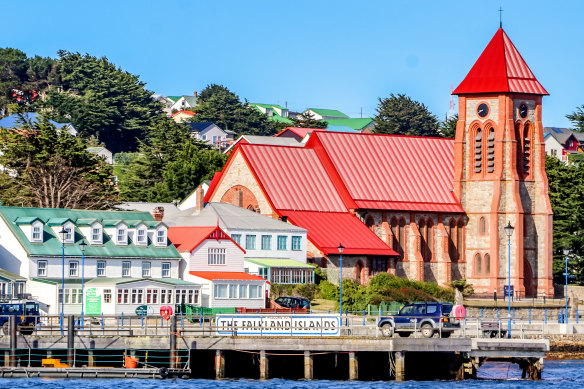
It’s early morning when we drop anchor off Stanley, and from the balcony of my suite the town looks unmistakably, unapologetically, British. I see an Anglican cathedral and rows of white clapboard houses separated by picket fences.
When I arrived in Pitcairn Island by supply ship a decade ago, I was passed like luggage onto a longboat full of tattooed islanders to motor across a reef to an island which was obviously Polynesian.
But in Stanley, it’s like I’ve arrived in Margate or Hastings. Up closer now – as the tender pulls to shore, beside a snoozing seal at the wharf – I see currant red, cast-iron K6 (short for Kiosk No. 6) phone boxes, red pillar mailboxes and a police car with its distinctively British white-coloured background with yellow and blue squares, and red and yellow stripes at the rear. There’s a fish and chip shop, two classic English pubs and guest houses which might’ve floated in from across the Atlantic.
I have a choice of shore excursions today – from wildlife viewing to battlefield touring – I opt for the discovery tour of Stanley. Partly because I’m told our guide will tell us how it really is in the Falkland Islands. Which seems important when you’re visiting islands settled and claimed by the French, the Spanish, the British and the Argentinians, who still want them back.
My guide, of course, is royal-lover Roxy King-Clark, a seventh-generation Islander who greets me with what I’d expect from a Brit (even one 13,000 kilometres from home): “You all right?”
In April 1982, Argentina invaded the Falkland Islands aiming to take back what they believed was theirs and Stanley was where they came first. King-Clark wasn’t born then, but says her parents and grandparents rushed to the nearest stone buildings to hide from the Argentinian soldiers, who were ultimately defeated by the might of the Royal Navy.
“I sometimes wake up in the middle of the night thinking of what I would’ve done,” she says. “Can you imagine? And they still want to take it from us.” I try to imagine, but can’t. This hardly looks like a war zone: a handful of locals sit in their front yards between hedges gossiping as huge gulls circle above; seals swim below in the harbour.
In response to the Argentinian attack, British prime minister Margaret Thatcher quickly sent a naval task force and for 74 days the two nations battled each other with the final death toll reaching 907. More than 20,000 land mines were laid across the islands by the Argentinians and the last of these were cleared as recently as 2020.
King-Clark takes us to the bronze memorial bust of the Iron Lady on Thatcher Drive, along the waterfront. She’s turning green, but I dare not point it out. She then leads us to a meadow beside Thatcher, near Government House. The sun’s out now, warming my cockles: it’s as lovely as an English mid-summer morning.
The 1982 war was not the first hostile outbreak on the islands. In 1914, 300 locals sat right here in this meadow and had a picnic as the British defeated German ships in a sea battle just offshore. And west from here, past the golf course, at the racetrack, in 1966 hijackers landed aboard Aerolineas Argentina flight 648, holding passengers and crew hostage in return for Argentina’s sovereignty of these islands.
“They should know, we’ll always be part of Britain,” King-Clark surmises.
And I get it now – these people, in this place, and why they seem even more British than actual Brits: they’re holding on to their statehood for dear life. They’re 500 kilometres from a country that could invade them at any moment, and 13,000 kilometres from the country that will defend them.
As I walk round Stanley, I note the defiance: Thatchers Gold on tap at the Victory Bar where locals play darts and watch the English Premier League on the telly; the Victorian-era terrace houses in neat rows fronted by gardens of primroses and lupins and daisies; the polytunnels in backyards to protect vegetables, the same vegetables they grow in England, from fierce Antarctic winds.
I’ll soon depart for Antarctica, but these hardy locals in their Land Rovers aren’t going anywhere. “Kids fly off to university in England,” says King-Clark. “But we come back. This is home, our part of Britain.”
THE DETAILS
FLY
Return flights from Sydney or Melbourne to Buenos Aires (via Santiago) with LATAM cost from $2300. See latamairlines.com/au/en.
CRUISE
Scenic’s 20-day Antarctica, South Georgia and Falkland Islands voyage, costs from $44,245 a person, including $9000 a person Super Earlybird savings and a 30-minute bonus helicopter experience. A chartered flight from Buenos Aires to Ushuaia, where the cruise begins, is included. See scenic.com.au
The writer travelled as a guest of Scenic.
 Craig Tansley is a Gold Coast-based freelance travel writer with a specialty in adventure, and a background in the South Pacific.
Traveller Guides
From our partners
Disclaimer : This story is auto aggregated by a computer programme and has not been created or edited by DOWNTHENEWS. Publisher: www.smh.com.au