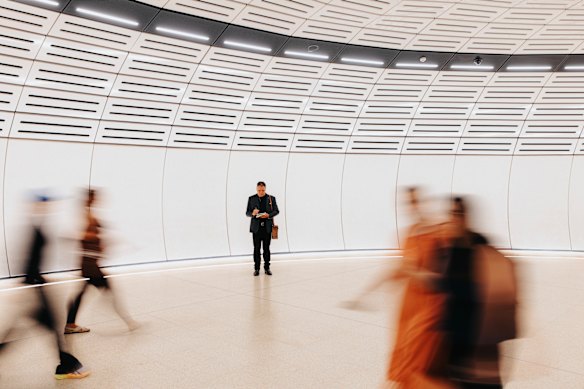
Some guerrilla activists plant trees to green otherwise hot and barren spaces. Architect David George Holm is creating public space by stealth in preparation for a future where another 4 to 5 million people call Greater Sydney home.
As cities grow in population over the next 50 years, every square metre will be precious. If Holm is successful, he will eliminate what a movement in the United Kingdom calls Sites Left Over After Planning, or SLOAPs, including spaces with no purpose or social life, or dead zones in or between buildings.
A principal with Cox Architecture, Holm has been designing additional public space into large projects since reading United Nations forecasts that by 2050, about two-thirds of the world will live in cities.
“We can’t let it fall into place. It has to be very, very strategic,” he said.
Greater Sydney, now about 5 million people, is forecast to be home to 9 million by 2060 and a metropolis of 10 million by 2080.
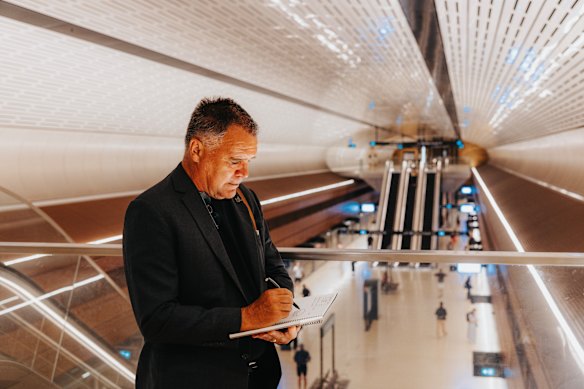
For 40 years, Holm has travelled the world drawing cities and public spaces – a panorama of the new metro station at Victoria Cross in North Sydney took him an hour. For one of the few architects who still draws by hand, it is also a bit of old-fashioned showmanship.
When he travels, he sketches buildings. Lurking on city streets and parks with a small sketchbook and pen in his hand, Holm has been mistaken for a council parking officer in London. In Dhaka, Bangladesh, he attracted curious followers. In Udine, Italy, a woman asked if he would mind her chicken. He did.
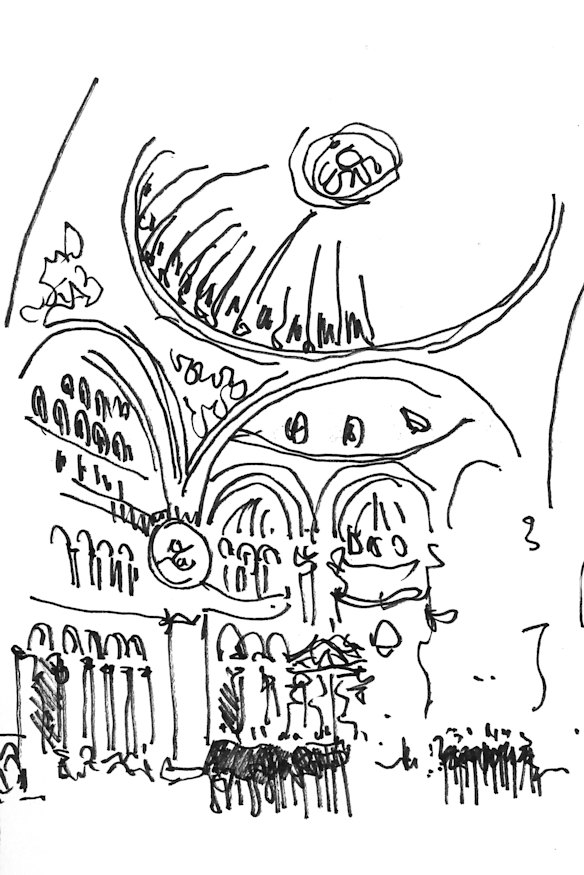
Over time, his fascination turned to the life between buildings documented in his new book, Drawing the City. It includes 500 drawings ranging from Angel Place in Sydney and Otho Street in Inverell, NSW – founded on a grid with many buildings retaining verandahs – to Mumbai’s The Oval, London’s Covent Garden, and Dongchang Wharf in Pudong, Shanghai.
“What I am interested in is the spaces between buildings. Because the architecture can come and go,” he said.
He cited Georges-Eugène Haussmann’s plan in the late 19th century that demolished overcrowded Parisian neighbourhoods, deemed unhealthy. Haussmann created new neighbourhoods often on wide boulevards and squares with parks and squares to bring light and air. Large apartment blocks often featured a central courtyard.
“Over the years, they’ve let buildings decay and go away. [Then] they put in a new building so long as it fits the rules. So you still get the light, you still get the setbacks, and the skeletal structure of the city stays the same, and the street stays the same.”
The team Holm led at Cox pushed the ticket gates back as far as they could when designing the entrance to the Victoria Cross metro station. This created “an unexpected new public place where people can gather. From our point of view, that’s beyond the brief. In many respects, we weren’t asked to do that, but that’s very much part of our agenda.”
He envisages a future when metro stops could be places of refuge on a hot day for anyone, not just those catching a train. More streets and laneways would have gardens and food trucks, every metre left over from planning would find a public use, and the line between what is public and private would be blurred.
“There are so many beautiful churches around the world, and they’re all bolted and closed up. One of my ideas is that as time goes by … is well, why can’t they become more available to the public as well?”
The design for the terminal at the new Western Sydney International Airport, conceived by Cox Architecture and Zaha Hadid Architects, created a large and light-filled space before the security and immigration gates for families who like to come to the airport in big groups to say goodbye.
The idea was to let families enjoy what his team calls “The Great Australian Light”, which will stream in through the large glass windows that face the Blue Mountains.
Holm is inspired by projects such as London’s new King’s Cross station, now refurbished by John McAslan + Partners to include open spaces, new streets, parks, homes, shops, offices, galleries, restaurants and schools.
“It doesn’t just have a function [travel hub], it is a public place as well. We need to do more of that.”
Start the day with a summary of the day’s most important and interesting stories, analysis and insights. Sign up for our Morning Edition newsletter.
Disclaimer : This story is auto aggregated by a computer programme and has not been created or edited by DOWNTHENEWS. Publisher: www.smh.com.au