
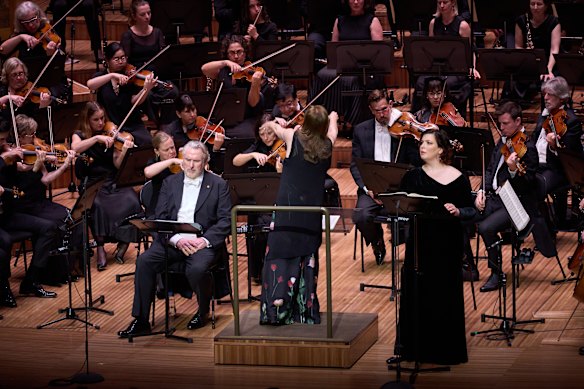
Simone Young conducts Mahler’s Song of the Earth
MUSIC
Sydney Symphony Orchestra, February 25
Reviewed by PETER McCALLUM
★★★★★
Mahler’s Song of the Earth begins with wild craggy upward striving phrases from the tenor, and ends with the mezzo-soprano subsiding in gentle steps of transcendent acceptance – ewig… ewig… (eternal … eternal …)
I’m not sure you’ll hear this better sung this side of eternity.
In the opening Drinking Song of the Sorrow of the Earth, tenor Simon O’Neill mixed his splendid Wagnerian heldentenor sound with colours of self-doubt, while conductor Simone Young measured out the surging rhythms and raucous blaring from the SSO horns and woodwinds as though controlling a petulant steed.
It became a song where lusty vigour glimpses its own delusion but presses on regardless, as though Wagner’s Siegfried had lived to middle age, taken to drink, and started to wonder what it was all about.
In absolute contrast, mezzo Alexandra Ionis sang the descending lines of the second song, The Lonely Man in Autumn, with a tone of velvety sorrow and quiet radiance while the strings threaded a line of murmuring quavers in the background like the measurement of deep time.
The songs continued to alternate between futile vigour and glowing stasis until the final one, The Farewell, in which Ionis, singing with immaculate control and enveloping warmth, and the SSO woodwind, playing with finely shaped restraint (Shefali Pryor, Emma Sholl, Olli Leppaniemi and Todd Gibson-Cornish), conjured luminously spare textures in a line to infinity.
Mahler’s initial inspiration for the work was a set of poems by Hans Bethge paraphrasing Chinese texts on the fragile transience of life, and a similar thought seems to have informed the inclusion of Qigang Chen’s piano concerto, Er Huang, in the first half. The title refers to a melodic type found in traditional Beijing opera devoted to lyrical reflection.
After a Rhythmic Acknowledgement of Country by Adam Manning to formally kick off the SSO’s 2026 season, Jean-Yves Thibaudet began the Debussy-esque opening solo of this work with a tone of subtly nuanced gentleness and depth, progressing to brightly highlighted rapid figuration as the melody moves around the orchestra.
The mood is of nostalgia for something lost, and the refinement and high craft of the orchestration give the sentimental mood a convincingly authentic tone and steer it away from predictability and cliche. In a complete change of mood, by way of generous encore, Thibaudet, Young and the SSO gave a superbly spiky, deftly accented performance of Gershwin’s Variations for piano and orchestra on “I got rhythm”.
Thibaudet got it in abundance.
The Unbearable Sadness of Being
MUSIC
Martin Hayes
Chatswood Concourse Concert Hall, February 25
Reviewed by JOHN SHAND
★★★★½
Martin Hayes excels at enunciating the exquisite sadness of being. Like the trumpet-playing of Miles Davis or the voices of Billie Holiday and Jose Carreras, it’s ever present in the great Irish violinist’s sound and phrasing.
Beyond the airs and laments in which you expect it, he even imbues the jigs and reels – pieces conceived for dancing – with an ineffable wistfulness. It’s as if, for Hayes, the human experience, for all its joy and certainly all its humour, is shrouded in grief and longing.
On previous visits Hayes had the late US guitarist Dennis Cahill with him, firstly as a duo and then as two-fifths of The Gloaming, who gave one of the finest concerts I’ve ever heard, to which their albums give ample testament.
Since then, Hayes formed another band that expands the perimeters of Irish traditional music, The Common Ground Ensemble, and he tours Australia this time with that band’s guitarist, Kyle Sanna.
Just as Miles sought endlessly to recontextualise his trumpet, Hayes does his fiddle, so Sanna is by no means a like-for-like replacement for Cahill. No one could be. Where Cahill’s acoustic guitar drove the up-tempo pieces to the point of explosive excitement, Sanna used a broader palette of harmony and texture on a semi-acoustic guitar, always understanding how little has to be done to frame Hayes’ mastery.
Once he played the simplest ostinato, out of which the violin line gradually took shape as if appearing from a mist. Later, when they came back for two heartily demanded encores, Sanna added some pedal effects to create a liquid pool in which the fiddle’s notes rippled.
A wonder of this idiom is that it brushes away the centuries, making time evaporate as a linear phenomenon. The ancient tunes, as interpreted by Hayes and Sanna, can still scorch the souls of the living, while new ones by Peadar O’Riada (on whose Trathan an Taoide the notes fell like leaves slowly pirouetting in the air) ensure the tradition never stultifies.
Highlights abounded. O’Carolan’s Farewell to Music had Hayes at his most visceral, beginning over a drone effect from Sanna, with the violin building from its usual diaphanousness to a coarser, almost braying sound, and then gradually fading again, with Sanna just cross-hatching the shadows of Hayes’ notes.
On so many pieces, including The Road to Cashel and O’Rourke’s Reel, Hayes’ rhythmic sensibility was stunningly sophisticated, as he draped the tune against the time so it felt impossibly light, yet had myriad little syncopated stings in the phrasing.
And always, as soon as a tune developed the slightest element of drive, his right leg rose and his right foot pumped quarter notes on the stage, earthing the beauty – and probably wearing out his right shoe rather faster than his left.
Good – but not great – Charlotte
MUSIC
Good Charlotte
Qudos Bank Arena, February 25
Reviewed by ROD YATES
★★★
Pop-punk bands don’t die, they just add more pyrotechnics to their live show.
Perhaps it’s a way to compensate for the fact that, 30 years in, Good Charlotte aren’t quite as fiery onstage as they once were.
Luckily, they have a catalogue of pop-punk songs that not only helped define the scene in the early 2000s, but is enjoying a second life as a soundtrack for a generation hellbent on reliving the glory days of their youth.
On that front, the band oblige with a set bursting with hits, from the joyous finale of The Anthem to the new-wave-tinged Keep Your Hands off My Girl and the outsider call-to-arms of debut single Little Things.
To the band’s credit they don’t lean solely on nostalgia, airing material from throughout their chameleonic career, including their eighth album, 2025’s highly enjoyable Motel Du Cap.
The new songs are greeted politely, which is probably the best a band at this stage of their career can hope for.
Album highlight Rejects is as catchy as anything in the Good Charlotte canon.
Pairing Bodies and Mean with a flat Actual Pain from the Generation Rx record, however, creates a mid-set lull from which the show takes a few songs to recover.
It’s hard to pick any glaring issues in the band’s performance, and vocalist Joel Madden and his guitar-playing twin brother Benji strike a welcome note of sincerity when acknowledging that Australia was the first country to embrace them.
And yet, something feels flat.
In its best moments, such as the raucous Lifestyles of the Rich & Famous and I Don’t Wanna Be in Love (Dance Floor Anthem), band and audience come together in a joyous, combustible wave of energy that, though born from nostalgia, feels very much alive and in the now.
Too often, though, the show feels like it’s cruising to its conclusion, the group making their way through the songs in a workmanlike fashion that is, ultimately, fine.
It makes for a show that is respectable rather than spectacular, solid rather than soaring.
Must-see movies, interviews and all the latest from the world of film delivered to your inbox. Sign up for our Screening Room newsletter.
 John Shand has written about music and theatre since 1981 in more than 30 publications, including for Fairfax Media since 1993. He is also a playwright, author, poet, librettist, drummer and winner of the 2017 Walkley Arts Journalism AwardConnect via X.
From our partners
Disclaimer : This story is auto aggregated by a computer programme and has not been created or edited by DOWNTHENEWS. Publisher: www.smh.com.au


