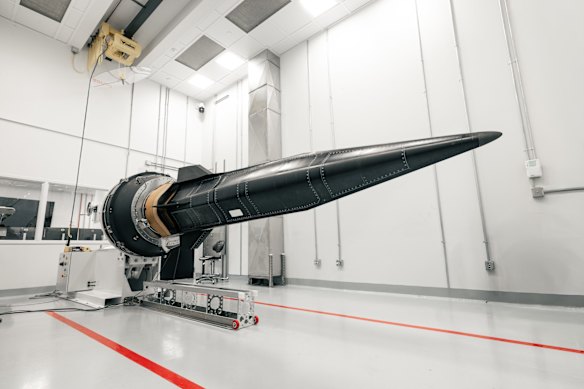

Bad weather on the east coast of the United States has delayed the test launch of a Queensland hypersonic scramjet capable of travelling at 12 times the speed of sound.
Brisbane-based Hypersonix had hoped to launch its Dart AE on a Rocket Lab vehicle from NASA’s Wallops Flight Facility in Virginia on Thursday morning (AEST), in a mission dubbed That’s Not a Knife in tribute to its Australian origin.
But Rocket Lab delayed the endoatmospheric launch, a little more than an hour before its HASTE rocket was due to begin its three-minute mission, due to “out-of-bounds launch commit criteria”.
Once free of the HASTE rocket at an altitude of about 50 kilometres, the Dart AE would have fired its engine and flown east over the Atlantic Ocean.
In a statement issued early Thursday afternoon, Rocket Lab did not elaborate on the cause of the delay.
“Out-of-bounds launch commit criteria means one or more required pre-launch conditions (like weather, rocket systems health, or range safety rules) aren’t met and fall outside safe limits,” a spokesperson said.
“Complex systems and unpredictable factors like weather make delays like these are a normal part of the process, and a delay of hours, days, or even weeks rarely affects the overall mission objectives.
“The priority is always to ‘launch when ready’, not ‘launch on time’.”
Comment was sought from Hypersonix.
The eight-metre, fully reusable, hydrogen-fuelled Dart AE hypersonic aircraft would be used for intelligence, surveillance and reconnaissance missions, rapid delivery and space system testing.
The aircraft’s 3D-printed Spartan scramjet engine, with no moving parts, was designed to propel aircraft to speeds of up to Mach 12.
If successful, the NASA-backed test flight would mark the world’s first sustained hypersonic flight using green hydrogen.
Before the launch, Hypersonix co-founder Michael Smart said the test flight would turn the theoretical – originally conceived in at the University of Queensland – into practical.
“This mission takes our propulsion, materials and control systems into the real hypersonic environment,” he said.
“At these speeds and temperatures, there is no substitute for flight data. What we learn from this mission will directly inform the next generation of reusable hypersonic aircraft.”
A new launch window was expected within days, and would about 24 hours’ notice ahead of take-off.
Along with military and travel applications – including a travel time of two hours between the east coast of Australia and London – the technology could also be used as part of staged payload deliveries to Earth’s orbit.
Start the day with a summary of the day’s most important and interesting stories, analysis and insights. Sign up for our Morning Edition newsletter.
From our partners
Disclaimer : This story is auto aggregated by a computer programme and has not been created or edited by DOWNTHENEWS. Publisher: www.smh.com.au