It was the government that decided it was time for Sierra to die. Sierra, it must be said, was a supercomputer, and so had never really been alive in the first place. But by any objective measure, she lived an impressive life. She resided in northern California at the Lawrence Livermore National Laboratory, where she was minded by dozens of staff at the lab’s computing complex, in Building 453. She completed her final jobs late last year, in October, before she went offline for good. She was 7 years old.
According to the TOP500, which ranks these mega-machines, Sierra was once the second-fastest supercomputer in the world. She was conceived in a Chicago hotel conference room more than a decade ago, at a technical discussion for officials from America’s national labs. The ultimate designer baby, Sierra was assembled from thousands of IBM Power9 CPUs and Nvidia Volta V100 GPUs—a daring, offbeat architecture for Livermore at the time.
Like other supercomputers, Sierra was girthy. She was composed of thousands of compute nodes, stored one on top of another in racks—basically cabinets—that held up her processing innards. She had 240 of these racks, spread across roughly 7,000 square feet. All of this was needed to support her life’s main occupation: performing specialized, super-high-security simulations for the National Nuclear Security Administration. At the time of her death sentence, her processing power ranked a still-respectable 23rd in the world.
Now, why did Sierra have to die? After all, an enormous amount of time and resources went into Frankensteining her together. The leadership of the lab won’t confirm how much she cost to build, but she was expensive—the government spent at least $325 million on her and her fraternal twin, a supercomputer called Summit at the Oak Ridge National Lab in Tennessee. (Summit was decommissioned in late 2024.) Also, she still totally worked. “At the end of the life of a machine, you could think, Oh, we have all these sunk costs. You should just keep running the machine forever,” says John Allen, the lab’s organizational information security officer. But that’s wrong. “Its good and faithful service is over, and we have to move on.”
There are several reasons to say goodbye. One is the hardware’s natural lifespan. Even at birth, certain virginal components are defective, so turning the thing on becomes an immediate experiment in discovering manufacturing errors and replacing those components. Then the machine enters its golden era. Eventually, though, the bulk of the computer’s chips are pushed to the brink, and the failure rate starts to rise again. This cycle of brokenness, from high to low to high again, is what IT experts sometimes call the bathtub curve, and there’s an obvious incentive not to reach the other side of it. “As you age—just like humans—you are likely to get more disease,” says Devesh Tiwari, who researches high-performance computing at Northeastern University. “You are likely to fail more, so you need more caring and feeding.” A related problem is obsolescence, for both the hardware and the software used to operate it. Replacement parts become hard or even impossible to source.
Sierra never got too far into the final phase of the bathtub curb, says Rob Neely, the lab’s associate director for weapons simulation and computing, but she was in danger of getting there. Neither the IBM nor the Nvidia components are still in production, and IBM no longer supports the version of the operating system—Red Hat Enterprise Linux—that Sierra used. “It’s really about resources,” says Ann Dunkin, the former chief information officer of the US Department of Energy, which oversees the national lab systems. “If they had infinite resources, they would run infinite supercomputers.” Seven years is a fairly typical lifespan.
But it is El Capitan, Sierra’s newer and speedier successor (and one-time next-door neighbor at the lab), who most threatened her existence. To the untrained eye, Sierra and El Capitan don’t look very different. They’re both long lines of whirring racks hooked into immense power supplies under the floorboards. But it’s the insides that count. Sierra had impressive components, but El Capitan came online in 2025 with the AMD Instinct MI300A APU, plus a common memory shared across his CPUs and GPUs. He can take up to 36 megawatts to run (compared to Sierra’s 11). That’s enough, the lab says, to power 36,000 modest homes.
Supercomputers can be measured in several ways, but the vital statistic is their ability to perform floating-point operations per second, or flops. Flopping as fast as possible is what makes you successful. At her peak, Sierra could hit 94.64 petaflops—94.64 quadrillion floating-point operations—per second. El Capitan, at 1.809 exaflops, is about 19 times faster. In late 2025, he was officially declared the world’s fastest supercomputer. Sierra’s juice, Neely says, was no longer worth the squeeze.
There was no big red button, no giant lever, that turned Sierra off. Someone could’ve just cut the cords, sure, but that’s not the recommended procedure. First, Sierra’s user scientists were warned, via email, to save their work. Then a DNR was formally instituted—no new parts.
The decommissioning proceeded in phases, starting with the compute nodes and the rack switches—management nodes are last, since they’re needed until the very end. The process involves running scripts that, digitally, shut the computer down, and then hard power switches are flipped off too. There’s also a dehydration. When she was alive, Sierra could get quite hot, so the lab recirculated thousands of gallons of water per minute, funneled through veiny pipes that came up from under her floorboards. As she approached death, that water had to be drained. It was tested by safety staff first, to ensure it was an environmentally healthy pH.
It’s worth saying here that supercomputers can receive more dignified retirements. Some end up donated to other facilities or at museums. They can be auctioned off, as the General Services Administration did in 2024 to dispose of Cheyenne, a petaflop supercomputer built by Silicon Graphics International. But the fact is, there isn’t much demand for old supercomputers, and most are simply stripped for parts. Back in 2013, when it couldn’t pique interest in the whole enchilada, New Mexico opted to break down its state-funded Encanto supercomputer and sell it in pieces. The Argonne National Lab tried to give much of its Intrepid supercomputer, once the world’s third-fastest, to other labs, as well as a computer museum, but there were few takers. Other than a small number of racks that went to North Carolina State, Intrepid was recycled.
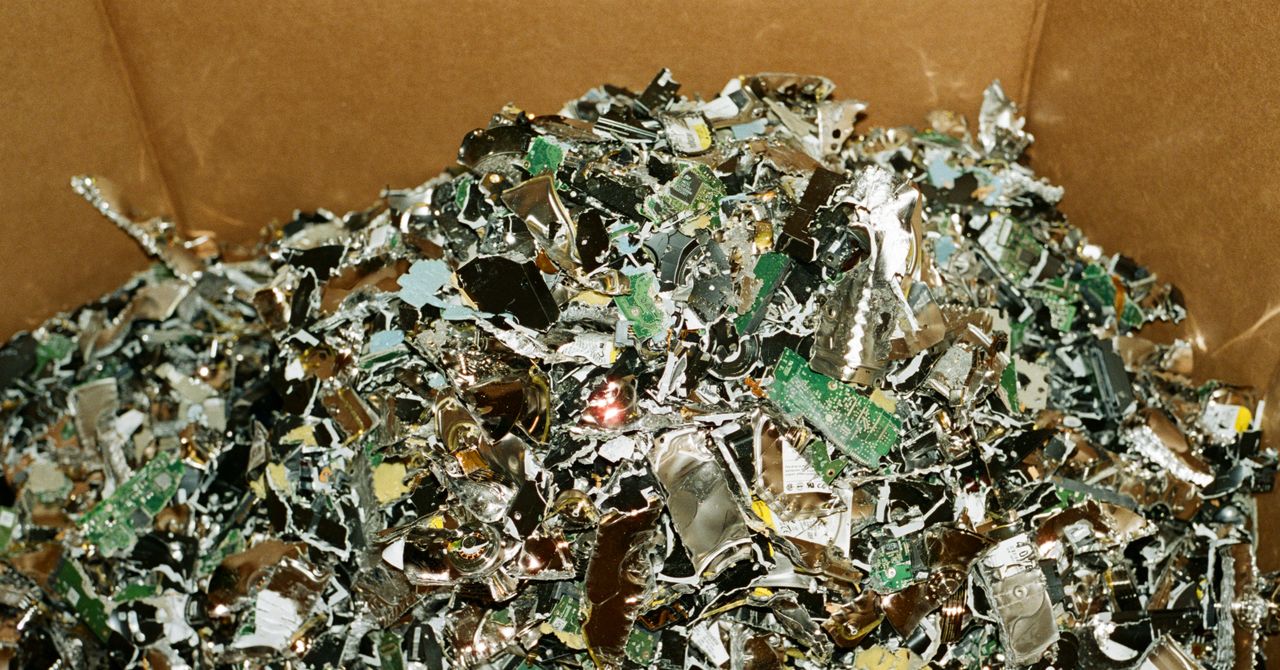
Sierra is being recycled on an extreme scale. She was, after all, designed to support the country’s nuclear stockpile and was therefore chock-full of classified data—the machine can’t just be thrown out. Instead, Sierra had to be beaten down to a pulp to avoid any chance that she might be partially resuscitated and used to reconstruct state secrets. This is a bloody process. Staff, wearing gloves, pull out nodes and remove the lithium-ion batteries peppered throughout. (These will be sent to a specialty battery recycler.) Other parts, like system boards, processors, and the skeletal racks that held Sierra together, are sent for a coarse shredding offsite. Anything that can’t be recycled is, after a solid data-security analysis, destroyed.
Sierra’s flash memory components, however, can store data even without power, so these are ground into a very fine powder. Meanwhile, to dispose of any magnetic drives, the lab keeps a special, government-approved degausser downstairs. The contraption uses a permanent magnet—a material that generates magnetic fields without electricity—to wipe components clean. (The magnet is strong enough to take out nearby credit cards, too, and interfere with sensitive medical devices.)
All together, this process takes a few months and, in Sierra’s case, will be just about finished by the time this story goes to press. In a last step, electricians sever her power supply for good. She’ll be totally gone, except for the cooling and power systems under the floor, along with structural bases the lab uses to protect the supercomputer from earthquakes. These will be saved for her replacement.
There’s no one way to say goodbye to a supercomputer, no engineering eschatology to consult. Back in 2006, Livermore scientists held a retirement party for the ASCI White system, an IBM supercomputer. Neely remembers that the people who actually used the computer were allowed, after a countdown, to flip off little power switches, even though the machine had already been powered down. At the end, cake was served. That same year, a similar ceremony, held in Albuquerque for the Sandia Lab’s ASCI Red, also included cake, adorned with purple flowers, silver ribbons, and a simple message written in icing: “Adios ASCI Red.”
Some people told WIRED they do get sad when the machines die. Others emphasized that it’s the users—the people who actually run simulations—who feel the loss, not the IT department. “I never got, you know, emotionally attached to any of the hardware,” says Larry Baca, a systems engineer at the Sandia National Laboratories. He’s packed up dozens of computers over the course of his career. There’s not much to be down about, agrees Horst Simon, a supercomputing expert who helps run the TOP500 marathon. “While individual supercomputers will die,” he says, the field of computing is “very much alive.”
Until it’s not. There are, experts say, at least two ways this all might come to an end. It’s possible that, one day, it’ll be so easy to sync new hardware up with old software, and new software with old hardware, that there won’t be a need for a discretely new supercomputer—just the same one, with an endless supply of ever better replacement parts. Another, less exciting possibility: We might run out of better, faster chip models to justify new machines. Many fear that Moore’s law is, indeed, slowing down.
For now, though, the end of Sierra will make way for another supercomputer that will almost certainly occupy the floor where she once stood. “It’s just a normal part of life,” says Allen, from the IT office. “It’s like when, you know, your cat or dog is suddenly very expensive and taking a lot of your time and having a lot of problems, right? You eventually have to have these discussions.”
Disclaimer : This story is auto aggregated by a computer programme and has not been created or edited by DOWNTHENEWS. Publisher: wired.com