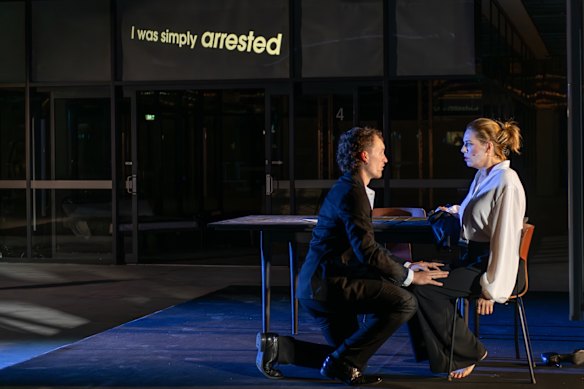

In a glass room in what looks like a semi-abandoned industrial office space people dressed in black are moving about with purpose. Everything about them, however, is slightly wrong. They’re dressed too warmly for this Perth weather: suits, long coats and scarves, and their clothes are somehow out of time.
A man wearing a bowler hat ascends a small staircase that leads to a one-metre drop, turns around and throws his arms in the air. A woman sits on a chair, intensely looking at her hands. Nearby, an orchestra is getting ready to perform – a big gong hangs to one side, and musicians have been trickling into the space for the past 10 minutes.
The audience isn’t quite sure how to take this – after all, the show hasn’t officially started yet. This is the Australian premiere of Philip Glass’ operatic adaptation of Franz Kafka’s The Trial, and the line between performance and reality had already started to melt before we walked through the doors. Tickets were accompanied by instructions on how to find the space, which can only be described as (I’m sorry) Kafkaesque.
We’re ushered through the cavernous venue to the far end of the room, past a temporary hallway formed with sheets of plastic. Once the show itself kicks off, it inhabits the space thoughtfully and completely. Projections play along the walls, a glass-walled office becomes a bedroom then an artist’s studio. Bright lights flare and the cumulative effect is surreal and disorienting, fitting for a story of a man who is put on trial for a crime that is never explained.
In her second Perth Festival as artistic director, Anna Reece has cemented what she accomplished with her first – an event that is ambitious and far-reaching while feeling intimate and pensive. Running for almost a month, finishing up on March 1, the festival brings together music, theatre, dance, opera, visual art and a few things that sit in between, defying definition.
For me, what linked every work I saw was how easy it was to immerse yourself completely in it. In The Trial, you spend two hours locked into a world that takes strange and evergreen truths and reflects them back to us through a fun-house mirror.
Jaha Koo’s Haribo Kimchi sees Koo cook a meal for two audience members while peppering the show with anecdotes and the occasional singing snail. On paper it sounds utterly chaotic; in practice it’s a work that challenged my notions of what home really is – and how you can continue to exist when what you thought was your home disappears forever.
Rampies sny (2022-2026) by Thania Petersen is an artwork that fills an entire room with scent, the far wall covered in small organza bags filled with citrus leaves, infused with frankincense. A bench in the middle is surrounded by speakers playing Jieker (2026) an artwork that shines a light on the connection between the Yolngu people and traders from South Sulawesi. As you sit and listen, your mind begins to look for patterns in the leaves and thinking soon drops away into feeling.
We all have walls in our minds. They’re created slowly, brick by brick, from experiences, from assumptions, eventually forming into structures that tell us what we like or dislike; what we think has value or not. Left unchecked, the walls grow so heavy and tall that we can’t see over or around them, and as a result our worldview shrinks. An arts festival is an opportunity to take a sledgehammer to these walls and challenge yourself. Not just to take a risk on experiencing something new, but in making yourself interrogate assumptions and to challenge your worldview. It’s an opportunity to push our own borders out beyond what would otherwise be possible.
In one night you can go from seeing a tech-infused dance work (U>N>I>T>E>D) to a dance battle on the street, to Snotty Nose Rez Kids followed by Baker Boy at the otherwise disused East Perth Power Station – transformed into a spectacular live music venue for the festival – before karaoke at the Town Hall.
David Finnigan’s Scenes from the Climate Era was one of the most unexpectedly impactful works I saw in my snapshot of the festival. There is a tendency to shut down when the word “climate” comes up, whether through self-preservation or exhaustion, but if the show started off at a disadvantage because of this, it quickly overcame it.
Presented by the West Australian Youth Theatre Company, the show delivers what it promises – a series of scenes set in the past and the future all tied to the theme of climate. It’s neither doom and gloom nor false optimism, however. Instead, it’s a punchy 70 minutes of clever, thoughtful and sometimes unexpectedly funny moments. Ask me what the most heartbreaking thing I’ve seen in theatre this year was and my answer now has to be a man playing a frog that is the last of its species. As the show went on, a couple sitting down the front each took turns looking at the small child sitting between them.
The arts are not just a way to distract yourself – they’re a way of being part of something larger. In a world where it is easy to feel siloed off, where it might feel easier to let our walls calcify, the arts – and festivals like this one – rail against this. Not through preaching or earnest discussion, but by simply showing you what else is out there, that there are other ways of thinking and being.
Elizabeth Flux travelled to Perth as a guest of Perth Festival
The Booklist is a weekly newsletter for book lovers from Jason Steger. Get it delivered every Friday.
From our partners
Disclaimer : This story is auto aggregated by a computer programme and has not been created or edited by DOWNTHENEWS. Publisher: www.smh.com.au