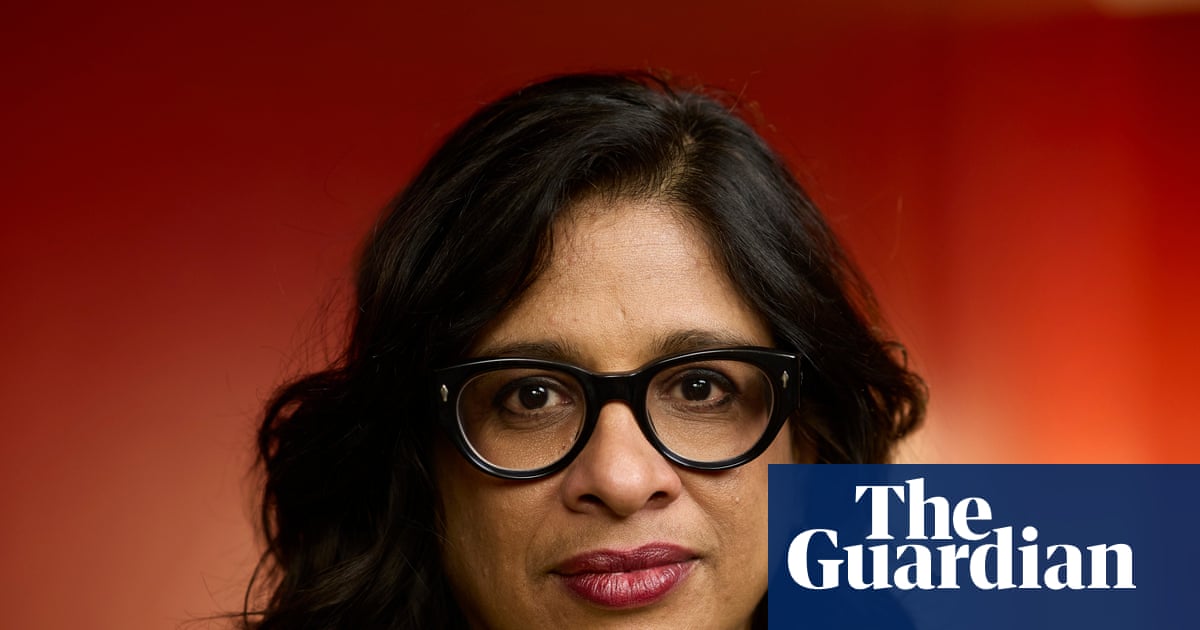
The National Theatre’s artistic director, Indhu Rubasingham, has said conservative theatre-making will kill the industry, even if it helps venues balance the books for now.
Delivering the second-ever Jennie Lee lecture in front of an audience of 200 representatives from the UK arts industry on Thursday, Rubasingham called for a renewed national commitment to backing creative risk and new writing.
“Investing in the arts when money is sparse requires courage. Courage to act, because we recognise what lies ahead if we do not,” she said. “Playing safe will be the end of us. If we are conservative in style, in content, in process, we might balance the books today but we will kill the future of theatre and betray Jennie Lee.
“We are seeing a steep reduction across the sector in new writing. I feel this is the clearest and most troubling sign of what’s happening.”
The Jennie Lee lecture series is organised by Arts Council England and the Department for Culture, Media and Sport. Last year the inaugural lecture was given by the culture secretary, Lisa Nandy, to mark the 60th anniversary of Lee’s groundbreaking white paper on the arts.
On Thursday Rubasingham highlighted research from the National Theatre’s new work department, which showed that between 2014 and 2024 there was a 70% decline in theatres receiving open-to-all submissions throughout the year.
There were also declines of 76% in new writing festivals, 44% in playwriting courses, as well as a 44% decline in new work on stages outside London and 30% in the capital.
“I fear for the decline in the volume and range of voices on our stages across the country,” Rubasingham told the audience at the Dorfman theatre in London. “I fear the effect this constricting and contracting pipeline will have when it hits our stages within the next decade.
“Our failure to mark this moment as a tipping point risks our betrayal of the legacy, pride and heritage of this country – of our leading cultural influencer William Shakespeare, our national playwright.”
She said these trends were “the canaries in the coalmine, signalling a quiet warning about the approaching danger to our democracy, to free speech, to tolerance, to freedom of imagination.”
Rubasingham referenced a world divided by disinformation, populist politics, alternate realities and loneliness. “If sameness becomes the norm, it nudges us only towards what is predictable and profitable. Theatre is becoming one of the few remaining places where we gather and face complexity together, where we embrace nuance.
“I worry that we are losing our capacity to understand each other, to be present, and to tolerate what does not feel comfortable to us.”
Rubasingham’s comments come amid warnings of a sharp decline in productions of new work since the pandemic. In November, the British Theatre Consortium reported a 30% drop compared with 2019, although demand had risen, with new work accounting for 41.9% of theatre attendances in 2023, up from 29.9% in 2019.
In response, the playwright James Graham told the Guardian: “We have a storytelling crisis in our nation. We’re struggling to imagine the next chapter of our national life.”
Disclaimer : This story is auto aggregated by a computer programme and has not been created or edited by DOWNTHENEWS. Publisher: theguardian.com