As officials in Ottawa were preparing for Prime Minister Mark Carney’s maiden visit to India, Canadian police were knocking on a Sikh activist’s door in Surrey, Vancouver, on Sunday to inform him that his life was at risk.
Moninder Singh, who heads the Sikh Federation of Canada, had previously already received three such warnings from the Vancouver police. But this time, citing a confidential informant, police told Singh that his wife and two children were at risk, too.
“I was told to make sure it’s extended to you, your wife and your two children,” the police officer told Singh in a conversation recorded on his home’s doorbell camera.
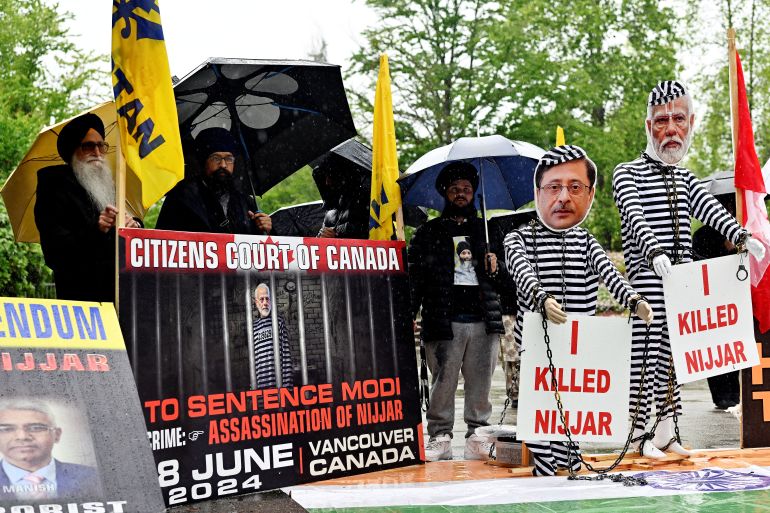
Singh was an associate of Hardeep Singh Nijjar, a Sikh activist and Canadian citizen who was assassinated in Canada in June 2023. The killing caused a massive diplomatic row. Canada accused Indian government agents of involvement in Nijjar’s killing, and framed it as part of an Indian policy of transnational repression targeting Sikh activists abroad.
But, while Singh was informed of the threat to him and his family on Sunday, a senior Canadian government official told reporters in an off-the-record briefing on Wednesday that “India is no longer a threat” to security, two days before Carney was due to land in New Delhi.
This marks a significant shift in Canada’s tone and approach to India under Carney, who is looking to diversify foreign relations to cushion the impact from United States President Donald Trump’s trade war, analysts say.
Observers say Carney’s visit to New Delhi this week could mark the start of a reset of the bilateral relationship, which hit new lows in recent years under Canada’s former Prime Minister Justin Trudeau.
The rupture in ties
The mood in Ottawa had already changed a great deal since Carney succeeded Trudeau to lead the government in March last year.
Advertisement
Under Trudeau, relations between Canada and India had deteriorated to tit-for-tat accusations and the expulsion of diplomats, particularly since the killing of Nijjar in June 2023.
Nijjar was a prominent advocate for a Sikh homeland in the form of an independent Khalistani state in India. New Delhi calls this separatism and views Nijjar and others in the movement as “terrorists”.
Following Nijjar’s killing, pressure mounted on Trudeau from the influential Sikh diaspora in Canada, demanding accountability. In October 2024, during an inquiry into foreign interference, Trudeau said there were “ever clearer indications” that India had violated Canada’s sovereignty by targeting Sikh activists on Canadian soil.
India’s “actions”, Trudeau said, were a “horrific mistake”.
Canada also accused India of interfering in its domestic politics, including by providing funds to politicians whom New Delhi preferred. India firmly rejected the allegations, calling them “preposterous”, and urged Canada to take action against anti-Indian elements operating from its soil – an apparent reference to Sikh activists.
But Nijjar’s killing opened a can of worms for the Indian establishment. In November 2023, the US Department of Justice charged an Indian national with allegedly plotting to assassinate Gurpatwant Singh Pannun, an American lawyer and also a Sikh activist.
Nikhil Gupta, 54, accused of plotting to kill Pannun, pleaded guilty to three criminal charges in a federal court in New York City earlier this month. He faces up to 40 years in prison for admitting to murder-for-hire, conspiracy to commit murder-for-hire, and conspiracy to commit money laundering.
Sikh activists in the United Kingdom were also reportedly warned of a threat from the Indian government.
Trudeau’s approach to the issue, in some sense, had become emblematic of the problem in bilateral ties, said Harsh Pant, a foreign policy analyst in New Delhi.
His confrontational approach “meant that issues that could have been dealt with at the bureaucratic level were elevated to the strategic level”, and it became difficult to disentangle the two, he added.

Thaw in icy relations
When Carney was elected new leader of the ruling Liberal Party in 2025, he replaced Justin Trudeau amid historic tensions with the United States and fears of a trade war with the Trump administration. Carney took the stage, actively looking for new partners to mitigate this threat.
Advertisement
Indian Prime Minister Narendra Modi leapt to congratulate him and immediately called on him “to strengthen our partnership and unlock greater opportunities for our people”.
Soon, Carney had invited Modi to Canada for the G7 summit in June last year, where both leaders met on the sidelines. New envoys in both countries followed. Suddenly, everything had changed in the relationship, said Michael Kugelman, a Washington-based analyst on South Asia.
“There is just more optimism and momentum for the relationship,” Kugelman told Al Jazeera. Under Carney, the Canadian government “recognises that this relationship is too important to let it flounder”.
The commercial incentives for Canada to get the relationship back on track are huge. “And that all starts with changing the tone and the mood,” Kugelman said. Hence, this week’s comments by Canadian officials that “India is no longer a threat”.
Vina Nadjibulla, vice president at the Asia Pacific Foundation of Canada, told Al Jazeera that Ottawa has moved from a public, crisis-driven posture to a more deliberate, step-by-step “reset”.
Under Carney, “the emphasis is on rebuilding structured channels so security concerns – including transnational repression and interference – can be handled through sustained law enforcement and national security cooperation rather than megaphone diplomacy,” she argued.
“Ottawa is trying to do both at once: defend the rule of law at home while advancing areas of mutual interest abroad.”
But Carney’s change in approach does not mean the problem of threats against Sikh activists has vanished.
“Canadian officials definitely still worry about the transnational repression issue, and particularly as legal proceedings continue,” said Kugelman.
The current Canadian government is merely taking a different approach, he suggested: “a more ‘accommodationist’ approach – one that focuses on essentially working through this issue with India”.
Unlike the Canadian officials in their off-the-record briefing, Foreign Minister Anita Anand evaded a direct question from reporters when quizzed about whether India is no longer considered a threat. Instead, she said, discussions on the issues of transnational violence are ongoing at the highest levels of both governments.
New Delhi will also want to address the challenges of “Khalistani extremism”, which will be a challenge for Carney, said Pant, who is vice president of the Observer Research Foundation, a New Delhi-based think tank.

The way forward
On Friday, Carney began his two-day visit to New Delhi, where the two prime ministers are holding talks at Hyderabad House and will review the India-Canada Strategic Partnership.
The Canadian PM is also expected to lock in deals on trade and investment, including on energy, critical minerals, agriculture, education, research and people-to-people ties.
Advertisement
Collaboration in these sectors will define the trajectory of this relationship going forward, said Pant.
Ultimately, the key external factor driving Carney’s visit to New Delhi is Trump’s trade war, said Kugelman. Both Canada and India have seen their relations with the US, a top trade partner, slide since Trump returned to the White House in January last year.
While India has somewhat stabilised its relations with the US this year since trade negotiations reached the final stages, Ottawa and Washington remain at odds over their worldviews and international trade.
“[Carney’s approach] is part of a broader global trend that we’re seeing, countries that have worked with the US for a long time are now looking to strengthen ties with other partners,” said Kugelman. “From the perspective of Ottawa and New Delhi, it’s really a no-brainer that this relationship not only has to get back on track, but it also needs to be put in a position where it can grow even more.”
Nadjibulla of the Asia Pacific Foundation of Canada added that India is key to Canada’s efforts to reduce over-reliance on the US and to diversify its economic and strategic partnerships.
But unresolved issues, like the ones of transnational violence, undermine the durability of now-blooming bilateral ties, she added.
“If unresolved security allegations sit in the background without credible processes and enforcement cooperation, normalisation becomes politically brittle,” Nadjibulla told Al Jazeera. “Vulnerable to the next incident, leak, or court development.”
Disclaimer : This story is auto aggregated by a computer programme and has not been created or edited by DOWNTHENEWS. Publisher: aljazeera.com