In Assam, where the Brahmaputra meanders through floodplains, and the monsoon remoulds the land into shimmering wetlands, Kaziranga National Park has long been celebrated for its one‑horned rhinoceros and prowling tigers.
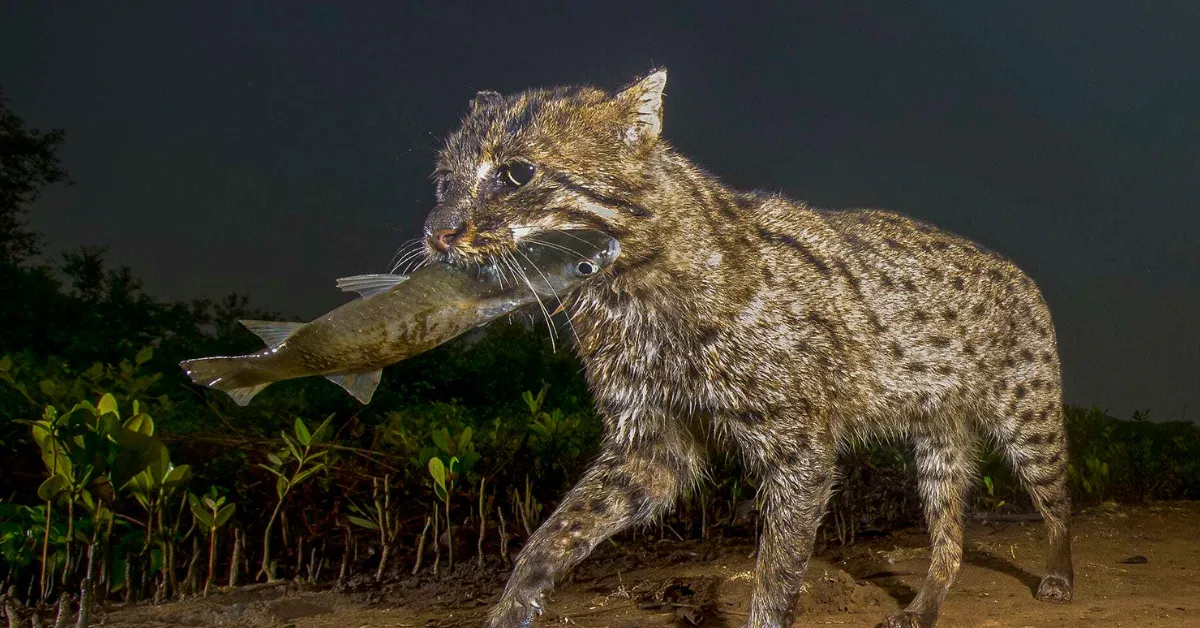
However, in the corners of its marshes and oxbow lakes, a smaller and more secretive predator has been silently making its home. Recent scientific surveys have revealed that the national park is now one of the most important refuges for the endangered fishing cat, a feline that depends on water for survival.
The first scientific assessment of fishing cats in the park drew upon images captured by camera traps originally set up for monitoring tigers.
Researchers identified at least 57 individual fishing cats across more than 450 square kilometres of the park’s floodplain, one of the highest counts from any freshwater habitat in India.
This revelation has shifted how conservationists perceive Kaziranga, showing that the park’s wetlands are not just a sanctuary for large mammals but also for smaller and highly specialised species.
Masters of the marsh
Fishing cats are nocturnal hunters, equipped with partially webbed feet and muscular bodies that make them excellent swimmers. They are adapted to stalking fish and amphibians in shallow water; however, their dependence on wetland ecosystems makes them vulnerable.
Across South and Southeast Asia, these cats face threats from habitat loss, pollution, and hunting, and their numbers have declined in many regions. The growing population in Kaziranga suggests that protected wetlands can offer the safety and resources needed for these elusive carnivores to flourish.
Field surveys conducted during the recent Fishing Cat Day emphasised the significance of the park as a stronghold for this species. Researchers highlighted that the park’s wet alluvial grasslands, shallow beels, and patches of woodland provide ideal habitats where fishing cats can hunt, breed, and raise their young.
Although the current population count may be an underestimation, it establishes a baseline for long‑term monitoring and underlines the role of Kaziranga as a refuge in a rapidly changing landscape.
Wetlands as a window to biodiversity
The findings also offer insights into the health of the park’s freshwater ecosystems. Fishing cats serve as indicators of ecological well-being, and their presence in significant numbers suggests that the wetlands are relatively intact.
/filters:format(webp)/english-betterindia/media/media_files/2026/02/27/kaziranga-fishing-cat-2026-02-27-12-40-24.png)
As climate change and human interventions alter river flows and flood patterns, maintaining such habitats will be critical not only for fishing cats but for the myriad species that depend on these waters.
Kaziranga’s change into a stronghold for the fishing cat is a reminder that conservation is not only about iconic animals but also about the smaller, often overlooked creatures that play essential roles in ecosystems. In the waters and grassy floodplains of this famed park, the fishing cat has found a sanctuary where life persists, hidden yet resilient, in the heart of Assam.
Source:
“Assam’s Kaziranga is a stronghold of the endangered fishing cat as first scientific assessment finds thriving population”: by Rajat Ghai for Down To Earth, Published on 24 February, 2026.
Disclaimer : This story is auto aggregated by a computer programme and has not been created or edited by DOWNTHENEWS. Publisher: thebetterindia.com