On Friday, the 13th of February, Jack Taylor looked at an empty exhibition centre filled with high-performance catamarans and said he no longer suffered from nightmares about any of them breaking.
It was the afternoon before the Auckland Sail Grand Prix, the second event in the sixth season of SailGP and the second year with Taylor as general manager of the technical team. Unlike in other sports’ grands prix, SailGP owns all 13 boats and leases them out to teams to race. As such, Taylor is the guardian of the fleet. If he can’t fix a boat’s problem in time, it will not race.
“Unfortunately, we had a few incidents last year,” he said. “This year, I think we’ll be locked in a bit more with the sailing teams. They’ve been becoming a bit more familiar with these products. So, the nightmares have gone away.”
Still, on that Friday, there were ominous signs that Taylor would have a busy week ahead.
“You look at the forecast for this weekend, and we’ve got 20 to 25 knots, which is quite rare for us, especially over both days,” he said. “I’ve been with the league for a while now, and I haven’t yet come to an event where we’ve had that forecast. So, this weekend’s going to be something that we haven’t seen yet.”
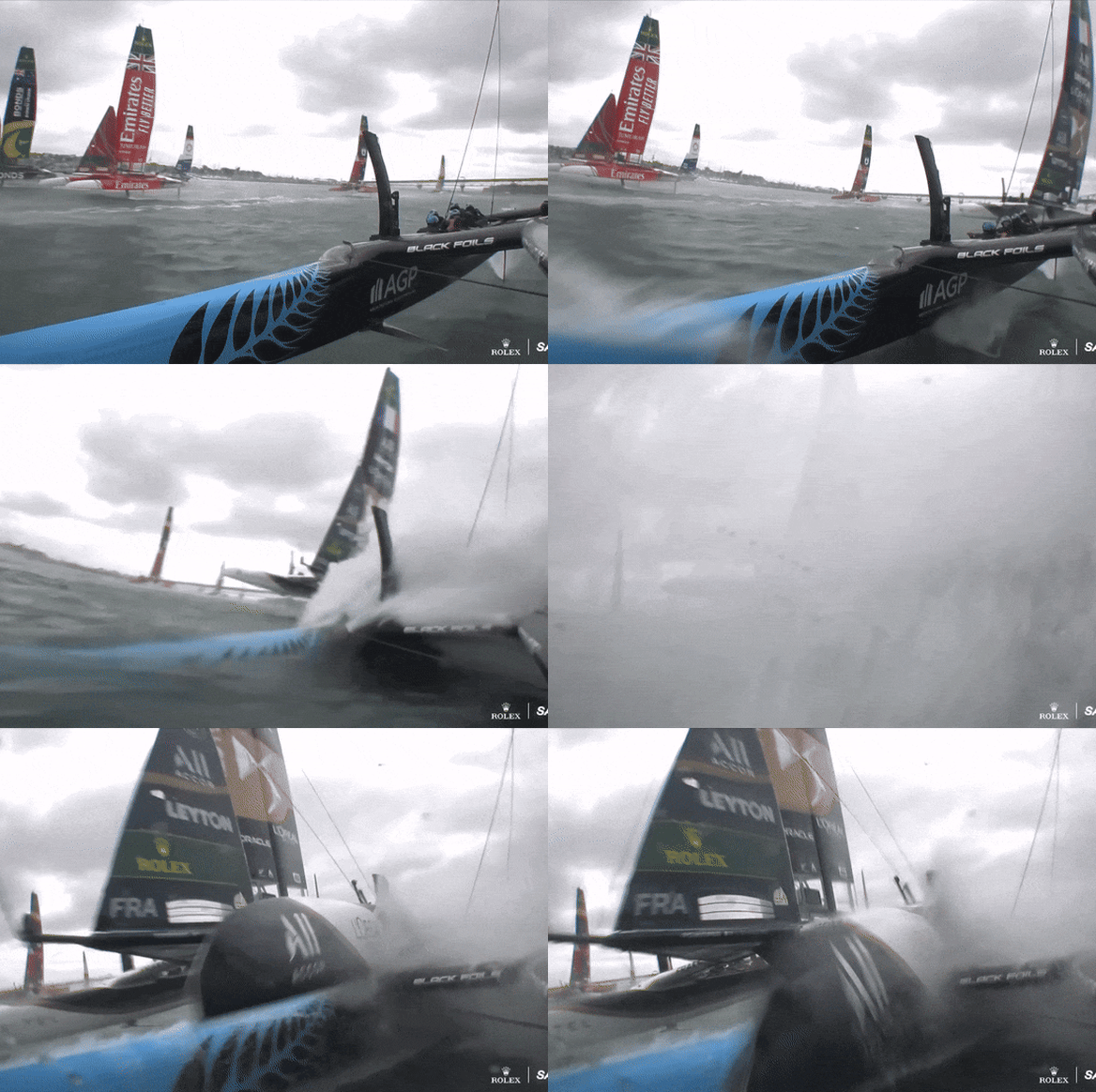
His predictions proved correct. The following day, SailGP saw its worst crash in six seasons. Team New Zealand was travelling at 90km/h when a gust of wind rapidly accelerated the boat, lifting the foils out of the water and turning the boat sideways. France, travelling at 86km/h, couldn’t stop. The hull of the French boat scraped across the Black Foils craft like a blade.
Footage of the French catamaran colliding with the New Zealand boat.Credit: SailGP
Two sailors were hospitalised and New Zealand’s catamaran, which Taylor had only just finished repairing, was significantly damaged, making it irreparable for at least the next event in Sydney and likely much longer.
Taylor’s reprieve from nightmares hadn’t lasted long.
“It’s definitely a hair-raiser every day,” Taylor said. “We are at these events for a week, and there’s not much sleep during that time.”
Anything salvageable from New Zealand’s catamaran will be used to fix the lesser-damaged French boat, and the rest will go back to Southampton, England – a second journey there for the boat in as many SailGP events.

A very broken team New Zealand catamaran is craned out of the water following a collision in Auckland.Credit: Felix Diemer for SailGP
Before this crash, Taylor had spent four weeks orchestrating repairs on New Zealand’s boat after a collision at the season opener in Perth.
Taylor had the catamaran flown to the SailGP workshop and then back to the Southern Hemisphere in time for the next race in Auckland. Similar repairs on a civilian boat would take months. But one day before the catamaran was due to sail again, it was in the water in Auckland’s Waitemata Harbour.
“A lot of the public thought we were dragging it out,” he said of the repairs. “Hand on heart, we were down to the wire.”
It would be in the water for one more day before being craned out as a wreckage.
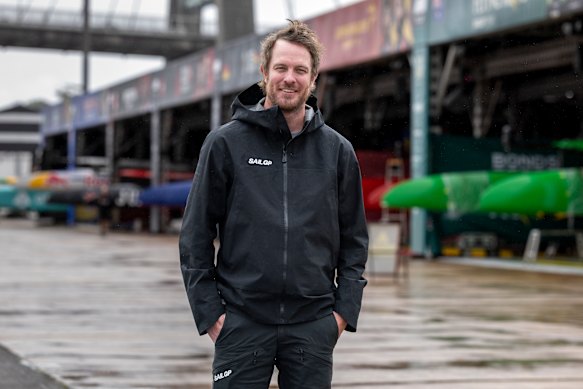
SailGP Technical Manager Jack Taylor in Sydney ahead of this weekend’s races.Credit: Felix Diemer for SailGP
Even if all the boats are working, Taylor’s job involves walking another wire – shipping all 13 catamarans to 13 events in 13 different cities. He uses an app that tracks cargo ships across the world, watching as his cargo crosses oceans, sometimes on time, sometimes late.
When each vessel arrives in a new city, it comes packed in four shipping containers. Taylor then choreographs their reassembly and craning back into the water while keeping them in one piece.
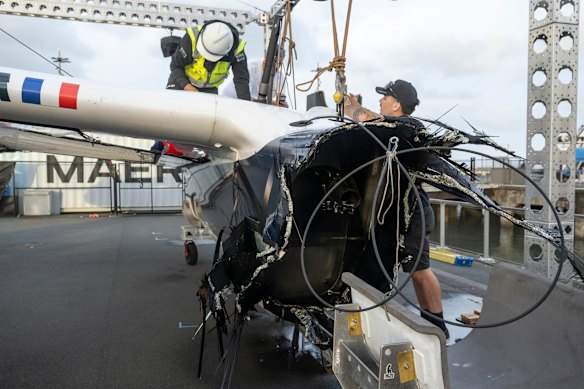
The damaged hull on Team France in Auckland.Credit: James Gourley for SailGP
“Sometimes we do have to think on our feet, and we do have to do things we wouldn’t normally consider doing,” he said. “A prime example of that was in Sassnitz [Germany] … We actually cut into the USA boat because they were at fault, and we took a section of that boat and placed it into [Great Britain’s] boat and glued it in for the next day of sailing.
“It’s not often that we go into a perfectly good boat and cut something out, but that’s one of our playbook moves now.”
Even when the boats are operating as planned, and Taylor has no fodder for nightmares, he has another objective to chase: how to make them even faster.
“The big one is the 100 club. So, 100km/h,” he said. “Every boat is trying to get into that club.”
A SailGP boat officially broke 100km/h midway through 2024 with the addition of T-foils to Canada’s boat, later added to all boats for the start of season five last year. But with more boats at greater speeds, Taylor’s job becomes harder.
This masthead travelled to Auckland as a guest of SailGP.
Most Viewed in Sport
Disclaimer : This story is auto aggregated by a computer programme and has not been created or edited by DOWNTHENEWS. Publisher: www.smh.com.au