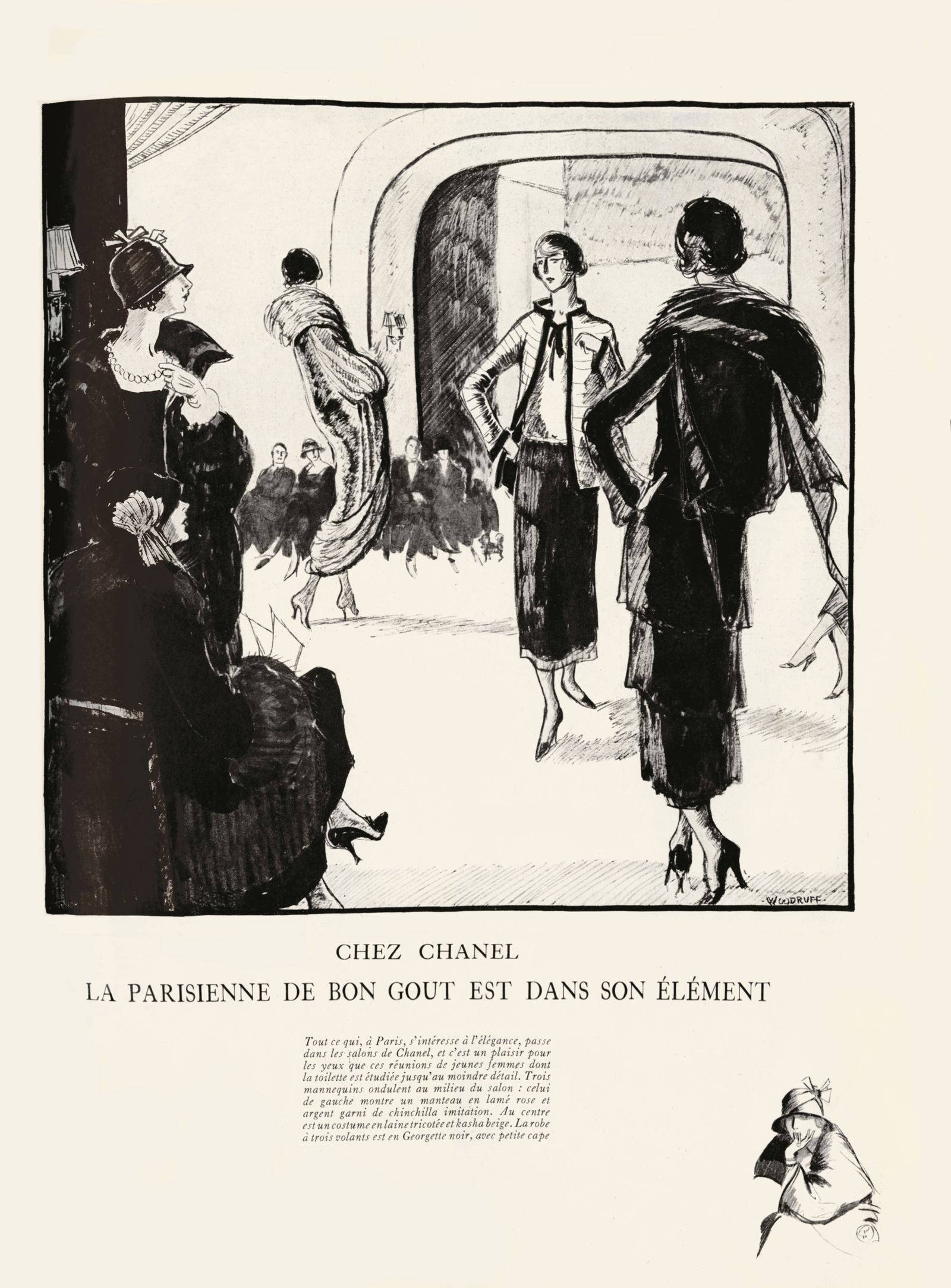
The authors point out some striking synergies between Chanel and Vogue. Chanel opened her first boutique, for hats, on 21 rue Cambon in 1910 at about the same time that Condé Nast, who acquired Vogue in 1909, started putting his own stamp on it. Diana Vreeland left Vogue in 1971, the year Chanel died. And Karl Lagerfeld was appointed creative director of the house in 1983, 100 years after the founder’s birth. Both Chanel and Vogue became ingrained in the fabric of popular culture, and both, Tuite writes, “understood self-promotion, protecting their image, building their prestige and recognition, and bolstering their own storylines to assure their legends preceded them.”
Excellence was the value assigned to the magazine, but there wasn’t a single person associated with the title. In contrast, Chanel the woman was as much as source of fascination as Chanel the brand. In the first chapters of Chanel’s career—the designer closed her atelier and moved to Switzerland during World War II—Chanel was associated with modernity in her person; the second time around with her spirited design.
Just as Paul Poiret’s corset-less, straight-lined pre-World War I silhouettes superseded Charles Frederick Worth’s controlled and curvy 19th century look, so Chanel would take the place of Poiret after the War. Tuite writes: “Of the pre-1914 wardrobe, Chanel would later recall, ‘Woman was no more than a pretext for riches, for lace, or sable, for chinchilla, for materials that were too precious.” That’s Poiret all the way: he put women on pedestals. Chanel was designing for herself and she eschewed decoration in favor of function (utilitarian pockets, for example) and movement. She made faux jewelry acceptable and used humble fabrics to make luxury garments. In 1957 Time declared that Chanel “invented the genre pauvre, or poor look. [She] put women into men’s jersey sweaters, created a simple dress based on a sailor tricot.” (In his debut collection, Matthieu Blazy made reference to Chanel’s preference for jersey by having knit underwear peeking out of waistlines.)
Chanel was associated with movement and youth, with sport clothes and the outdoors. “Women’s lives were changing in real time” Tuite writes. Chanel was adapting to those developments in cloth while Vogue was putting them down on paper. Horst P. Horst once said that Nast’s support of artists led to the creation of fashion photography as its own genre. “‘Make Vogue a Louvre,’” Edward Steichen, who was on contract to the magazine, once wrote to editor-in-chief Edna Woolman Chase. Chanel, too, contained multitudes. Not only was she her own best model, she had a head for business. In photographing Chanel at home, Vogue demonstrated how her style was absolute.
Disclaimer : This story is auto aggregated by a computer programme and has not been created or edited by DOWNTHENEWS. Publisher: vogue.in