PAVLOHRAD, Ukraine — Four years into Russia’s full-scale invasion, Kyiv says it is now killing or wounding more Russian troops each month than the Kremlin can replace — a shift they argue could change the war’s trajectory.
The Ukrainian Ministry of Defense’s latest figures are staggering: 65,000 Russian troops killed or wounded over December and January alone, according to Kyiv — a number exceeding the roughly 58,000 US troops killed during the entire two decades of the Vietnam War.
Some estimates have the ratio as high as 27 Russian losses for every Ukrainian killed.
While The Post was unable to independently verify the figures, the highly digitized, drone-saturated nature of the war has made battlefield losses easier to document than in past conflicts, with many strikes captured on video.
Kyiv does not disclose its own casualty figures. The total number of casualties (killed, wounded, and missing) is at least 1.2 million Russians — which is the most of any major power since World War II, a late-January report by the Center for Strategic and International Studies found. In comparison, Ukrainian forces suffered somewhere between 500,000 and 600,000 casualties.
Looking at deaths alone, between 100,000 and 140,000 Ukrainian troops have been killed since the war began, and roughly 325,000 Russian troops have died, CSIS found.
Even though Kyiv wants peace, Russia has so far been unrelenting in its determination to keep sending soldiers into Ukraine. In the meantime, Ukraine’s Deputy Defense Minister Yurii Myronenko told The Post this week the goal for summer is even more ambitious — inflicting up to 50,000 Russian casualties every single month.
“We’re not stopping,” he said with a steely resolve. “The task is clear: we will keep killing Russian soldiers and make it impossible for them to continue this war.”
The change comes after a shakeup in the Ukrainian government, with the nation’s energetic, young drone czar Mikhailo Federov — formerly minister of digital transformation — becoming the country’s new defense minister last month.
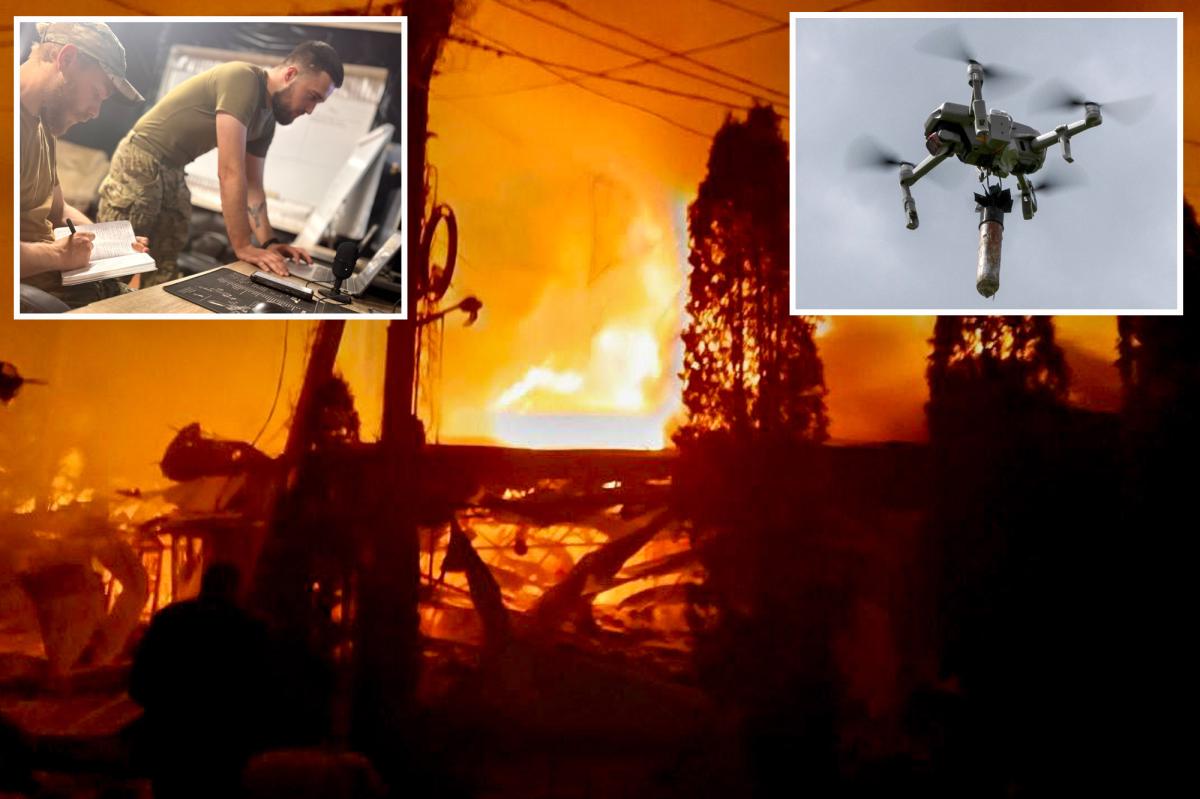
The Post spent Friday with a unit in the Ukrainian Armed Forces’ “Spartan” brigade as they hunted for Russian troops across the countryside — not from trenches, but from a heated command room lined with screens.
About 25 troops sat in a dim room, scanning dozens of live feeds for sudden movement — a flicker in a tree line, a shadow in the rubble of villages that were once home to thousands of people now buried beneath them or evacuated far away.
The Kremlin’s strategy, according to a soldier known as Anatoly, is a numbers game — pushing waves of troops into what Ukrainian soldiers grimly describe as a “meat grinder,” attempting incremental advances in the east regardless of cost.
While Moscow shows little regard for humanity in its war, it shows about the same amount for their own troops. They have shown a willingness to absorb heavy losses, and Ukrainian troops who watch their deaths daily say the burden appears to fall mostly on poorly supported infantry units.
Outnumbered roughly five to one in drones in some sectors, this unit says it has managed to blunt Russian assaults through coordination and experience.
“They send them one by one, spread out over a wide area,” Anatoly said, squinting at a drone livestream sweeping over a forest. “They don’t care if they come back, only that they go forward.”
Modern warfare has transformed the battlefield. Drones now allow both sides to spot enemies miles away — and in some cases intercept each other’s live video feeds, creating a surreal contest of surveillance and counter-surveillance.
“It is hell, because we see that they have a huge advantage over us in terms of drones,” Ivan said. “If we compare our number of drones to theirs, it’s something like one to five.”
“Sometimes we detect up to 300 drones in just our sector, which is only five kilometers,” he added.
Even so, Ivan said his unit believes it could meet the defense ministry’s goal of 50,000 Russian casualties per month by summer, arguing that winter conditions — not battlefield limitations — are currently slowing Russian troop movements.
The Ukrainian military is also seeking to expand its technological edge, with plans to integrate artificial intelligence more deeply into drone operations. According to Myronenko, roughly 90% of successful Ukrainian strikes are now carried out by unmanned aerial vehicles.
“These drones allow us to strike deep behind enemy lines,” Myronenko said.
The pace of fighting remains intense. In the Donetsk region alone, Ukraine estimates Russia is losing roughly 600 troops per day — or more than 18,000 per month — though those figures could not be independently verified.
“They can’t replace these losses,” Myronenko said. “Even with reinforcements, Russia cannot afford these kinds of casualties.”
For example, Ukraine estimates Russia recruited roughly 22,000 new troops in January but suffered approximately 30,000 casualties during the same period.
But Ukraine’s strategy extends beyond battlefield attrition. Myronenko said Kyiv is increasingly targeting Russia’s economic lifelines, particularly its oil infrastructure.
“We’re going after their economy,” he said. “Without oil revenue, Russia can’t fund its war.”
Ukraine’s long-term ambitions are expansive. By mid-2026, officials say they aim to field up to 1 million service members and deploy as many as 9 million unmanned aerial vehicles. Systems such as the Delta situational awareness platform allow commanders to track and strike enemy positions in near real-time.
Myronenko said Ukraine’s military transformation is still underway.
“We’re developing a whole new way of fighting,” he said. “This isn’t just about bullets and bombs. It’s about tech, strategy and precision.”
As Ukraine sets its sights on dramatically increasing Russian casualties, Myronenko framed the campaign as existential.
“This war is paid for by our blood and [Europe’s] money,” he said. “But we are learning, we are growing — and we intend to win.”
Disclaimer : This story is auto aggregated by a computer programme and has not been created or edited by DOWNTHENEWS. Publisher: nypost.com