A letter signed by most of the Matildas squad calling on the Asian Football Confederation to increase prizemoney for the Women’s Asian Cup has been dismissed, with the continental governing body claiming it does not receive enough revenue through women’s football.
This is despite a projected possible revenue of US$82.4 million ($115 million) from the 2026 Women’s Asian Cup, and a prizemoney pool of US$1.8 million.
Twenty-four Matildas players, including captain Sam Kerr, joined members of the India, Japan, South Korea, Philippines, Taiwan and Uzbekistan teams in formally requesting Asia’s top international tournament allocate prizemoney equal to the men’s equivalent and a guarantee that at least 30 per cent be paid directly to participating players.
Submitted on December 22, 2025, they also called for equal and identical regulations and conditions to the men, plus shared legacy initiatives to support the development of women’s football in Asia and Oceania.
The 2026 Women’s Asian Cup prize fund offering of $1.8m is unchanged from the 2022 tournament – the first time the world’s oldest women’s national team competition introduced prizemoney.
The prize pool, which is the lowest of all confederation championships and pales in comparison to the 2025 Women’s Euros pot of $47.2 million, is allocated only to the top four teams and there is no participation bonus.
In contrast, the AFC allocated $14.8 million in prizemoney for the men’s Asian Cup, with all 24 teams – including the Socceroos – awarded a separate participation fee of $200,000.
The AFC’s recently introduced continental club competition, the Women’s Asian Champions League, boasted a prize pool of $1.5 million dedicated to the winners and runners-up, while every other team was given $100,000 just for making the group stage.
On January 16, the AFC responded to the players’ requests via a letter to the general secretary of FIFPro Asia/Oceania, Ms Shoko Tsuji.
The AFC general secretary, Datuk Seri Windsor John, stated that the AFC had made “significant investments in women’s football” including “record high prize money”.
That was, he wrote, “even though revenues from the women’s competition are still not able to fund all the activities.”
The AFC has invested more money into the 2026 Women’s Asian Cup than any previous edition, with a budget increase to $21.7 million from $7.7 million in 2022. It is still less than the $36.7 million spent on the 2023
men’s Asian Cup.
According to a report commissioned by FIFPRO Asia/Oceania and conducted in early 2025 by sports intelligence agency Gemba, the tournament should be able to generate a projected sum of $82.4 million, not including government support.
That includes $31.1 million in sponsorship and $11 million from media rights and broadcast. Former Matilda Sarah Walsh, the tournament’s chief operating officer, said the event had already generated unprecedented sponsor support as of late December 2025.
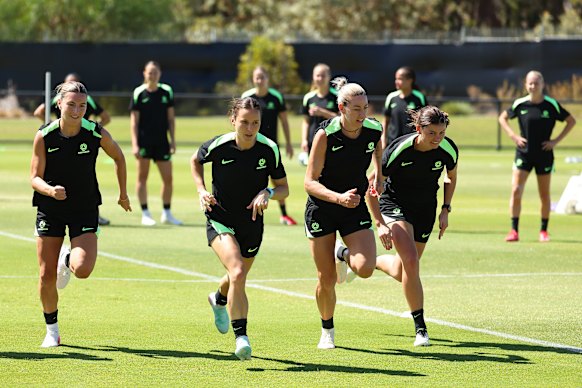
The Matildas warm up during training in Perth on Saturday.Credit: Getty Images
Windsor John also placed the onus back on member federations to distribute the existing pot of prize money as they see fit.
“Please be reminded that matters pertaining to national team players, prize money and other conditions should be addressed directly with the respective member associations, who are primarily responsible for managing their own stakeholders, to identify solutions appropriate to their own circumstances, which are different to one another,” he wrote.
Prizemoney is traditionally paid to national federations, with variable shares passed through to players depending on agreements in each country.
Under the Matildas’ agreement with Football Australia, national team players receive 40 per cent of prizemoney if they are champions, and 33 per cent for anything less than that. It means each player would make around $21,000 for lifting the trophy.
But similar arrangements are not in place in many other – especially poorer – Asian nations, meaning those players stand to earn nothing even if they win the tournament.
FIFA remedied this inequity before the 2023 Women’s World Cup by prescribing a minimum 30 per cent share of prize money to be received by players.
Most Viewed in Sport
Disclaimer : This story is auto aggregated by a computer programme and has not been created or edited by DOWNTHENEWS. Publisher: www.smh.com.au