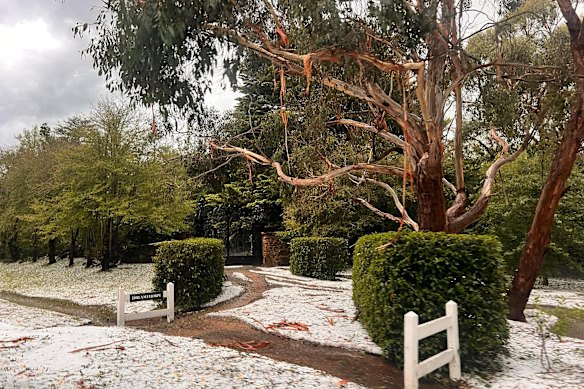

Victoria’s wild and wet end to summer is forecast to continue into March, with two more downpours expected before Tuesday.
The Bureau of Meteorology forecasts up to 15 millimetres of rain in Melbourne on Sunday, and another 35 millimetres on Monday, as rain that has caused flooding in the outback moves south.
The bureau warns severe thunderstorms and heavy rainfall, which could cause flash flooding, are likely for western parts of Victoria from Sunday.
“Overnight tonight [Saturday], a band of heavy rainfall will move into western parts of Victoria and New South Wales,” meteorologist Dean Narramore said.
“That tropical low that’s been causing all that heavy rainfall through central parts of the country is finally on the move south through South Australia, and that will bring another round of heavy rainfall on Sunday.
“As we get into Monday afternoon and evening, that threat moves into inland New South Wales, but that low does finally weaken.”
Cumulative rainfall totals of 50 to 100 millimetres are predicted across Victoria in these two rain bands, with isolated falls above 150 millimetres.
The SES is warning eight parts of western Victoria to prepare for minor to moderate flooding from Sunday evening, including the Portland coast, Warrnambool, the Grampians, Loddon, the Wimmera and Mallee.
The warning comes after several areas near Melbourne’s urban fringe recorded about 50 millimetres of rain in one hour and huge hailstones on Friday, and another downpour that flooded Melbourne streets on Tuesday.
SES volunteers have responded to nearly 500 requests for assistance in the aftermath of these storms, with the town of Gisborne being hard hit in both.
Notwithstanding the risks of damage and flash flooding, the forecast rain is welcome news for regional Victoria.
The same parts of the state now on flood watch have experienced their lowest rainfall on record in the past two years, prompting drought declarations and financial relief from the state government.
Brett Hosking, president of the Victorian Farmers Federation, said so far the rain hadn’t fallen evenly.
“We are quite literally seeing some farmers get in excess of 25 millimetres, and five kilometres down the road the rain hasn’t even wet the ground,” he said.
“The ground is hungry for the moisture, and soaking it up at this stage, but in some areas we’re starting to see the ground reach saturation and the water start to run off the paddocks into the dams and rivers. Our river systems are incredibly dry.”
Horsham, the largest town in western Victoria’s Wimmera region, received 96 millimetres on Friday night, 85 of that total in just 80 minutes.
A national phenomenon
Flood watches and warnings now cover about half of Australia’s landmass, with five catchments in Queensland and the Northern Territory experiencing major flooding.
Mt Isa in north-west Queensland has already had its wettest February on record, with almost 400 millimetres falling in the copper city.
Senior Bureau of Meteorology forecaster Jon Fischer said the slow-moving tropical low – which had sat over the Simpson Desert in the south-east Northern Territory for a week – was highly unusual.
“We’ve all seen images of roads being washed away, impacts to the rail line and usually dry creeks turning into torrents,” Fischer said.
In South Australia, Premier Peter Malinauskas has warned residents to prepare for the risks that lie in the days ahead.
A severe weather alert is in place for the state’s western coast and west pastoral and Eyre Peninsula districts, with six-hourly totals of 30-70 millimetres likely and isolated totals of 120 millimetres possible.
With AAP
From our partners
Disclaimer : This story is auto aggregated by a computer programme and has not been created or edited by DOWNTHENEWS. Publisher: www.smh.com.au