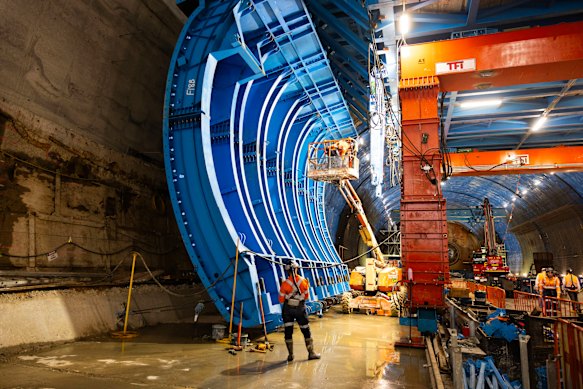

Deep beneath the northern end of central Sydney, a giant bunker-like cavern for the city’s largest metro train station is being built to withstand water pressures that would threaten to lift it like an object in a bathtub.
Helping it to withstand those pressures is a three-and-a-half metre thick slab of concrete, which makes up the cavern’s floor and acts like a giant dead weight.
In the coming months, concrete more than half a metre thick will be poured over an intricate weave of reinforced steel to strengthen the cavern’s walls beneath Hunter Street, which is at the eastern end of tunnels for the 24-kilometre Metro West line. A blue lining underneath acts as a waterproof membrane.
Eastern tunnelling project director Bob Nowotny said contactors were ensuring the cavern was fully watertight for it to withstand hydrostatic loads.
“That’s why it is so massive. It’s designed to hold a myriad of things,” he said, adding that the weight of the concrete and steel held the cavern down.
The latest breakthrough of a final boring machine into the cavern beneath Hunter Street marks the end of tunnelling on metro rail projects in Sydney for the foreseeable future, unless the Minns government changes tack and decides to extend or build another line.
Asked if it would be the last tunnelling of a metro rail project while Labor was in power, Premier Chris Minns said the government would consider future projects in Sydney but in a “responsible way” by ensuring it had the funds in place to build infrastructure.
“We’re putting $30 billion a year into infrastructure in Sydney. That is on par with previous years,” he said. “I’m going to make sure that we’re responsible, both with spending and infrastructure.”
At 28 metres wide and 180 metres long, the cavern for the Hunter Street station will be larger than both Victoria Cross station in North Sydney and the Martin Place metro station, which is the busiest on the M1 line between the city’s north-west and Sydenham.
Sydney Metro chief executive Peter Regan said the Hunter Street station would be critical to the future of the city’s transport system, and the only one to have a direct connection to both the M1 metro line and the heavy rail lines in the CBD.
“This will be a real hub, and change the way people are able to move around,” he said. “This is the biggest station on the metro network by some distance. It will have the highest patronage of any single platform in the Sydney network.”
Once open to passengers in 2032, Hunter Street station is forecast to be almost twice as busy as the Martin Place metro station, handling a predicted 16,200 passengers between 8am and 9am.
The first 130-metre-long boring machine to arrive at the cavern in December is slowly being pulled apart, while the front of the latest arrival protrudes into the western end.
As the machines are disassembled, their parts are lifted by crane to the surface, and trucked out of the central city in the dead of night to Newcastle, where they will be shipped back to China.
By October, two giant shafts at either end of the cavern will have been dug to a depth of about 25 metres, from which two skyscrapers up to 58 storeys high will emerge over the coming years.
To be built by a Lendlease-led consortium, the station is costing $1.5 billion, which is $908 million higher than the amount Sydney Metro forecast in internal documents in mid-2020.
 Matt O’Sullivan is transport and infrastructure editor at The Sydney Morning Herald.Connect via X or email.
From our partners
Disclaimer : This story is auto aggregated by a computer programme and has not been created or edited by DOWNTHENEWS. Publisher: www.smh.com.au