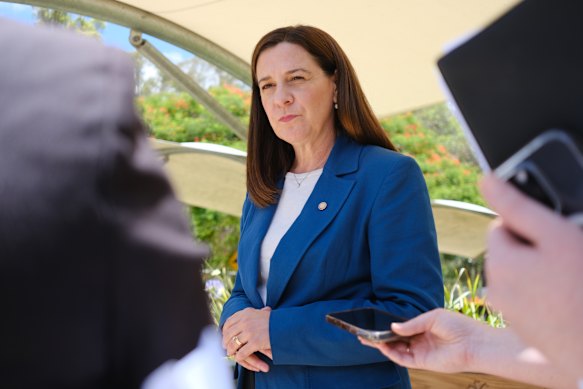
The Queensland government has made an eleventh-hour tweak to its contentious hate speech and gun laws proposal, walking back previously unrivalled powers granted to the attorney-general.
The laws initially would have granted the attorney-general powers to regulate against phrases, spoken or written, and symbols deemed to be regularly used to incite hostility toward a group and which are reasonably expected to offend the public.
However, the cabinet voted on Monday morning to reduce the attorney-general’s reach to symbols alone, requiring banned phrases to instead pass through parliament.
Frecklington said the tweak came after the state “listened carefully” to concerns raised during public consultation in February.
The changes come as the state’s Labor opposition conceded it will ultimately back the bill, despite internal pressure and fears that some elements go too far, and others fall short.
Opposition Leader Steven Miles told reporters on Monday that an afternoon meeting of his partyroom colleagues ahead of Tuesday’s parliamentary return had come to the decision.
Miles said the decision was based on the sentiment from hundreds of submissions to the rushed parliamentary scrutiny process, and the statement of reservations from his colleagues involved.
“Labor supports the stated intention, the stated sentiment of the bill, and therefore will vote for it,” Miles said at a brief media conference, declining to say if there was internal resistance to the stance.
“However, these laws put Queensland out of step with the rest of the country when it comes to gun law reform, they will leave Queensland with the weakest gun laws in the country.
“We have also carefully considered the government’s proposal to criminalise speech … [which] give the government of the day extreme and unchecked powers.”
Flagged after the December attack on a Jewish Hanukkah event in Sydney, Attorney-General Deb Frecklington introduced the suite of laws last parliamentary sitting.
The bill goes further than any other jurisdiction, with two phrases on the banned list – the common pro-Palestine protest chant “from the river to the sea, Palestine will be free” and “globalise the intifada”.
Warrantless police stop-and-search powers will be extended to anyone suspected of committing the offence, which carries a maximum penalty of two years in jail.
The laws also make gun law changes that stop short of a national buyback or mental health checks, broaden banned hate symbols and boost penalties for offences related to places of worship.
Dozens of major civil society groups and legal experts across the political spectrum raised concerns about the bill’s scrutiny and elements of the ban, in more than 300 submissions lodged in only days.
Police have conceded they will have to be selective in their enforcement at any large-scale protests.
Labor has faced grassroots pressure to oppose the laws, and MPs who spoke with this masthead after the bill’s introduction said the party was considering those calls.
On Monday, Miles said the opposition would – if given the opportunity – symbolically vote against the specific elements of the laws which deal with the criminalisation of the protest slogans.
But he conceded that this was not a guaranteed outcome if the government were to use its control of parliament to fast-track that element of the bill’s passage.
The government intends to pass the bill into law this week. On Monday, Police Minister Dan Purdie said the hate speech laws would criminalise phrases that “led to people being murdered at Bondi”.
Purdie also reiterated a call for Labor to outline its position the third stage of the LNP’s “adult crime, adult time” laws. Miles said Labor would consider that bill after its introduction this week.
Start the day with a summary of the day’s most important and interesting stories, analysis and insights. Sign up for our Morning Edition newsletter.
 Matt Dennien is a reporter at Brisbane Times covering state politics and the public service. He has previously worked for newspapers in Tasmania and Brisbane community radio station 4ZZZ. Contact him securely on Signal @mattdennien.15Connect via email.
From our partners
Disclaimer : This story is auto aggregated by a computer programme and has not been created or edited by DOWNTHENEWS. Publisher: www.smh.com.au