On the Shelf
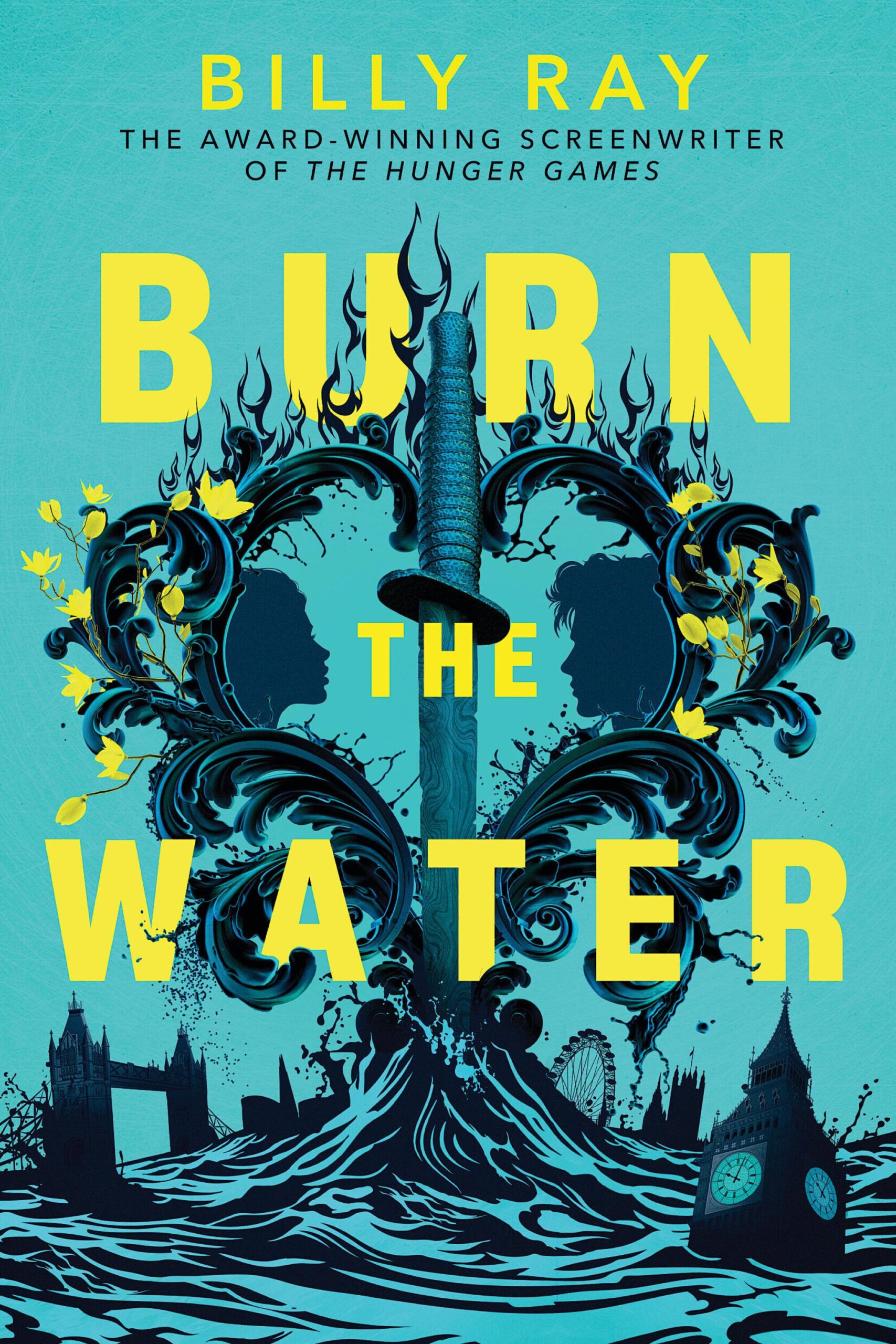
Burn the Water
By Billy Ray
Scholastic Press: 368 pages, $20
If you buy books linked on our site, The Times may earn a commission from Bookshop.org, whose fees support independent bookstores.
Billy Ray is terrified.
Or at least that’s what the award-winning screenwriter says in response to the innocuous-to-the-point-of-pitiful interview-opener: “How are you doing?”
Strangely, he is not referring to the state of our country (though he has been scathingly critical of both the Trump administration and the Democratic Party) or the potential perils of artificial intelligence (which he recently described to The Times as “a cancer masquerading as a profit center”) or even the state of the box office in Hollywood’s new age of contraction (Ray famously wrote the now-iconic, pro-cinema Nicole-Kidman-in-a-sparkly-pantsuit ad for AMC.)
No, Ray is terrified because his first novel, a YA dystopian take on “Romeo and Juliet” called “Burn the Water,” is about to come out. And though he knows what it’s like when a film underperforms, this feels very different.
“If you’re a screenwriter and you write a movie and for some reason people don’t come,” he said amid the clatter and conversation in a West Hollywood coffee shop, “you can hide behind the director, you can hide behind the cast, you can hide behind all kinds of things. But if you write a book and nobody buys it, there’s nobody to hide behind.”
(Scholastic Press)
In “Burn the Water,” Ray imagines London in 2425, roughly 300 years after the polar ice caps have collapsed, flooding most of the world in a cataclysmic event. In the turmoil that followed “the Great Soak” of 2100, a biological weapon was set off in London, further decimating its population by nerve gas and creating two warrior houses known as the Rogues and the Crowns.
The Rogues and the Crowns went on to engage in three centuries of warfare over the half-submerged city’s dwindling resources. (The unaffiliated masses, known as the Habs, do most of the labor.) Predictably, life expectancy shortened dramatically, so many of the warriors and their captains are teenagers and children. Including Jule, ace fighter for the Crowns, and Rafe, her counterpart for the Rogues, who we meet in the book’s opening pages and quickly become the star-crossed lovers of the story.
Propulsive and cinematic, “Burn the Water” cries out for a film adaptation, which isn’t surprising since Ray is a screenwriter and the bones of the tale began as a movie. Fifteen years ago, he said, he heard that Greg Silverman, then head of Warner Bros., was looking for a new spin on “Romeo and Juliet.” “So I thought, ‘OK, what if I do “Romeo and Juliet” in the future; what would that look like?’”
As often happens in Hollywood, it turned out that this is not what Silverman had wanted at all, but Ray had become attached to his idea and so it sat on the back shelf of his mind, first as a feature, then as a series and, finally, a novel.
When the Writers Guild of America went on strike two years ago, he thought, “If I don’t write a novel now, I never will.”
So he did. While also hosting a Deadline-sponsored podcast called “Strike Talk,” Ray spent the sixth months between when the WGA strike began (May 2, 2023) and the overlapping SAG-AFTRA strike ended (Nov. 9) learning how to write a novel.
Which, as it turns out, is very different from adapting one.
“I was feeling such impostor syndrome,” he said. “I knew I was a screenwriter but I didn’t think I was a novelist.”
He set it in London for reasons topographical — ”I needed a city that was on an island so it would be completely cut off” — and historic — ”in homage to Shakespeare.”
That homage did not extend to long soliloquy; “Burn the Water” is intentionally economical. Indeed, Ray’s initial draft was “very lean — I was so afraid of boring people, of seeming pretentious.” When he showed it to readers he trusted, they told him, “‘This isn’t a novel, it’s a screenplay in prose.’ They said, ‘You have to understand that in a novel, you’re the camera, you’re the actors’ faces, you’re the production designer.’”
So he wrote another draft that was 50% longer and more descriptive. And while he hadn’t intended to write a YA novel, he realized that by making his characters a few years younger than he had initially conceived them, he could reach a younger audience.
“I ultimately wanted it to be a gift to young people, young women specifically, about leadership,” he said. “I’ve spent so much time in the political space and a lot of what we talk about is young people feeling so disenfranchised and so disempowered; they don’t know what to do. And I want them to know they have the option of leading.”
By “political space,” Ray is referring to the fact that for almost 10 years, he has served as something of a communications consultant for the Democrat Party. “When Trump was elected the first time, I knew I had to do something beyond writing checks,” he said. That something includes writing, or helping to write, speeches and campaign ads and more generally advising elected officials and candidates about “how to sound less like a Democrat” in order to appeal to voters in the center. He is currently working with 80 sitting members of the House and Senate and another 60 candidates.

“Stop excluding people from the party,” Billy Ray tells Democrats. “Wanting secure borders does not make you a racist. Owning a gun does not make you a school shooter. Being unsure about vaccines doesn’t make you a flat-Earther.”
(Genaro Molina / Los Angeles Times)
“Americans are not actually divided,” he has said before and repeats now. “A majority agree with the Democratic position on abortion rights, minimum wage, healthcare, cost of living and climate change.”
But the party, he said, has become so afraid of offending someone that it spends more time arguing over pronoun use than it does over the fact that “in 1960, the average age of a first-time homeowner was 23; now it’s 40. Talk about that. Stop excluding people from the party. Wanting secure borders does not make you a racist. Owning a gun does not make you a school shooter. Being unsure about vaccines doesn’t make you a flat-Earther.”
What Ray perceives as unexamined thinking and entrenched prejudice is, along with a clear warning about climate change, very present in “Burn the Water.” Still raging 300 years after the event that initially provoked it, the war between the Crowns and the Rogues is essentially meaningless; it has become a self-sustaining cycle of violence based almost entirely on clan identity. Having been raised to hate the opposing side simply because they are the opposing side, Rafe and Jule initially cannot believe that their love is possible, much less sustainable.
“It is a political book,” Ray said, but he was striving for an equal balance of love, violence and politics. “When people read it, I would ask three questions: ‘Were you ever bored? Were you ever confused? Do you think [those things] are balanced?’”
Beyond “The Hunger Games,” and the upcoming prequel “The Hunger Games: Sunrise on the Reaping,” Ray has not read much YA fiction. When he was asked to adapt “The Hunger Games,” he didn’t know what it was. “I asked my kids — my daughter was 14, my son was 9 — and they looked at me as if I had stepped off the Mayflower.”
Unlike most first-time YA novelists, however, he was able to “send an early draft to Suzanne [Collins, author of ‘The Hunger Game’ series] and she was hugely helpful.”
“Romeo and Juliet” is, in many ways, a YA play, and love that must overcome socially inflicted obstacles (including of the interspecies variety) fuels much of the genre, as do worlds ravaged and divided by futuristic visions of current realities taken to their extremes. Ray says he chose apocalypse by water because it is the most likely result of an unchecked climate crisis, but the real villain of the piece is tribalism — the Rogues and the Crowns would rather make a bad situation worse by killing each other than unify in an attempt to solve larger problems.
Even with his ironclad writing credentials, which includes an Oscar nomination for “Captain Phillips,” he seems genuinely surprised that he landed a lucrative two-book deal with Scholastic; he’s already written the second in what he hopes will be a trilogy.
“We’ll have to see how this one does.”
If it does well, he would like to see a trilogy of films as well.
Not TV?
“Maybe,” he said. “But I want to do whatever I can to help movies.”
After all, as a more modern master than Shakespeare once wrote: “Heartbreak feels good in a place like this.”
More to Read
Disclaimer : This story is auto aggregated by a computer programme and has not been created or edited by DOWNTHENEWS. Publisher: latimes.com