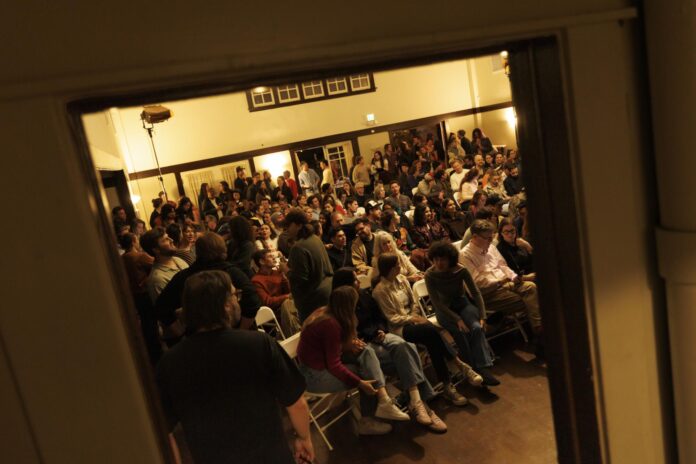
Last June, Naomi Welikala noticed a line curving around the block of her local American Legion, an unassuming building that rarely invited commotion. Curious, she asked the person at the back of the queue what they were waiting for.
Welikala had stumbled upon one of L.A.’s more unlikely cultural phenomena: Public Assembly theater. Founded in 2018, the nonprofit seeks to democratize creative opportunity and reimagine community theater by presenting a monthly showcase of three 12-minute plays, all written, developed and performed within that same four-week cycle. It draws a diverse crowd that skews young, as well as a healthy smattering of glitterati, including Brie Larson, Jena Malone and Daniel Scheinert, director of the Oscar-winning “Everything Everywhere All At Once.” The group doesn’t have a brick-and-mortar home. Instead, it stages work in unlikely spaces: Masonic lodges, American Legions, women’s centers, but never traditional black box theaters.
People take their seats before Public Assembly‘s show at the Women’s Twentieth Century Club. Tickets to the monthly shows sell out fast, and guests are encouraged to submit play ideas for the next month’s show.
(Carlin Stiehl / For The Times)
Tickets to Public Assembly’s word-of-mouth shows typically sell out within 30 minutes. Welikala was lucky enough to get a last-dash one at the door. She paid $5 for entry, which entitled her to the showcase, as well as an open bar.
Since Public Assembly’s pieces are always developed in such a short time frame, they are immediate and reactive, able to comment on cultural issues of the day, while offering a counter to the long-development purgatory that is the Hollywood movie industry (to which many Public Assembly affiliates claim membership).
At the end of the night, guests are invited to shout out suggested themes for the following month’s plays. Anyone who has ever attended a Public Assembly show is strongly encouraged to submit a scrappy 400-word submission based on the theme of the month. They have only a few days to do so; the company encourages writing from the gut. Once the submissions are in, three selected pieces move through a rigorous workshop process over a period of weeks under the guidance of professional curators, writers and directors. Inspired, Welikala sent in her 400-word submission, a personal play about her grandmother’s dementia. She had never written for the theater before. Public Assembly chose her piece.

The founders of Public Assembly theater company, (from left) Clara Aranovich, Alexander Tavitian and Satya Bhabha, gather in Bhabha’s home.
(Carlin Stiehl / For The Times)
This is typical of the company. Founding artistic directors Satya Bhabha, Clara Aranovich and Alexander Tavitian, conceived of Public Assembly in 2018 as a response to several shortcomings they encountered in the film industry: the high barrier to entry, glacial development timelines, and the degradation of ideas through prolonged exposure to notes, executive meddling and institutional risk aversion.
“So much of our creativity in this town is distilled into capitalistic value,” Bhabha says. “People live in a culture of fear around their creation, they think their work is going to get canceled if it doesn’t sell enough on the front or back end.”
That resonates with Scheinert, who describes himself as a “big fan” and says he’s been to 10 shows in the past two years. “I love how they’ve created this community that’s so enthusiastic, while making things at such a fast pace, and not doing it for profit,” he says. “It has a passionate summer-camp energy, with some of the warmest audiences out there.”

Members of Public Assembly theater raise their hands for a team cheer before their show at the Women’s Twentieth Century Club. The tiny nonprofit stages three new 12-minute plays each month.
(Carlin Stiehl / For The Times)
The vast majority of Public Assembly’s labor is voluntary. Fundraising drives have enabled the company to split ticket sales among performers, while writers receive the benefit of the workshop and writing lab. The company also maintains a strict diversity initiative, and many writers come from low-income households.
For the most recent showcase, the company’s 45th, the theme was “scales.” The selected plays were Diana Dai’s “The Weight of Being Me,” about a teen and her grandfather reconnecting at a recycling center; Grant Crater’s “Buxom Buddies,” a politically charged dramatic comedy; and Matt Kirsch’s “Weighing In,” in which a ceremonial UFC face-off becomes an intimate encounter between competitors, reminiscent of the “Heated Rivalry” era.
As always, the plays run for one night only. The company prizes ephemerality in a quasi-Buddhist way: They treat their pieces like mandalas, spending a month gathering grains of sand only to blow them away at the end.

Nadine Ellis (left) and West Liang perform “Buxom Buddies,” written by Grant Crater and directed by Aaron Leddick, at a Public Assembly theater show at the Women’s Twentieth Century Club on Jan. 29.
(Carlin Stiehl / For The Times)
The development process is a key part of the company’s philosophy. Submissions are selected through a collaborative review by the company’s directors and curators, followed by a table read, multiple rehearsals and internal showings. After each run-through, participants gather in a circle to offer critiques. It is an explicit antidote to the Hollywood model, where notes are often anonymous and top-down.
“This is an iterative process,” Bhabha often says. The plays this month were revised around 10 times, some 15. Curators, writers, actors and directors met several times a week to zero in on each piece, shaping it beat-by-beat while searching for its emotional pulse.
While directors help mold the work, the writer retains ultimate authority. During rehearsals, directors regularly checked in to ensure that each choice resonated. The process is prescriptive, but the effect is liberating. “The tight container becomes freeing for most creatives,” Bhabha says.
I observed rehearsals for “The Weight of Being Me” in a donated room in Chinatown, small and dark enough to resemble a scene from “Saw.” By then, the characters had names, ages, accents and personality traits: “popular,” “agile,” “self-conscious.” Time was precise: “The fourth hottest day of the year.” Directors and actors fleshed out the world by asking ultra-specific questions: How many cans should be in the recycling bags? Should the beat last a millisecond longer? All the while, the company emphasized playfulness at the core of creation. Watching rehearsals, I felt as though I were observing a rigorous version of children’s make-believe.

Gerald C. Rivers performs a reenactment of Dr. Martin Luther King Jr. at a Public Assembly theater show at the Women’s Twentieth Century Club.
(Carlin Stiehl / For The Times)
Public Assembly’s combination of structural rigor and verve gives its work a distinct sensibility. Screwball humor often runs through the pieces; they indulge in abstraction and never skew didactic. There are no needless digressions, and their architecture is as robust and tightly engineered as their characters are fully fleshed. The work moves with its own rhythms.
“We like to think of Public Assembly reaching a point where it could become an iconic institution in the city, something that feels like a rite of passage, while also imparting a style that is entirely its own,” says Tavitian.
For the January showcase, tickets sold out in 15 minutes, and actors struggled to comp their friends and family. That night’s plays were staged in a women’s center in Eagle Rock. Inside, the atmosphere was familial. The person who had shouted out “scales” at the previous showcase was there. So was Welikala.

Aaron Leddick (left) and Anastasia Leddick perform warm-up exercises before a Public Assembly show at the Women’s Twentieth Century Club.
(Carlin Stiehl / For The Times)
When the audience again suggested themes — “drum solos,” “AI,” “squares” — the curators and artistic directors huddled and emerged 30 seconds later with their theme for February: “bodies of water!” The room burst into cheers.
New writers would submit. New plays would be born, rehearsed and dissolved. And in unassuming buildings scattered across Los Angeles, a reiterative imagining of community theater would continue, one Thursday night at a time.
More to Read
Disclaimer : This story is auto aggregated by a computer programme and has not been created or edited by DOWNTHENEWS. Publisher: latimes.com