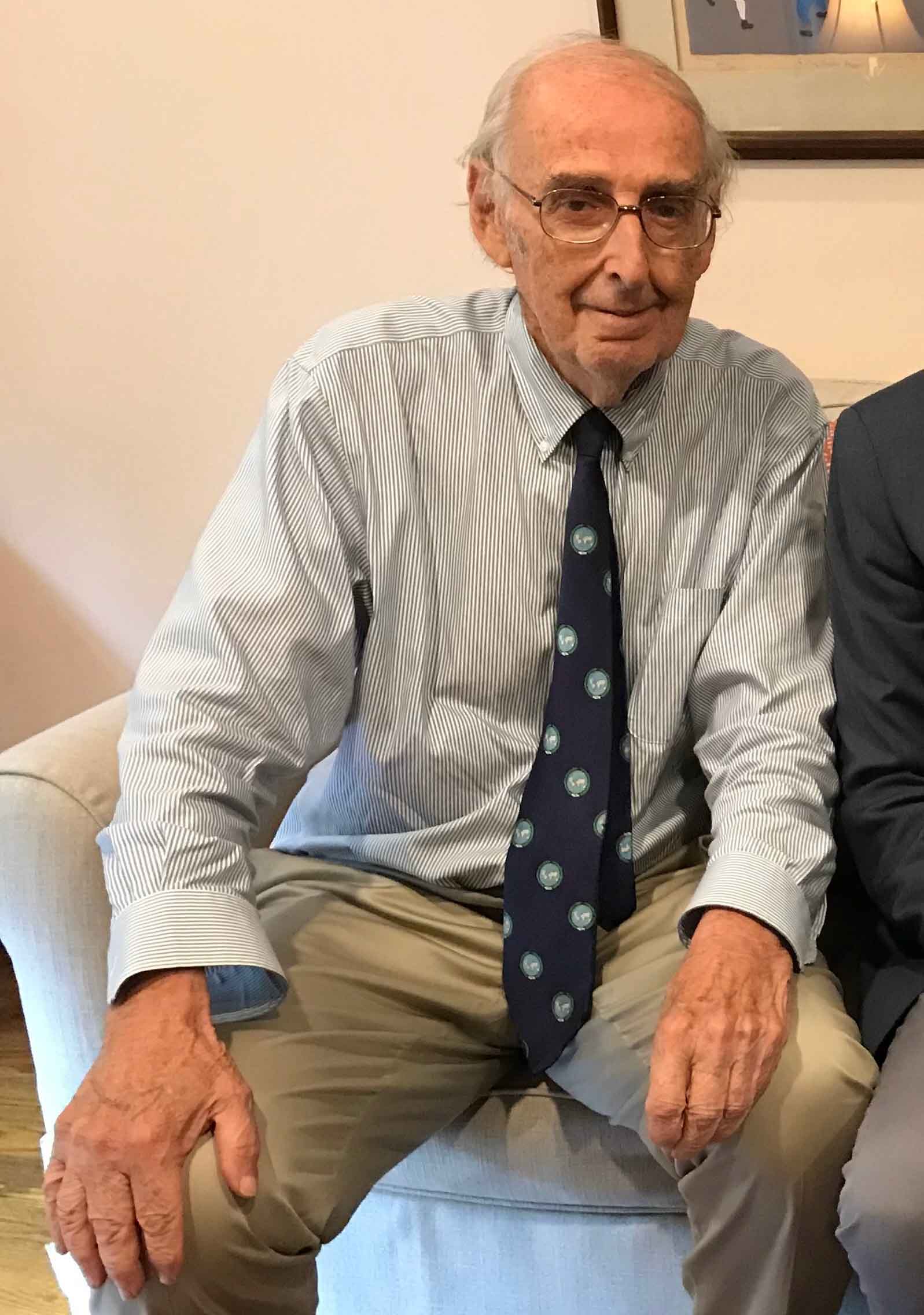
Colman McCarthy, one of my golf and writing heroes, died the other day. He was best known as a liberal op-ed page columnist and editorial writer for the Washington Post, where he had a nearly 30-year run, starting in the late 1960s. He was a true believer in a core value of Quaker teaching, that war begets war. As a golfer, he was a true believer in miss-’em-quick — and still he broke par innumerable times.
Before Colman became a reporter, writer and columnist, he had two long and almost unintentional apprenticeships. He spent almost a decade, through high school on Long Island in the 1950s and then college in western Alabama, planning to become a professional golfer. Then, after playing college golf at Spring Hill College, a Jesuit school in Mobile, he spent a half-decade living in a monastery in rural Georgia, training to become a Trappist monk. That was his pathway to his life in journalism, and to the long series of classes he taught, in universities and high schools, under a rubric he called Peace Studies.
As he settled into his inside-the-Beltway life, with his wife and their three sons, Colman made a return to golf. His adulthood unfolded in a city — the nation’s capital — where fluency in golf is a kind of passport, whether you’re touring the East Potomac public course or visiting Burning Tree, the no-women-allowed golf club for presidents and diplomats and other grandees. When the spirit moved him, Colman wrote about the game, always with unfailing logic and a light touch.
When the spirit moved him, Colman wrote about the game, always with unfailing logic and a light touch.
The Lords of Augusta, back in the day, could not have had much use for Colman McCarthy. On the eve of the 1977 Masters, in his widely syndicated column, Colman mocked the tourney for its tiny, handpicked fields, as it casually excluded many established and hot-handed golfers, to say nothing of Black golfers and stars from distant lands. He suggested a player boycott of the Masters by which (as he called it then) the “Tournament Players Championship” would rise to major status and the Masters would be rechristened as the “Clifford Roberts Invitational,” in mock tribute to the club chairman. A half-year later Roberts died (Colman had nothing to do with it!), and in time the criteria for a tournament invitation became way more meritocratic.
Colman McCarthy was born on the North Shore of Long Island in 1938. His father was a golf-and-baseball loving immigration lawyer, an attorney out of the do-gooder Atticus Finch tradition, except the elder McCarty was an Irish-Catholic New Yorker. Colman never lacked for heroes. Tommy Bolt, as a kid. (Colman caddied for him a number of times.) Mother Teresa, years later. He was drawn to people who figured out their own paths in life. Chi Chi Rodriguez, for instance, even though their politics were on opposite sides of the fairway. Colman liked Notah Begay, too.
In 1977, Colman wrote a slender book called “The Pleasures of the Game,”which I found as a new release in my local library in Patchogue, on the South Shore of Long Island. I was a senior in high school, and it was a game changer. Colman wrote about the pleasures of the nine-club bag, the benefits of walking, playing briskly, abiding by the rules, bringing your own food. He described his days caddying at an upper-crust Long Island club, sometimes for luminaries like the Duke of Windsor and Perry Como.
Then came a sort of demotion, to the pro shop, where he sold socks by the pair and golf balls by the sleeve. Finally, his big break: “From there, I went into darkness — working as the nightman in charge of rotating fairway sprinklers. In between rotations, especially midnight to 3 a.m., I practiced putting by moonlight, sighting Venus in my plumb-bob on sidehill putts.”
Long Island summer nights in those days were (and remain) warm, humid and still. Those old-timey ‘round-and-‘round fairway sprinklers, typically on a stake, offered a rhythmic, spritzing evening soundtrack, along with the occasional and impromptu passing shower. Colman’s picture landed in me. With it came the idea of the golf course as a sort of monastery. Early in “Pleasures,”McCarthy got golf’s broad joys down to a single sentence: “Golf exercises the body, stimulates the mind and elevates the spirit.”
I have a vague memory of writing to the author after reading “Pleasures,” and I am certain I met Colman at the 1985 Kemper Open at Congressional, where I was caddying and he was wandering, wearing a bucket hat and carrying a reporter’s notebook. One night that week I sat in on his Peace Studies class at American University. (Over the years I have pointed students to the class. One of Colman’s main points is that it’s not enough to aware of violence throughout the world — our responsibility is to do something about it.)
After the class, Colman and I got a quick cafeteria dinner. (He was a vegetarian.) Done with supper, I got on a Metro to return to my digs for the week, the sofa of a reporter friend from college living in Foggy Bottom. I don’t recall how Colman got back to his home but he didn’t own a car and was famously committed to public transit, as well as his three-speed Raleigh. He biked everywhere.
In his travels, he talked to everybody. That was one of his things: talk to everybody, because you can learn from anybody. He lived as he preached. He counted Joan Baez and Sargent Shriver as friends, as were various golf pros, Congressional staffers and bus drivers. We stayed in touch (though too sporadically) over the past 40 years. I am proud to say that Colman McCarthy shaped my life immeasurably.
I can’t imagine a life without heroes. I don’t know how you feel about the subject.
Colman McCarthy and his granddaughter, Vivienne, in 2022.
courtesy jim mccarthy
About a month ago, a young woman with a hint of the South in her voice was scanning my items at a neighborhood grocery store in Philadelphia, where I live. She said she was from Mobile, Ala., and that she had attended school there, at Spring Hill College, but left without getting her degree when she ran out of money. I offered the young lady a squib about Colman McCarthy — though nothing about his sub-70 scoring average as a junior on the Spring Hill golf team — and his later life a teacher. The young lady said she was saving money with a plan to return to school and begin her own career as a teacher.
Colman’s wife, who went by Mav, was a nurse, a Scotch drinker, a meat-eater, a conservative — as a couple they were further proof that opposites can and do attract. (Both were, it should be noted, devout Catholics, though she from High Society Greenwich, Conn.) Mrs. McCarthy died in 2021. When the couple met and quickly became engaged, Colman’s future father-in-law had a plan to scuttle the relationship — take him out for golf at the family’s high-brow club! In tennis shoes and borrowed sticks, Colman went around in 66. The marriage was on.
Two of their sons, John and Edward, became teachers and baseball coaches. A third son, Jim, became a public relations executive and advisor who helped Augusta National’s leadership through its point-of-a-bayonet brouhaha as a single-sex club in the early 2000s. Colman and his three sons formed a golfing foursome whenever the occasion arose, sometimes on Long Island or in the Dominican Republic, where John McCarthy lives. Since Mav’s death, Colman lived with John and his family in the Dominican, and he died there on Feb. 27 at age 87. He was puttering around the Casa de Campo practice greens to his end, still smitten by the game. All the while, he remained eager to make the world a more just place for its 8 billion human citizens, including the 60 million golfers roaming our planet’s many and varied fairways.
Disclaimer : This story is auto aggregated by a computer programme and has not been created or edited by DOWNTHENEWS. Publisher: golf.com