
Updated ,first published
London: There is a wild violence to the Iranian attacks that have killed soldiers and civilians over the past three days, and there is even greater danger ahead.
The Islamic Republic has enough weapons to keep striking targets across the region for weeks, which means more casualties and more chaos.
Israel estimates that Iran held about 2500 projectiles at the start of this war on Saturday because its production of ballistic missiles and drones had been on an “upward trend” in recent months.
This helps explain why there could be four to five weeks of war, if not more.
The United States and Israel have pounded Iranian targets in a bid to destroy weapons stores and missile launchers, but nobody is claiming to have taken out the regime’s capacity to fire more missiles.
In fact, the widening of the conflict to include Britain, France and Germany highlights the calculation in Europe that Iran can inflict more damage on military and civilian sites.
Airports. Hotels. Apartment buildings. Military bases. The regime treats all of them as legitimate targets now that it has lost its supreme leader, Ali Khamenei. It is lashing out at its enemies.
Iranians loyal to the government believe the US and Israel have killed countless civilians, including 153 people at a girls’ school in Minab. There is no way to verify this number in the heat of the conflict, when the internet is blocked, and independent media cannot access the site. It may be propaganda, but if the estimate is anywhere close to the truth, it is a tragedy that will only enrage the regime and drag out the war.
Iran is using missiles and drones to damage military targets, such as the US Navy base in Bahrain or a base in Kuwait. More often, however, it is inflicting random violence to spread terror among civilians. This borrows from Russia, the biggest customer for the Iranian Shahed drone, in the way missiles and drones destroy homes, hospitals and playgrounds in Ukraine. It is no more sophisticated than Germany firing V1 and V2 rockets into London in 1944 and 1945.
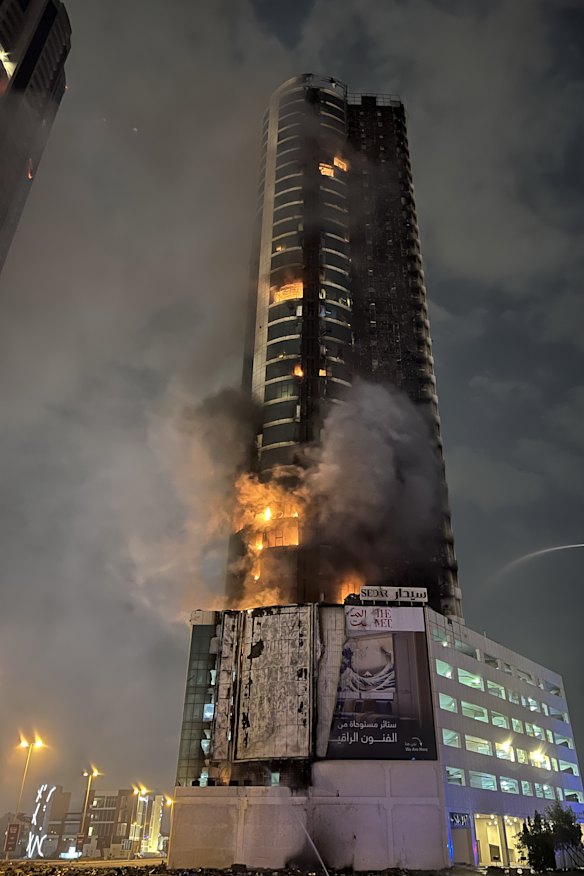
The footage of an Iranian drone hitting an apartment tower in Bahrain on Sunday looks no different from a random Russian strike on Ukraine. So, too, the attack on the Palm Jumeirah resort in Dubai.
If there is a pattern or a strategy, it is simply to widen the war. Iran aimed at a British military base in Cyprus, for instance, before there was any sign from London that it wanted to join the conflict. UK Defence Minister John Healey said on Sunday that two Iranian missiles were fired in the direction of the RAF base at Akrotiri.
This provoked Britain at the very moment its prime minister, Keir Starmer, had upset Trump by refusing to allow the US to use British bases for its attacks. Hours after the threat to Cyprus, the UK changed its stance. Starmer declared later on Sunday that the US could use the British bases for defensive operations.
Trump and Starmer were at odds over this war. Iran brought them together. This is a measure of the madness in Tehran.
The result? Britain, France and Germany are ready to deploy their forces to eliminate Iranian missile and drone sites. The UK says one of its Typhoon jet fighters shot down two Iranian drones near Qatar. Greece is sending frigates and fighter jets to Cyprus.
While they frame this as a purely defensive operation, the effect is to assist the US and Israel in degrading Iranian military capacity.
Every nation in the region is now arrayed against a common threat. Iran appears to have fired projectiles, or launched powerful strikes, against Abu Dhabi, Bahrain, Cyprus, Dubai, Iraq, Israel, Jordan, Kuwait, Oman, Saudi Arabia and Syria.
This led to a rare joint statement on Monday in the Middle East from the United Arab Emirates, Qatar, Saudi Arabia, Bahrain, Jordan, Kuwait and the US condemning Iran.
Trump is hazy about how long the attacks will continue and what he wants when the fighting stops. The US president said in one interview on Sunday that he expected the conflict to last for about four weeks, and in another, it could be “four to five” weeks. A day later, he implied that ground forces could become involved, telling the New York Post: “I don’t have the yips with respect to boots on the ground.”
‘This is not Iraq’
Trump previously suggested Iranians would rise up against the regime, but also told The New York Times that his strike on Venezuela in January was the “perfect scenario” for a foreign conflict. In Venezuela, of course, he simply decapitated the government and allowed a more compliant leader to rise to the top. That was a regime tweak, not a regime change.
US Secretary of War Pete Hegseth said on Monday in Washington (about 2am on Tuesday, AEDT) that the Trump administration knew better than to tip America into another Iraq. “This is not Iraq, this is not endless,” he said. This was a boast without any real assurance. Every aspiring strongman says he will not make the same mistakes as the other guy.
If this means the US will rely on air power alone to smash the Islamic Republic, the surviving leaders of the regime will bunker down and step up their missile and drone strikes. That means more danger at airports, more risks for civilians, more threats to shipping, and a greater economic disruption. Trump does not rule out boots on the ground and, therefore, is open to a much longer war.
How long can the regime hold out? It is massively outnumbered, but it still has an arsenal. Israel considers the Iranian missile stockpile to be an existential threat, and it vows to eliminate the weapons, but it is not declaring the job done.
We think we know how many missiles and drones Iran had at the start of this war. We cannot be sure how many it has left. Without an assurance on that, we are set for weeks of war.
Read more on the US-Israel-Iran war:
 David Crowe is Europe correspondent for The Sydney Morning Herald and The Age.Connect via X or email.
From our partners
Disclaimer : This story is auto aggregated by a computer programme and has not been created or edited by DOWNTHENEWS. Publisher: www.smh.com.au