
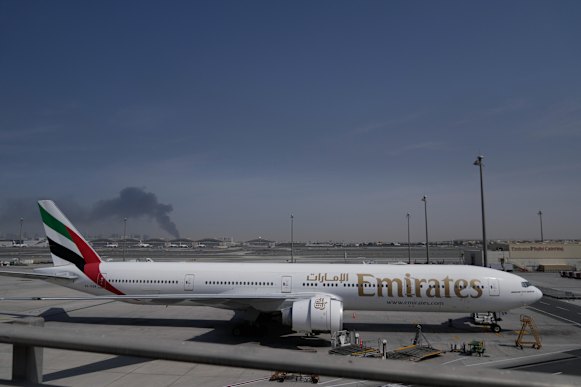

Australians stranded in the Middle East are making plans to leave, as the Iran war has forced the closure of airspace in the region and limited options for flights.
Those unable or unwilling to wait for the resumption of air travel are finding alternative routes to leave the region, according to Australian travel agents.
Mark Trim, the founder of Adelaide-based Complex Travel Group, said travellers who had long-haul flights from Europe or Africa through the Middle East were now “rebooking via Asia at significantly higher price points, and seat availability is moving quickly at a premium”.
For travellers in the region where airspace is open – such as Saudi Arabia or Oman – but who have impacted flights on Emirates or Qatar Airways, his company had been booking various scenarios.
“Some are flying out through Johannesburg, and home on Qantas from there,” Trim said. “We just re-booked some clients in Cairo on that routing.”
Since Israel and the US began attacking Iran on Saturday evening (AEDT), 12,903 of the 32,003 flights that were scheduled to arrive or depart from the Middle East – or 40 per cent – had been cancelled, according to flight analytics data company Cirium.
At any time, about 11,000 Australians are transiting through the region, which is a hub for Emirates, Virgin Australia’s partner Qatar Airways, and Etihad. Travellers caught out by the military strikes during their transfer are now unable to fly out of the war-affected part of the Middle East.
The Australian government initially directed stranded Australians to look to commercial carriers for repatriation; however, with planes grounded, options for leaving are extremely limited.
Canberra has said it can’t facilitate repatriation flights under the circumstances, but Defence Minister Richard Marles on Tuesday said the government was looking into “contingency arrangements” to help Australians get home.
While the United Arab Emirates has instituted tightly defined corridors for flights to and from “Dubai, Abu Dhabi and other UAE airports”, as SafeAirSpace.net notes, “official airport updates still describe operations as suspended or heavily disrupted”. The central corridor of Middle East airspace remains shut.
The Oman option
Some travellers are planning to cross land borders to countries such as Saudi Arabia and Oman, where flights to leave the region can be boarded.
Cirium’s Asia editor Ellis Taylor said “Muscat [in Oman] has the potential to offer a way out of the Middle East for some passengers who are willing to take land transport from neighbouring countries”. Oman Air operates flights to Bangkok, Kuala Lumpur and Jakarta that “could offer a way back to for Australian travellers”, he said.
Oman also has flights to Phuket and Manila, but not to Singapore, he said.
Anthony Goldman, a joint managing director of the Melbourne-based Goldman Travel Group, also said Muscat was a possibility, “if you want to drive in the middle of a situation”.
“At the end of the day, if somebody chose to fly out of Oman, we’d help them,” said Goldman. “But, you’ve got to have an appetite to drive a few hours, and who knows what’s going to happen over there?”
In an operational update on Tuesday, Oman Air said “flights to/from Asia, the Indian subcontinent [India, Bangladesh and Pakistan] and Europe [except Russia] continue to operate as scheduled”.
Another scenario to leave the Middle East is for people in the island nation of Bahrain to travel by land to neighbouring Saudi Arabia, fly to the Indian cities of Delhi or Mumbai and transit from there.
“You can go Malaysia Airlines, Air India,” Goldman said.
“There are plenty of options; you’ve just got to be creative and be prepared to spend the extra money.”
Many of the hub options are “Hong Kong, Bangkok, Singapore, India, or you go via the US – right around the world.”
Online travel agency Webjet said that in the past few days, “we have seen travellers opting to redirect through Asian hubs such as Singapore, Bangkok and Kuala Lumpur, as well as the Perth–London direct service”.
“We are working closely with airline partners and, where flights are operating, helping customers explore alternative routes across different airlines – whether they are in Europe trying to return to Australia, or vice versa,” a spokesperson said. “We are assessing options in real-time and guiding customers through what is feasible.”
Flight routes
The airspace over Qatar, Bahrain, Kuwait, Syria, Israel, Iran and Iraq remains closed, and Cirium’s Taylor said that meant there were two clear corridors around the conflict area: Oman and Saudi Arabia in the south and Turkey in the north.
“To the south, there are flights routing over Oman and the south-west part of Saudi Arabia, while to the north, flights are going over the subcontinent to Afghanistan, Turkmenistan and Turkey to dodge Iranian airspace,” Taylor said.
“That northern path seems to be allowing flights to operate from India and South-East Asia through to Europe with relatively little deviation, and this is allowing the Perth-London flights that Qantas operates to continue, albeit with a fuel stop in Singapore.”
Qantas chief executive Vanessa Hudson said the Australian airline had customers on code-share services with Emirates who were now stuck in the Middle East, while Qantas-operated services such as those flying to Europe via Perth and Singapore were not “materially impacted”.
“We are going to do everything that we can to support our customers,” she said at The Australian Financial Review’s business summit in Sydney.
Qantas said that from Wednesday, its Perth-to-London flight would stop in Singapore, allowing it to add up to 60 extra passengers.
Qatar Airways, a partner of Virgin Australia, has cancelled its Doha services until March 5, “due to the ongoing security situation in the Middle East and the closure of Qatari airspace”.
Bookings
Goldman urged stranded Australians to speak to travel agents, who could help navigate complex travel arrangements. But with limited protection for the impact of war on travel bookings, travellers should not cancel arrangements without first talking to a travel agent.
“We can search all options at our fingertips,” Goldman said.
He also noted that the UAE announced it was “bearing all hosting and accommodation costs for affected and stranded passengers” in hotels.
“If you’re in a hotel, you’re going to be looked after,” he said. “You’re going to be fed. You’re going to be housed.”
Yet the regional situation remains fluid, as military bases, and occasionally airports and civilian infrastructure, had been targeted.
To date, it’s largely an inconvenience. But the nature of the conflict could also change.
 Chris Zappone is a senior reporter covering aviation and business. He is former digital foreign editor.Connect via X, Facebook or email.
From our partners
Disclaimer : This story is auto aggregated by a computer programme and has not been created or edited by DOWNTHENEWS. Publisher: www.smh.com.au


