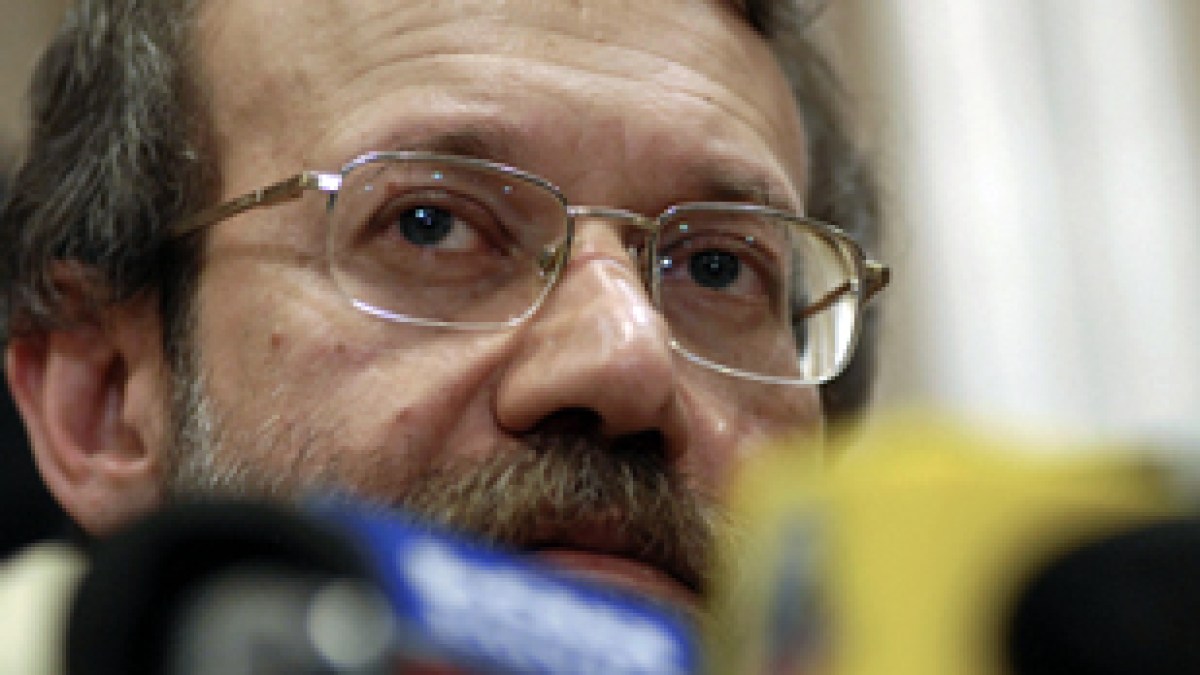
For decades, Ali Larijani was the calm, pragmatic face of the Iranian establishment – a man who wrote books on the 18th-century German philosopher Immanuel Kant and negotiated nuclear deals with the West.
But on March 1, the 67-year-old secretary of the Supreme National Security Council’s tone changed irrevocably.
Recommended Stories
list of 3 itemsend of list
Appearing on state television just 24 hours after US-Israeli air strikes killed Supreme Leader Ayatollah Ali Khamenei and the Iranian Revolutionary Guard Corps (IRGC) commander, Mohammad Pakpour, Larijani delivered a message of fire.
“America and the Zionist regime [Israel] have set the heart of the Iranian nation ablaze,” he wrote on social media. “We will burn their hearts. We will make the Zionist criminals and the shameless Americans regret their actions.”
“The brave soldiers and the great nation of Iran will deliver an unforgettable lesson to the hellish international oppressors,” he added.
Larijani, who accused US President Donald Trump of falling into an “Israeli trap”, is now at the centre of Tehran’s response to its biggest crisis since 1979.
He is expected to have an important role alongside the three-man transitional council running Iran after Khamenei’s death.
So, who is the man tasked with steering Iran’s security strategy as its war with Israel and the US continues?
The ‘Kennedys’ of Iran
Born on June 3, 1958, in Najaf, Iraq, to a wealthy family from Amol, Larijani belongs to a dynasty so influential that Time magazine described them, in 2009, as the “Kennedys of Iran”.
Advertisement
His father, Mirza Hashem Amoli, was a prominent religious scholar. And like Larijani, his brothers have held some of the most powerful positions in Iran, including in the judiciary and the Assembly of Experts, a clerical council empowered with choosing and overseeing the supreme leader.
Larijani’s ties to Iran’s post-1979 revolutionary elite are also personal. At age 20, he married Farideh Motahari, the daughter of Morteza Motahhari, a close confidant of the Islamic Republic of Iran’s founder, Ruhollah Khomeini.
Despite his family’s conservative religious roots, his children have had a diverse trajectory. His daughter, Fatemeh, a medical graduate from the University of Tehran, completed her specialisation at Cleveland State University in Ohio, US.
The mathematician philosopher
Unlike many of his peers who came solely from religious seminaries, Larijani also has a secular academic background.
In 1979, he earned a bachelor’s degree in Mathematics and Computer Science from the Sharif University of Technology. He later completed master’s and doctorate degrees in Western philosophy from the University of Tehran, writing his thesis on Kant.
But it is his political positions that have been the centrepiece of his career.
After the 1979 revolution, he joined the IRGC in the early 1980s, before transitioning to government, serving as culture minister under President Akbar Hashemi Rafsanjani between 1994 and 1997, and then as the head of the state broadcaster (IRIB) from 1994 until 2004. During his time at the IRIB, he faced criticism from reformists who accused his restrictive policies of driving Iranian youth towards foreign media.
Between 2008 and 2020, he served as the Parliament (Majlis) speaker for three consecutive terms, playing a major role in shaping domestic and foreign policy.
Return to the security fold
Larijani ran for the presidency in 2005 as a conservative candidate, but did not make it to the second round. In the same year, he was appointed the secretary of Iran’s Supreme National Security Council, and the country’s chief nuclear negotiator.
He resigned from those posts in 2007, after growing distant from then-President Mahmoud Ahmadinejad’s nuclear policies.
Larijani entered parliament in 2008, winning a seat to represent the religious centre of Qom, and became the speaker. This allowed Larijani to grow in influence, and he maintained his connection to the nuclear file, securing parliamentary approval for the 2015 nuclear deal between Iran and world powers, known as the Joint Comprehensive Plan of Action (JCPOA).
Advertisement
After leaving his position as parliamentary speaker and member of parliament in 2020, Larijani attempted to run for president for a second time in the 2021 election. But this time, he was disqualified by the Guardian Council, which vets candidates. He was disqualified again when he attempted to run in the 2024 presidential election.
The Guardian Council gave no reason for the disqualifications, but analysts viewed the 2021 move as a way for the establishment to clear the field for hardliner Ebrahim Raisi, who won the election. Larijani criticised the 2024 disqualification as “non-transparent”.
But he did return to an influential position in August 2025, when he was reappointed as secretary of the Supreme National Security Council by President Masoud Pezeshkian.
Since taking the post, his stance has hardened. In October 2025, reports emerged that Larijani had cancelled a cooperation agreement with the International Atomic Energy Agency (IAEA), declaring that the agency’s reports were “no longer effective”.
Diplomacy amid war
Despite that tough stance, Larijani is often regarded as pragmatic and someone inside the Iranian system who may be willing to compromise, in part due to his past role in backing the 2015 nuclear deal.
Just weeks before the current escalation, Larijani was reportedly engaged in indirect negotiations with the US.
In February, during talks mediated by Oman, he stated that Tehran had not received a specific proposal from Washington, and accused Israel of trying to sabotage the diplomatic track to “ignite a war”.
In an interview with Al Jazeera prior to the US and Israel’s attacks on Iran, Larijani described his country’s position on talks as “positive,” noting that the US had realised that the military option was not viable. “Resorting to negotiation is a rational path,” he said at the time.
However, the air strikes, which began on February 28, have shattered the diplomatic window.
In his latest address, Larijani assured the nation that plans were in place to arrange the leadership succession according to the Constitution. He warned the US that it was delusional to think killing leaders would destabilise Iran.
“We are not intending to attack regional countries”, he clarified, “but we are targeting any bases used by the United States”.
The more pragmatic tone appears to have disappeared – for now. Larijani has rejected media reports that he wanted new talks with the US, saying on Monday that Iran would “not negotiate” with Washington.
Instead, with Khamenei gone and the region on the brink, Larijani has promised a response to the US and Israel with “a force that they have never experienced before”.
Disclaimer : This story is auto aggregated by a computer programme and has not been created or edited by DOWNTHENEWS. Publisher: aljazeera.com