
Three days after the Bondi massacre, Muslim, Jewish and Palestinian leaders sat at Premier Jacinta Allan’s cabinet table and expressed their fears, grief and sorrow. It was, given the circumstances, an extraordinary gathering.
For the previous two years since the October 7 attacks and war in Gaza, it had become increasingly difficult for Muslim and Jewish leaders to share a room, much less their thoughts. A rich tradition of multi-faith work in Victoria had all but collapsed.
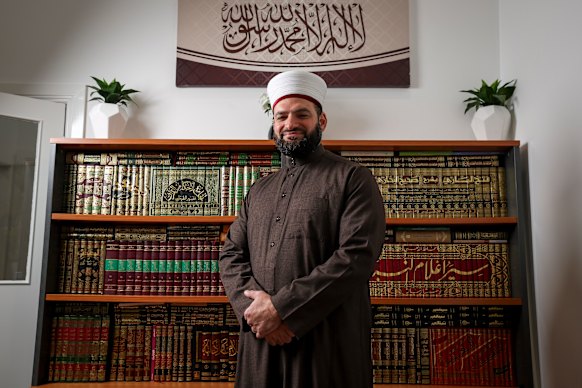
Amid the horror of Bondi, something shifted. Jewish Communities Council of Victoria president Philip Zajac, who was at the meeting, describes it as a wake-up call. For Sheikh Moustapha Sarakibi, a Sunni Muslim cleric who has dedicated much of his working life to stopping the poisonous creep of extremist thought, it signalled a fresh resolve.
“The Muslim community has suffered enough from people like that, people who think they can commit heinous crimes in the name of Islam,” says Sheikh Moustapha, from the Board of Imams Victoria. “They have no right to do so. Islam rejects them and rejects whatever claims they make.
“There was a unified stance that we had around that table with the premier. We will continue to fight against these dangerous, extremist ideologies. Whether it from the Islamic community or another community, we will work to stamp out extremism that threatens the social cohesion that we are proud of in this country.”
There are an estimated 1 million Muslim people in Australia. This month, as they celebrate Ramadan with families and friends, they are confronting something troubling and unprecedented in Australian politics – mainstream support for a party whose founder openly questions their rightful place in this country.
Pauline Hanson’s “no good Muslims” claim, while publicly denounced by others in her party, is central to One Nation’s vision for a smaller, whiter Australia. Her political creed since her return to federal parliament 10 years ago is steeped in Islamophobia, even if not all voters drawn to One Nation share her views about Muslims and Islam.
The potential for anti-Islamic rhetoric to escalate into violence was made clear in Perth last week when a 20-year-old suspected white supremacist, Jayson Joseph Michaels, was arrested and charged with preparing a series of terror attacks at mosques, police headquarters and the WA state parliament. An extremist manifesto was allegedly found at his home, alongside a gun and ammunition.
In an interview with this masthead, Sheikh Moustapha describes the rise of One Nation, in part, as evidence of the need for his community to do more to improve understanding of Islam in Australia.
“There are many reasons why some people would choose to support One Nation,” he says. “Our issue with One Nation is mainly about the divisive nature of their rhetoric and policy.
“When One Nation talks about an Australian way of life, what do they mean by that? Does One Nation want all of Australia to look a certain way? Does it want Australia to only speak English and no other languages in public? They play on people’s emotions, they try to capture a lot of people who don’t understand Islam and other traditions.
“Muslim values are very much in line with Australian values – values of family, values of equality, values of social cohesion, values of respecting other people’s practices and traditions, values of abiding by the law of the land we live in.
“We are very integrated, very assimilated into this country, and we are very proud of that too. We raise our children not just to be Muslims but to be Australian Muslims.”
The One Nation view of who belongs in Australia and who doesn’t is made clear in a “spot the Westerner” video post by the party’s Victorian secretary Bianca Colecchia. In the video, Colecchia pans across a sea of brown faces outside Flinders Street Station on New Year’s Eve and cites it as evidence that our “cultural identity” is being eroded.
Colecchia ran as a One Nation candidate at last year’s federal election in the seat of Bruce and secured 8 per cent of the primary vote. As state secretary she will be a key figure in shaping the tone and content of the party’s Victorian election campaign.
Sheikh Moustapha is deeply concerned about what the growing popular support for One Nation signals. He is also optimistic about what the state election results will show when Victorians go to the polls in November.
“The Victoria I know is a Victoria that supports diversity and social cohesion and acceptance and tolerance,” he says. “I have a lot of faith in the Victorian people and their choices when it comes to the ballot box.
“We can’t be complacent either. When we see reports that support for One Nation is rising to 20 per cent that tells me there needs to be more work from our part of the community to reach out to people and do more advocacy work so people can understand what Islam is about and the Muslim community is about in Victoria.
“For those who are ill-informed, and maybe haven’t met a Muslim before, we need to reach out to those people and show them that we are just like them. We are just trying to live our life and get by and raise our families and work towards the advancement of this nation. There are no hidden agendas out there. We are not trying to bring Sharia Law into this country or change people’s way of life. There is absolutely none of that.”
It is a poor reflection of the political climate, in Australia and across other Western democracies, that such things need to be said. But Ramadan with its nightly Iftar celebrations, aside from its religious significance, is an important, month-long forum for community and outreach.
Two years ago, the Victorian and NSW governments were forced to cancel their Iftar events after influential Muslim groups, including the Islamic Council of Victoria and the Australian National Imams Council, publicly called for a boycott to protest the war in Gaza and the refusal of both state governments to denounce it as a genocide.
Then ICV chief executive Adel Salman, a prominent figure in the pro-Palestinian protest movement, led the boycott campaign against the premier’s annual Iftar dinner, giving Allan no choice but to cancel the event. The dinner resumed in March 2025.
On December 17 last year, when in the aftermath of the Bondi massacre the premier called together an emergency meeting of her anti-hate taskforce, no one from the ICV attended.
According to the premier’s published diary entry from the meeting, the Jewish leaders in the room were Zajac and Rabbi Daniel, while the Muslim leaders were Sheikh Moustapha, Shia Imams Council of Victoria president Maulana Syed Abul Qasim Rizvi, and Palestinian Australia Relief and Action director Rasha Abbas. Other faith leaders, Victoria Police Commissioner Mike Bush and senior government ministers and bureaucrats were also at the table.
Allan has quietly re-engaged with the Muslim community after the Bondi massacre. A week after the shootings, the Premier met Muslim leaders, including ICV president Mohamed Mohideen, at the Preston Mosque. In the early weeks of January, she interrupted her summer holiday to personally call Ismet Purdic after the Imam and his wife Sabina were accosted and abused by bigots while driving on the outskirts of Melbourne. She met with them again last week.
Australian-born Sheikh Moustapha studied at the Madinah Islamic University in Saudi Arabia, which teaches a strict, Salafist interpretation of Islam. Since graduating, he has worked as a prison chaplain and developed an expertise in countering violent extremism and reintegrating Muslims released from jail.
He knows the families of some of the women who travelled to Syria during the rise of Islamic State and are now seeking to return to Australia after years spent in the squalid confines of the Roj internment camp. He believes they can return safety with the proper support, and should.
“I understand when governments make decisions around these matters that they are thinking about the population, they are thinking about risks, they are thinking about people’s safety. That is the right way to think. But I truly believe we have the capacity, whether as an Islamic community, a state or a nation to mitigate those risks with programs that are in place.
“Australia is a nation that I believe, is very forgiving and embracing, even for people who have made mistakes. Turning a cold shoulder is not befitting for us as a great country, knowing that we have citizens out there in very difficult circumstances.”
Start the day with a summary of the day’s most important and interesting stories, analysis and insights. Sign up for our Morning Edition newsletter.
 Chip Le Grand leads our state politics reporting team. He previously served as the paper’s chief reporter and is a journalist of 30 years’ experience.Connect via email.
From our partners
Disclaimer : This story is auto aggregated by a computer programme and has not been created or edited by DOWNTHENEWS. Publisher: www.smh.com.au