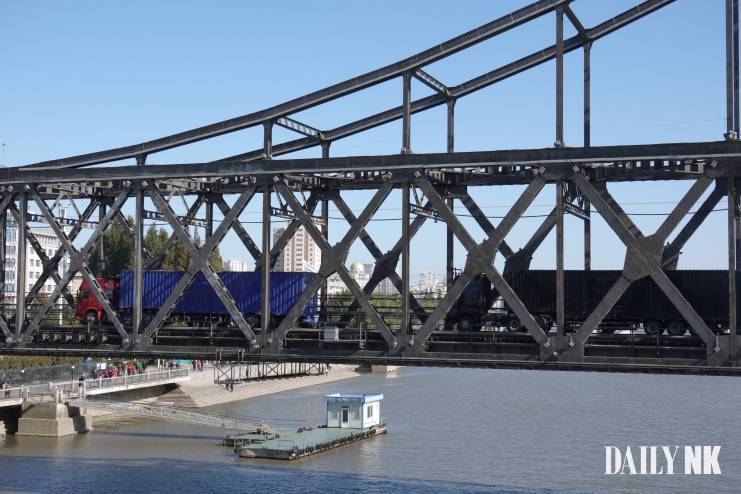
North Korean consulate vehicles in China have been used to transport goods banned under U.N. Security Council sanctions on North Korea. The practice has continued even during the Ninth Korean Workers’ Party Congress, with consulate cars making repeated crossings between North Korea and China carrying prohibited items.
Multiple Daily NK sources familiar with North Korea confirmed today that the North Korean consulate in China has been leading efforts to circumvent the U.N. sanctions regime by using official vehicles to transport agricultural products, marine goods, minerals, and manufactured goods whose import and export are prohibited under U.N. Security Council resolutions on North Korea.
Sources said that on Feb. 24 — the sixth day of the Ninth Korean Workers’ Party Congress, North Korea’s most significant political event — consulate vehicles made multiple trips between Dandong in Liaoning province and Sinuiju in North Pyongan province carrying sanctioned goods. The sources, who requested anonymity for security reasons, said the items brought from Sinuiju into Dandong that day included North Korean cigarettes and ginseng.
“Large amounts of North Korean ginseng have been leaving for China recently,” one source said. “It sells for high prices on the Chinese market, and demand is strong enough that trade representatives are bringing it in.”
The goods transported from North Korea to China via consulate vehicles consist mainly of agricultural and marine products such as sea cucumber and ginseng, manufactured goods including cigarettes and alcohol, and minerals including silver and gold ore. These fall under the list of prohibited imports and exports specified in U.N. Security Council resolutions 2371 and 2397.
North Korean consulate vehicles in China were also used to transport sanctioned goods when North Korean authorities sealed the North Korea-China border during the COVID-19 pandemic in 2020. Sources say the vehicles have been used even more frequently this year as authorities have clamped down hard on border smuggling around events such as the party congress.
The consulate vehicles used to carry sanctioned goods are mainly small trucks or vans suited for cargo, sources said.
Diplomatic plates offer a convenient loophole
The primary reason consulate vehicles have become a preferred method of sanctions evasion is that Chinese customs does not conduct thorough inspections of vehicles bearing diplomatic license plates. The vehicles pass through with little interference and avoid customs fees, making them an ideal tool for evading the sanctions regime.
The arrangement reflects a mutually beneficial relationship between the consulate and trade representatives. Trade representatives pay the consulate a set transportation fee to move prohibited goods, while the consulate generates its own revenue from the arrangement, creating a symbiotic structure.
As North Korean authorities have stepped up border controls recently, consulate vehicle trips have become more frequent. Some observers believe that even if Pyongyang were to ease border restrictions in the future, the use of consulate vehicles to move sanctioned goods in and out of the country will only become more brazen.
“The consulate is providing its vehicles to earn money for itself,” another source said, who also requested anonymity for security reasons. “For profit, the consulate will keep providing vehicles to trade representatives and continue to undermine the sanctions.”
A Note to Readers
Daily NK operates networks of sources inside North Korea who document events in real-time and transmit information through secure channels. Unlike reporting based on state media, satellite imagery, or defector accounts from years past, our journalism comes directly from people currently living under the regime.
We verify reports through multiple independent sources and cross-reference details before publication. Our sources remain anonymous because contact with foreign media is treated as a capital offense in North Korea—discovery means imprisonment or execution.
This network-based approach allows Daily NK to report on developments other outlets cannot access: market trends, policy implementation, public sentiment, and daily realities that never appear in official narratives. Maintaining these secure communication channels and protecting source identities requires specialized protocols and constant vigilance.
Daily NK serves as a bridge between North Koreans and the outside world, documenting what’s happening inside one of the world’s most closed societies.
Disclaimer : This story is auto aggregated by a computer programme and has not been created or edited by DOWNTHENEWS. Publisher: dailynk.com