When I was a kid, I thought that high blood pressure was a condition that only affected people who made egregious lifestyle choices. This is not true. Since 1990, the incidence of hypertension has increased globally, with up to one in three adults worldwide affected by it.
Most of those people have no idea they have it. If people could diagnose and monitor hypertension at home, the World Health Organization estimates that up to 76 million lives could be saved with easy fixes, like stopping smoking or adjusting diet. In the past year, it’s gotten much easier to monitor your blood pressure at home. Our top pick is the traditional Withings BPM Vision ($180), which offers tabletop, medical-grade results. Withings also offers Cardio Check-Up, an electrocardiogram review service available through the app that works with the company’s ECG-enabled devices.
If you’ve been diagnosed with hypertension, you should hold on to your cuff for now. But in the past year, fitness trackers like the Apple Watch introduced the concept of cuffless BP monitoring, which is more comfortable and can monitor you 24/7. (If your blood pressure doesn’t drop while you sleep, that is a serious indicator that you may have heart disease.) Blood pressure monitoring also showed up on the Whoop MG ($359/year), and a new cuffless monitor called the Aktiia Hilo will be making its way stateside later this year.
Curious about the latest developments? Check out our roundup here. And don’t forget to check out the rest of our health and fitness coverage, including the Best Fitness Trackers, the Best Smart Rings, and the Best Walking Pads.
Best Overall


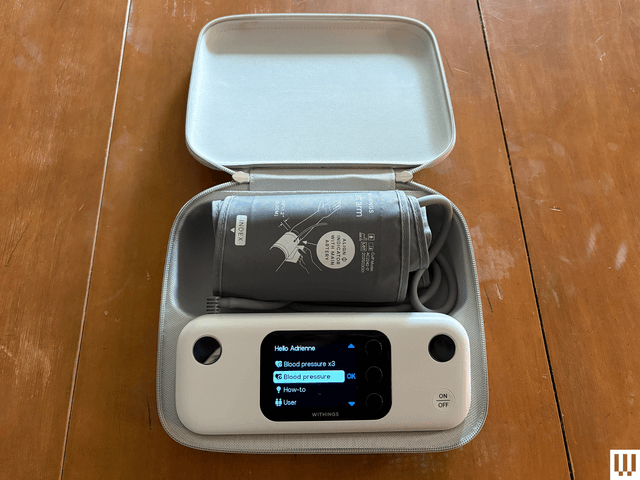
The main difference between the latest Withings BPM Vision (8/10, WIRED Recommends) and its predecessor, the slightly cheaper Withings BPM Connect ($130) is that the BPM Vision is a tabletop unit. The BPM Connect had all the electronics in the cuff itself, which makes it harder to put on and use (if slightly more portable). Comfort is an important factor when it comes to blood pressure monitors, since nearly everything can affect the readings, including whether your ankles are crossed. The BPM Vision is FDA-cleared and meets the validation protocols recognized by organizations such as the Association for the Advancement of Medical Instrumentation and the American Heart Association. I also double-checked the heart rate readings against the Oura Ring 4 and found that they tallied.
You can turn it on and connect it to the Withings app on your phone; you can also see the readings on the LCD screen. The BPM Vision syncs with Apple Health, Samsung Health, and a few other health apps. I also like that you can use guest profiles, so you don’t need to have the Withings app to use it, and multiple people can also use the BPM Vision. I also like that you can take several readings in a row, which I recommend because my first reading is always high (from the stress of having my blood pressure taken).
The BPM Vision doesn’t actually work with Withings’ Cardio Check-Up—you need an ECG-enabled Withings tracker, like the ScanWatch 2 ($370), to use that feature. It’s also bigger than the BPM Connect and a few of the other monitors we’ve listed here, but this is the best, most accurate, and easiest-to-use blood pressure monitor for home monitoring.
The Cuffless Blood Pressure Monitor


New advancements in the category of blood pressure monitoring are few and far between, but the Aktiia Hilo band (8/10, WIRED Recommends) is probably the most exciting in a while. Last year, the Hilo was FDA-cleared; it has been tested and reviewed in multiple clinical-grade studies over several years, and meets the ISO 81060-2 standard for validating the accuracy of blood pressure monitors. If you have hypertension, the Aktiia Hilo could be a game changer when it goes on sale in the US later this year. (It’s already on sale in many European countries and in Canada, Australia, and New Zealand.)
The reason that the Hilo is significant is because the gold standard for measuring your BP is while you’re walking, sleeping, or lying down. Even taking your BP in a doctor’s office can confound the results, since a lot of people are more relaxed in a clean, empty doctor’s office than when trying to get their kids ready for soccer practice. The Hilo measures up to 25 times a day, including while you’re sleeping, which is a key measurement, since if your BP doesn’t go down during this activity, that’s a strong indicator that you may already have cardiovascular disease. Continuous measuring lets you take the average of your measurements, rather than spot-checking at times that may give you an incomplete picture of your cardiovascular health.
Unlike the traditional cuff, which uses oscillometric detection (vibrations, basically) to listen to when the blood stops and starts flowing in your veins, the Hilo uses the same optical photoplethysmography (PPG) sensors that many other fitness trackers already use to extrapolate your BP from the shape of your blood vessels. To use the Hilo, you connect both the slim band and the included cuff to the app (iOS, Android), calibrate the band, and then just … wear it. The band is waterproof, and battery life lasts for up to 15 days (I got around 10). You can also sync your measurements to Apple Health and download a PDF report to send to your doctor. If you want to measure your blood pressure at home, the Aktiia Hilo promises to be the easiest and most accurate way to do it.
The One You’re Already Wearing


The flagship health feature on last year’s Apple Watch Series 11 was hypertension notifications. This is significant because the Apple Watch is the most widely used consumer health device in the world. Apple cleared the feature with the FDA in September 2025; however, it is important to note that in the FDA paperwork, Apple states that the Apple Watch itself is not intended to replace traditional methods of diagnosis; it has limited indication for those who have not previously been diagnosed; and that the absence of a notification does not indicate the absence of hypertension. Just because you don’t get a notification doesn’t mean you don’t have high blood pressure, and the readings on the watch are much less accurate than those using a traditional cuffed method.
Keeping all that in mind, the Apple Watch is so widely used that it stands to reason that a lot of people who might otherwise not have known about their hypertension will be more aware of it. To turn on hypertension notifications, you must have an Apple Watch Series 9 or later with the latest version of WatchOS; an iPhone with the latest version of iOS; Wrist Detection must be turned on; and you must be older than 22, not pregnant, and not previously diagnosed with hypertension.
The Apple Watch is not calibrated with a cuff. It takes 30 days of cardiac data from the existing optical PPG sensors, analyzes it, and gives you a probability that you might have hypertension. It’s also significant that this is the first year that the Apple Watch has had a true 24 hours of battery life, so you can wear it while you’re sleeping without taking it off to charge. I’ve turned this on with my Series 11 and have not yet gotten a notification (and hope I never will), but given that general awareness, screening, and detection of hypertension is a huge barrier to diagnosis, the Apple Watch is a significant step forward.
Best Value BPM

The iHealth Ease is one of the cheapest blood pressure monitors that you’ll find on the market. As former contributor Richard Baguley says, it achieves this feat with a remarkable degree of accuracy (the device is ESH-10 approved, a widely recognized standard for accuracy in automated blood pressure monitors).
The Ease basically turns your phone into a BPM. It consists of a cuff, an air tube, and a base for your phone. The base communicates via Bluetooth to your Apple or Android device, takes the reading, and sends it to the iHealth MyVitals app, which is free and accessible to others, like your family or doctor. Baguley notes that the Ease is true to its name and was very easy to use, although it’s a bit slower than the other devices we’ve tried. There’s also a useful emergency stop button on the base for anyone who finds the pinching sensation of a blood pressure cuff too uncomfortable, though with every monitor here, if it becomes uncomfortable, you can always just take it off.
Alternative: Baguley also tested the Omron Evolv ($120), which is another stand-alone BPM that syncs with the Omron Connect app. You slip the whole device on your arm to measure. Baguley notes that, unlike other devices we’ve tested, it’s a little finicky to use, and the app has to be running to receive data from the device; others, like the Withings, can store data onboard until the app can sync.
Not Approved by the FDA


When I reviewed the Whoop MG (8/10, WIRED Recommends) in June last year, I noted that it was the first wearable fitness tracker that I’d seen to offer blood pressure measurements. At the time, the feature was still in beta; later, Whoop would opt not to pursue FDA clearance. In July, the FDA sent a warning letter to the company for marketing the feature without pursuing clearance. Whoop continues to stand by its blood pressure feature. Whoop does have similar disclaimers as Apple, but it’s notable that both Apple and Aktiia opted to pursue FDA clearance.
Whoop calibrates the feature with readings from a third-party BPM. It uses the onboard PPG sensors to measure your heart rate, heart rate variability (HRV), and blood flow patterns to estimate your blood pressure and offers you estimated systolic and diastolic readings. When I tested the feature, I calibrated it with the Withings BPM Vision and then checked the estimated readings against the BPM Vision’s. I did not find anomalies, but I also don’t have hypertension.
The controversy between Whoop and the FDA highlights the difference between devices that are marketed for wellness versus those that are intended for clinical use. (I did note that Whoop has since changed the wording of its marketing from “medical-grade insights” to “cutting-edge insights” on its website.) As with the Apple Watch, the Whoop band’s accessibility may be its main advantage when it comes to checking your blood pressure. Whoop is a privately held company, and sales are not disclosed, but it has been expanding rapidly since 2024.
Since screening is one of the major problems with diagnosing hypertension, offering the feature can increase awareness and potentially help flag the condition for users. And unlike the Apple Watch, it is calibrated with a third-party monitor and does offer systolic and diastolic readings.
How to Measure Your Blood Pressure
Every monitor and device that we have listed here includes instructions for how to measure your blood pressure. However, here are a few general tips for getting a more accurate reading, according to the Centers for Disease Control and Prevention.
Plan ahead. If possible, take your reading at the same time every day. Don’t drink caffeine or alcohol, or exercise for 30 minutes prior to your reading. If possible, sit still and rest for about 5 minutes before each reading.
Get into position. Sit in a comfortable chair with your back supported and your feet flat on the ground. I have noticed a difference in my readings even when my ankles are crossed. If you’re using a cuff or tabletop unit, keep your arm flat on the surface in front of you.
Don’t leave clothing under the cuff. Your doctor or nurse may take a reading over a T-shirt; you should not.
Take multiple readings. My first reading tends to be elevated, just from my anxiety around taking a measurement. If possible, take two or three measurements one or two minutes apart.
What Is a Normal Blood Pressure Reading?
Each of us has gone to a doctor’s office for a routine check-up and had our blood pressure taken. But what do the readings actually mean?
Your systolic blood pressure is the high reading; it’s the maximum force exerted against the walls of your blood vessels when your heart pumps blood. A normal reading is generally below 120.
Your diastolic blood pressure reading is the lower reading; it’s the pressure exerted when your heart is at rest. A normal reading is generally below 80.
If your blood pressure is elevated, it’s not necessarily a sign that you’re having an emergency. If you get a single elevated reading, calm down, take a few deep breaths, and try taking a measurement again before contacting your doctor. If, however, you have an elevated reading and symptoms like chest pain or shortness of breath, call 911 immediately.
Power up with unlimited access to WIRED. Get best-in-class reporting and exclusive subscriber content that’s too important to ignore. Subscribe Today.
Disclaimer : This story is auto aggregated by a computer programme and has not been created or edited by DOWNTHENEWS. Publisher: wired.com