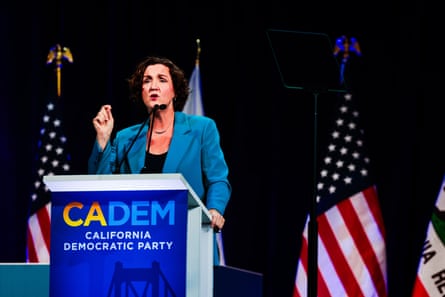
It’s been three decades since Democrats last had a wide open competition for the California governorship, one of the most visible and most powerful positions in the US. Instead of relishing in the competition of a crowded field, though, party leaders worry that the race to succeed Gavin Newsom could blow up in their faces.
On Tuesday, the state’s Democratic party chair, Rusty Hicks, wrote in an extraordinary open letter to the candidates: “If you do not have a viable path to make it to the general election, do not file to place your name on the ballot for the primary election.”
With no clear frontrunner and less than three months to go before the 2 June primary, Democrats worry that their nine candidates vying for the state’s top job could become a circular firing squad and, under an idiosyncratic state primary system that rewards the top two vote-getters regardless of party, allow two Republicans to advance to November’s general election.
Such a scenario would be hard to swallow at the best of times, since California is a Democratic bastion and the richest, most populous state in the country. But with Donald Trump in the White House and Democrats laser-focused on trying to retake control of Congress from Trump’s Republican allies, losing California would be little short of a catastrophe.
“So much is at stake in our nation and so many are counting on the leadership of California Democrats to stand up and speak out at this historic moment,” Hicks wrote in his open letter. “We all have a duty to act in a responsible manner.”
Hicks and analysts in both parties consider the likelihood of two Republican contenders in November to be small, since Democrats enjoy a vast advantage in party registration, but anxiety over the prospect has been simmering ever since two recent polls showed a Republican, the British-born political consultant Steve Hilton, leading the race and a second Republican, Riverside county sheriff Chad Bianco, sitting close behind in third place.
At least three Democrats are performing strongly, too: former congresswoman Katie Porter, who previously ran an unsuccessful campaign for Senate, progressive billionaire Tom Steyer, who has poured more than $60m of his own money into the campaign, and sitting congressman Eric Swalwell, a late entrant who saw an opening after Kamala Harris, the Democrat who lost the 2024 presidential election to Trump, announced she was not running.
None of these three, though, is showing signs of breaking away, while party support remains splintered among the other candidates. The latest Emerson College poll puts the top five candidates within eight percentage points of each other, while a survey by the Public Policy Institute of California has them within just four percentage points.
Without California, Democrats lose one of the most important brakes on Trump’s agenda. Worse, Hicks said, if two Republicans were to be the candidates for governor in November it could depress Democratic turnout so badly that congressional seats now firmly in the blue column could start turning red.
“We do have to just make sure that we don’t shoot ourselves in the foot,” the party’s national chair, Ken Martin, said in an interview. He and other party officials have been urging the less viable candidates to drop out at least since the state party convention in San Francisco 10 days ago.
But the candidates polling on the lower end do not necessarily agree that they are unviable – yet – and have proved tough to convince otherwise ahead of Friday’s filing deadline to appear on the primary ballot.
It does not help that those lower-order candidates include some prominent, familiar figures with long track records in elective office including former state attorney general Xavier Becerra, former Los Angeles mayor Antonio Villaraigosa, and former state controller Betty Yee.
Delegates to the state convention last month did little to help clarify the field, coming nowhere near endorsing a single candidate and, in a vote, elevating Yee and Becerra to second and third place behind Swalwell even though neither has caught fire with voters.
Meanwhile, a relatively new candidate, San Jose mayor Matt Mahan, is gaining momentum, and stands virtually alone in the Democratic field as a centrist and outspoken critic of Newsom’s public tussles with the White House. Mahan is generally mistrusted by organized labor, a key force in Democratic politics in the state, but enjoys significant financial backing from Silicon Valley.
His campaign’s response to Hicks: “Voters choose the next governor, not political gatekeepers.”
Garry South, a political consultant who worked on the last truly competitive Democratic primary for governor in 1998, pointed to three major endorsements that are likely to change the contours of the race – from the California Labor Federation and the Service Employees International Union, which play a significant role in mobilizing unionized workers and getting out the vote, and from former House speaker Nancy Pelosi, whose continuing influence and fundraising pull was key to sending Adam Schiff, not Porter, to the Senate in 2024.
“I don’t know if they will jump on the same candidate,” South said, “but it’s pretty clear there are powerful forces out there that have not yet come into play.”
Swalwell would appear to be best placed to pick up these endorsements, according to party insiders, but even in a split field South was confident that primary voters would themselves move away from low-polling candidates to avoid wasting their ballots. “That dynamic alone makes the prospect of two Republican candidates in the general election unlikely,” he added.
The California Labor Federation, for its part, expects not only to make an endorsement soon but also to use its own weight to exert pressure on the lower-polling candidates. “We have to start having some tough discussions with some of our really good friends about viability,” the federation’s president, Lorena Gonzalez, said in an interview.
For months, Democrats at all levels have expressed misgivings about the quality of the candidate pool as well as its size. Porter alienated a lot of colleagues with her decision to resign her House seat and run for higher office in 2024, and has struggled ever since to hold on to her appeal as a sharp-tongued truth-teller with a populist bent. A pair of viral videos showing her losing her cool with a staffer and with a CBS reporter have also raised questions about her temperament and judgment.
Swalwell has not quite fulfilled expectations that he would become the frontrunner the race needed as soon as he entered the fray in November and has come under fire since for missing an unusually large number of votes in Congress. Mahan, sensing both an opening and an appetite among voters for a candidate resisting the party’s drift to the populist left, threw his hat in just last month after openly expressing disillusionment with the quality of the other candidates.
South said one problem was the unusually large number of former office-holders as opposed to current elected officials. This presented a significant voter perception problem, he said, in part because California law does not allow candidates to list old job titles in capsule descriptions on the ballot. “It’s part of what’s making this race so squirrelly,” he said.
Many party insiders are still cautiously putting their money on Swalwell, who played a role in Trump’s two impeachments during his first presidential term and can plausibly distance himself from California’s biggest headaches – the high cost of living, a ballooning state budget that faces a significant shortfall, housing shortages, and homelessness – because he has been in Congress, not state government, for the past 13 years.
At a candidates’ debate in Los Angeles last week, Swalwell described California as “a blue state held down by red tape” and vowed to focus relentlessly on generating more revenue without squeezing middle and low-income taxpayers.
Steyer has pushed himself into the conversation with a relentless diet of television and online ads and unusual positioning as a billionaire who supports tax increases on the billionaire class. “At the end of the day, I’m always going to come down on the side of supporting working families,” he wrote recently, “and if that includes making billionaires like me pay more taxes, then so be it.”
In a state that may be frustrated by business as usual after 16 years of one-party rule but is resolutely uninterested in Trump’s brand of anti-establishment politics, Steyer is an intriguing choice. “California has a penchant for people out of the political establishment going back to Ronald Reagan, if not further,” said Elizabeth Ashford, a political consultant who has worked with governors from both major parties.
But Steyer may also be hamstrung by his wealth at a time when billionaires tend to inspire revulsion more than admiration, especially among progressive voters and union leaders. California already has a history of rejecting self-funded candidates who outspend the competition, including Meg Whitman, the former chief executive of eBay, who ran for governor in 2010, and Al Checchi, a Democratic businessman who ran and lost in 1998.
South said Steyer’s advertising blitz reminded him of Checchi, who was similarly relentless when competing against South’s ultimately successful client at the time, Gray Davis. “Two to three months out from the primary, we were doing a focus group, and up came one of Checchi’s spots,” he recalled. “The reaction was, oh no, not that guy again, I’m so sick of having him in my face. Steyer’s going to have the same problem – he’s wearing the voters out.”
Steyer’s campaign counters that, unlike Checchi, he has a long record of championing progressive issues including labor rights, environmental protection, and access to healthcare, not as an elected official but through California’s ballot initiative process. That, in turn, makes them optimistic he can break through with key voting groups including young people and Latinos. “Tom’s entire campaign,” spokesperson Kevin Liao said, “is about addressing the problem that Californians can’t afford to live in California. That’s hitting home for voters.”
Disclaimer : This story is auto aggregated by a computer programme and has not been created or edited by DOWNTHENEWS. Publisher: theguardian.com